


Putting two kids in one room is a practical solution that creates its own entirely separate problem. And when one or both of those kids have ADHD, the problem compounds fast. What starts as a shared space quickly becomes a source of ongoing territorial disputes, ownership confusion, sensory frustration, and the particular kind of argument where nobody remembers how it started and both people are completely certain they’re right.
The conflict in a shared ADHD sibling bedroom is almost never actually about what it looks like on the surface. It’s not really about who touched whose stuff or whose side has more space. It’s about predictability and control. ADHD brains crave both, and a shared bedroom without clear physical structure offers neither. When everything in the room belongs to the general category of “ours,” nothing has a clear home, nothing has a clear owner, and nothing is safe from being moved, borrowed, or lost. That’s an environment that produces constant low-grade anxiety for a brain that is already working hard to regulate itself.
The fix is not more rules. More rules in a high-conflict ADHD environment produce more arguing about the rules. The fix is physical structure that makes the correct behavior obvious without requiring anyone to remember or enforce a verbal agreement.
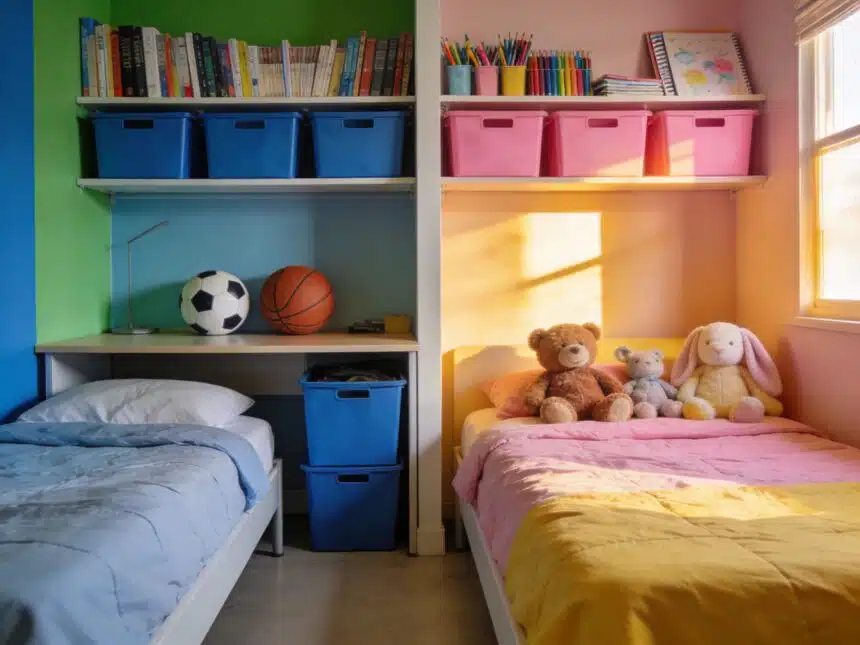
Start with a genuine physical split of the room if the layout allows it. Not just a line down the middle conceptually, but a visual and physical division that each child can see and feel. Bookshelves positioned perpendicular to the wall, a curtain on a tension rod, a low dresser positioned as a room divider, anything that creates a sense of separate zones within the same space. This isn’t about one child having a bigger half or a better view of the window. It’s about giving each brain a defined territory where they have full ownership and full control. Once that’s in place, a large portion of the “stop coming on my side” argument disappears because the side is now unmistakably clear.
Each child’s storage should be in their zone. Not shared bins, not a communal toy box, not one dresser split down the middle. Each child has their own bin system, their own shelf, their own designated spot for the categories of things they own. Color coding this system is practical rather than decorative. One child’s items are stored in blue bins, the other’s in green. When something is on the wrong side of the room in a blue bin, that’s visually obvious and requires no detective work to resolve. When an item gets misplaced, the color tells both kids where it came from. For children who are truly clutter-blind, the color coding removes the cognitive step of figuring out whose something is before returning it. It just goes back to the matching color zone. That’s fast enough to actually happen.
The landing strip is the piece that most room-sharing systems skip and it makes the biggest daily difference. A landing strip is a designated surface or hook area right at each child’s entry point into their zone where everything comes off when they enter. Backpack on this hook, shoes in this spot, today’s jacket here. It’s the same principle as the afterschool routine that keeps afternoons functional, just applied to the bedroom entry rather than the front door. Without a landing strip, items get dropped wherever they’re standing when they stop moving. In a shared room, that wherever is almost always on the other child’s side, which starts the next argument.
Shared items are a specific category that need their own rules and their own physical home. The items both children use, a shared tablet, board games, craft supplies, need to live in a neutral zone that belongs to neither child specifically. A shelf between the two zones, a bin in the closet with a clear label, something that is visually outside both territories. The rule is that shared items live in the shared zone when not in use. Not on one child’s desk, not stacked near one child’s bed. In the shared zone. Both kids have equal access. Neither child’s zone is the default storage for communal things. This removes the argument about one child having more access to shared items or one child having to ask to get into the other’s space to retrieve something.
The homework and wind-down zones deserve special attention in a room where both children need to be doing different things at the same time. For ADHD, doing homework in the same space as a sibling who is playing or watching something is genuinely difficult. The distraction is not a choice. It’s neurological. If there’s space for one child to do homework at a desk in the room while the other uses a separate corner or the living room for play, that separation dramatically reduces after-school friction. If both must be in the same room, one rule helps consistently: quiet activity only in the shared space during homework windows. Not silence, just quiet. A set timer the kids can see. When the timer finishes, the wind-down window opens. The visual timer carries the authority rather than the parent having to enforce it repeatedly. The visual timer approach from the evening meltdown article works the same way here.
The floor is the hardest surface to keep functional in a shared ADHD bedroom and it’s worth addressing directly. Things land on floors because putting them away requires more steps than dropping them. Reducing those steps is the solution. Low open bins on the floor in each zone mean that toys, clothes, and random items can be dropped into them in a single motion. You’re not asking a tired or dysregulated child to sort, stack, fold, or organize. You’re asking them to drop things into a nearby bin. That’s achievable. Once a week, the bins get sorted into the right places during a short reset. The one room at a time declutter method applies this same logic at a larger scale.
The reset routine for the shared room works best when it’s done together, briefly, with a clear start and end. Ten minutes, same time each day, preferably right before dinner or right after school. Each child resets their own zone only. They are not responsible for the other person’s mess. They are not allowed to comment on the other person’s zone during the reset. They only touch their own things. The reset ends when the timer goes off, not when the room looks perfect. Done consistently, this prevents the accumulation that leads to the full-blown room disaster that triggers a major cleaning project and a major argument once a week.
For kids who resist the reset entirely, body doubling helps. Body doubling means one parent or sibling being physically present in the room during the task, not helping, just present. For many ADHD children, the presence of another person is enough to provide the external regulation they need to initiate and complete a task they’d abandon alone. It’s one of the most effective and least complicated tools available for ADHD task initiation, and it costs nothing. Sit on the bed and read while the child tidies their zone. The task gets done.
Older siblings, particularly teens sharing a room with a younger ADHD child, have a specific frustration that’s worth naming. Their need for order and privacy often conflicts directly with the younger child’s clutter-generating tendencies and lack of awareness about personal space. Giving the older child more visible, defined autonomy over their zone, a proper lock on their storage if they have genuinely private items, a no-touch rule for their desk that’s physically enforced by placement rather than just verbally stated, acknowledges that their needs are real and reduces the dynamic where the older child feels they’re always losing out in the arrangement.
The shared room will never be completely frictionless. But most of the recurring arguments have a structural root. When the structure changes, the arguments tend to follow. Clear zones, color-coded storage, shared item neutrality, a consistent brief reset, and individual landing strips handle the majority of what makes ADHD sibling room sharing hard.
For the cleaning products and tools mentioned here, Amazon has everything you need delivered to your door.









What zones have worked for your kids? Check out these tips for a calmer space! #ADHD #SiblingGoals #CozyCornerDaily