





You did not plan to spend forty-seven dollars at 11 p.m. last Tuesday. You were just looking. Then the cart had three things in it. Then your thumb hit checkout before your brain fully registered what happened. By morning you remembered the order existed but not exactly what was in it or why it felt urgent at midnight.
That is not a spending problem. That is a dopamine problem, and the standard advice of “just stick to a budget” misses the point entirely for ADHD brains. Adults with ADHD are up to five times more likely to develop problematic spending habits, largely because impulsivity compresses the gap between the urge to buy and the act of buying until there is almost no gap left. A budget app does not fix that. A visual, physical system that inserts friction before checkout does.
Why Digital Willpower Fails ADHD Brains
Budgeting apps track what already happened. They tell you after the fact that you overspent, which for an ADHD brain is roughly as useful as telling someone they already missed the exit. The information is accurate and completely unhelpful in the moment that matters.
The low-buy challenge works differently. Instead of tracking the damage, it creates a visible, physical barrier between the impulse and the purchase. The ADHD brain is wired to respond to visual cues in a way it simply does not respond to abstract numbers on a screen. When the barrier is physical and in your line of sight, the pause happens automatically rather than requiring willpower you may not have at midnight.
Nighttime doom spending and Amazon cart overload both follow the same pattern: low energy, low resistance, one-click access, and a reward system that fires before the consequence registers. The fix has to interrupt that loop before the purchase, not after.
Building the Visual Tracking Station
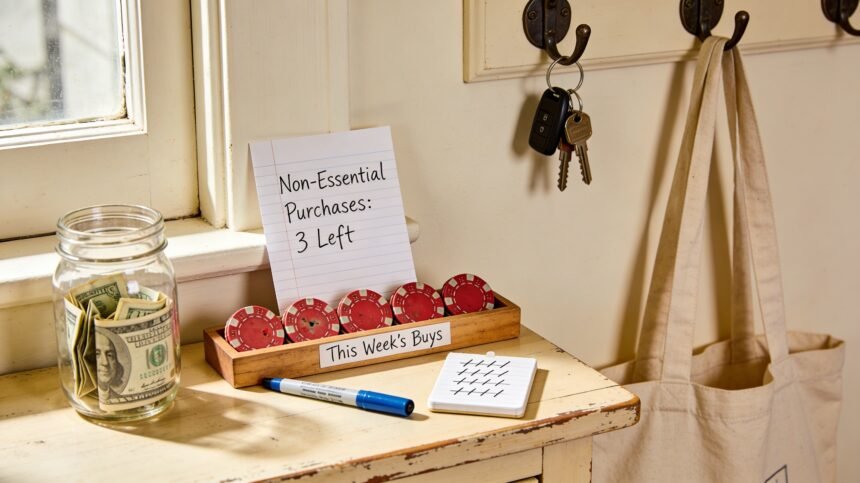
The tracking station lives in a high-visibility spot, ideally the entryway, your desk surface, or somewhere you pass multiple times daily. It does not need to be elaborate. It needs to be impossible to ignore.
Here is what you need:
- A small tray or flat surface: This anchors the system visually and signals that this is intentional, not a pile
- Five physical tokens: Poker chips, smooth stones, wooden coins, painted bottle caps. One token equals one non-essential purchase allowed per week. Five is a starting number. Adjust based on your reality, not your ideal self
- An index card: Handwritten. The week’s category limit on one line. “Home and decor: 2 max.” “Clothes: 1 max.” Keep it specific and visible
- A small jar or bowl: Tokens start in the tray. Each time you buy something non-essential, move one token to the jar. When the jar is full, the week’s non-essential budget is spent. Simple. Physical. Immediate
The reason tokens work better than app notifications is rooted in how ADHD brains process information. Picking up a physical object and moving it activates a different part of the brain than clicking a button. The tactile action creates a moment of conscious awareness that the digital checkout process is specifically designed to eliminate.
The Purchase Pause Protocol
Every time you feel the pull to buy something non-essential, run it through a three-step pause before touching a token:
Step one: Name it out loud. Say what you are about to buy and why. Out loud, not in your head. Externalizing the thought activates the prefrontal cortex and slows the impulsive chain. “I want to buy a new desk lamp because the current one feels dim and I am bored” tells you something different than “I need a lamp.”
Step two: Move it to a list. Before any online purchase, add it to a wish list or a notes app rather than the cart. The 48-hour cart rule is one of the most effective friction tools available because it separates the dopamine hit of finding the item from the actual purchase decision. A significant percentage of items on wish lists never get bought once the initial excitement passes.
Step three: Check the token tray. If tokens remain and the item still makes sense after 48 hours, use one and buy it without guilt. If the tray is empty, it waits until next week. The token is the permission slip. Without it, the answer is simply not yet.
Setting Your Weekly Limits
Start with five tokens and one spending category limit per week for the first month. Do not try to overhaul every spending habit at once. The ADHD brain needs the system to feel achievable, not punishing, or it will abandon it within two weeks.
After the first month, add a second category limit or reduce to four tokens. Tighten the system gradually rather than all at once. You are training a new habit loop, and that takes repetition at a pace the brain can sustain.
Keep the token count honest. Five non-essential purchases per week sounds like a lot until you start counting. Coffee shop stops, a new candle, a clearance shirt, a random Amazon add-on. The goal is visibility, not restriction. Seeing the tokens move tells you something concrete about your spending patterns that a bank statement at the end of the month never could.
Closing Online Spending Loops
The token station handles in-person and conscious online purchases well. But doom spending late at night tends to happen in a different context entirely: phone in hand, low energy, scrolling with no goal.
A few friction adjustments that close those loops:
- Remove saved payment information from Amazon, Target, and any other site you tend to buy from impulsively. The extra step of entering card details is enough friction to break the trance for most people
- Log out of shopping apps after each session so re-entering credentials adds a pause
- Use the Amazon returns habit as a recalibration tool. If you are returning purchases regularly, that pattern is telling you something about the gap between what you think you want and what you actually need
- Do a full subscription audit to eliminate recurring charges you forgot about. Those do not count as purchases anymore but they still drain the account
What the Low-Buy Challenge Actually Teaches
Most people who run this challenge for a full month are not surprised by how much they were spending. They are surprised by when and why. The pattern that shows up is almost never random. It clusters around specific emotional states, boredom, stress, overstimulation, evenings after hard days.
Where your money actually goes becomes obvious quickly when you have a physical record of every non-essential purchase you almost made. That information is more valuable than any budget category because it tells you what your triggers are, not just your totals.
Once you can see the pattern, you can work with it. ADHD money habits built for couples or solo households both benefit from the same core principle: make the spending visible before it happens, not after.
Connecting It to the Bigger Picture
The token system is a behavior tool, not a full financial system. Once the impulse spending is more controlled, pair it with a best budget app for families in 2026 to build the wider financial picture. If debt is already part of the conversation, the debt snowball starter guide gives a clear, low-intimidation path forward. If there is nothing in savings yet, building a three-month emergency fund from zero is the next logical step once the spending leaks are plugged.
What clutter is really costing you includes every item that came in impulsively and never quite earned its place. The low-buy challenge reduces the financial drain and the physical clutter at the same time, which is why it feels so different from just cutting a budget category.
And if Amazon specifically is the main spending spiral, Stop the Amazon Spending Spiral: The System That Saved Me $200/Month lays out a complete framework built specifically for that pattern. It is the detailed system behind what the token station starts.
You are not bad with money. Your brain just needs a different kind of guardrail than the ones that were designed for everyone else.