





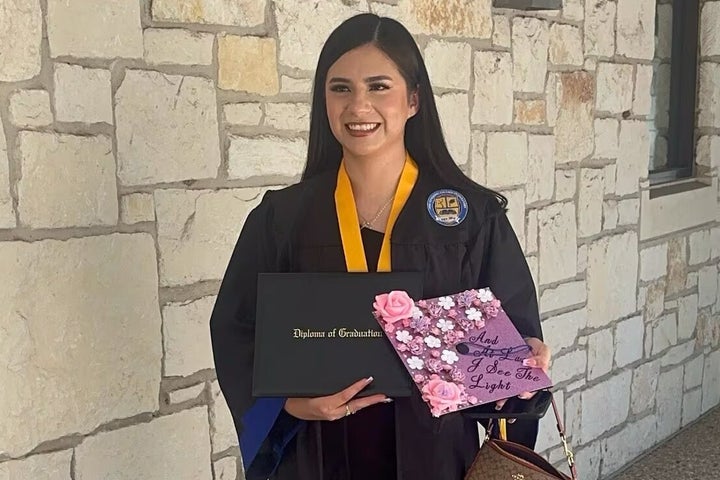
BOSTON (AP) – As Any Lucia Lopez Belloza sat on a deportation flight headed to Texas, she kept asking herself why. At 19 years old, she was a college student with no criminal record, believing she had no reason to fear being sent back to her native Honduras.
“It just shocked me. I don’t know, like I was numb,” Lopez Belloza said in a phone interview from Honduras, where she is staying with her grandparents. Lopez Belloza was detained at Boston’s airport on November 20 while preparing to fly home to Texas to surprise her family for Thanksgiving. Two days later, she was deported, returning to Honduras for the first time since she was eight.
The U.S. government has apologized for mistakenly deporting her, even after a Massachusetts judge had ruled that she should not leave the U.S. Nevertheless, her future remains uncertain. Her lawyer has requested a federal judge to compel the Trump administration to develop a plan to facilitate her return to the U.S.
Far from Home
Lopez Belloza and her mother had previously been ordered deported several years after arriving in the United States. The government claims she missed multiple opportunities to appeal. Lopez Belloza argues that her former attorney informed her there was no removal order in place, stating she would not have attempted to fly home had she known otherwise.
The hardest aspect of her sudden deportation has been missing the holidays with her parents, leaving her feeling depressed and in tears. She worries about her parents, who fear leaving their house in Texas, alleging they have also been targeted by Immigration and Customs Enforcement despite applying for green cards.
“They’re scared. They’re scared to step outside because of how everything is,” she expressed. “They’re traumatized. I’m traumatized.”
The Department of Homeland Security did not comment on her parents’ case and has not responded in court to her attorney’s request to bring her back to the U.S.
Lopez Belloza keeps her spirits up by regularly communicating with her mother and maintaining her faith in God. Although she briefly considered attending a university in Honduras, she has decided to remain committed to Babson College, which has offered her support as she continues her studies remotely.
Wondering Why She Was Deported
To consult with a lawyer, Lopez Belloza was instructed by a federal immigration agent at the airport to sign a deportation document. When she refused, she was moved to an ICE facility holding cell with little more than a thermal blanket. In court documents, she described two nights packed among 17 other women without enough room to lie down.
“Those hours I was detained, it was so horrible,” Lopez Belloza reflected.
Before being loaded onto a plane to Texas, her last stop before departing the country, she managed to call her family. “I was numb the whole plane ride. I was like, ‘If this is it, then this will be it,'” she recounted, holding onto hope of avoiding deportation. “I just kept questioning myself. Why is it happening to me?”
As she boarded the flight to Honduras, her mood sank. The life she had built in a college dorm in a well-off Massachusetts suburb, where she was pursuing a business degree to help her father open a tailoring shop, appeared to be over. “I guess this is where my dreams are gone,” she thought, realizing that in Honduras, pursuing dreams often requires considerable wealth, unlike in the United States, where aspirations seem more attainable.
Feeling Hopeful for a Return
Lopez Belloza feels grateful for the government’s recent apology in court regarding the mistake that led to her deportation. “Knowing that it was a mistake, it does hurt me. Based on that mistake that they made, my life did a 360 change,” she shared.
Her lawyer, Todd Pomerleau, referenced cases where deportations were carried out despite court orders, questioning the legality of her removal. Lopez Belloza’s situation is part of a broader pattern of deportations that have raised concerns about adherence to judicial decisions.
U.S. District Judge Richard Stearns ruled that he lacked jurisdiction over Lopez Belloza’s habeas petition, but he encouraged the government to address the acknowledged error regarding her deportation. He suggested several solutions, including a possible non-immigrant student visa that would allow her to continue her studies at Babson while her immigration status is resolved.
“I’m anxious to talk to the government representatives about a workable solution,” Pomerleau stated, expressing optimism for a favorable outcome for Lopez Belloza in the near future.
Original source: Open the source
Editorial note: Cozy Corner Daily summarizes topics based on available reporting and updates posts as new details emerge.
Read our editorial guidelines.








Interesting read, there’s definitely a lot to unpack here.