




Most people know what a doom fridge is because they’ve had one. It’s the fridge where things get pushed to the back and forgotten. Where a container of leftovers gets buried behind three condiment bottles and doesn’t resurface until it’s grown something alarming. Where the produce drawer contains something that may have once been lettuce. Where opening the door triggers a low-level dread before you’ve even identified what you’re looking for, so you close it again and order something instead.
For people with ADHD, the doom fridge isn’t laziness or carelessness. It’s a direct result of how the executive function system handles “out of sight, out of mind.” The moment something goes into the fridge and gets visually obscured by another item, it essentially stops existing to the brain that forgot to register where it was placed. There’s no internal reminder that fires to say “that soup has been in there since Tuesday.” There’s just an occasional uncomfortable awareness that the fridge probably needs attention, paired with the fact that the task of dealing with it feels enormous, undefined, and likely to involve something unpleasant. So it waits. The waiting makes it worse. The worse it gets, the harder it is to start. That’s the cycle.
Breaking the cycle doesn’t require a refrigerator overhaul or an expensive organizational system. It requires changing two things: the visibility of what’s in the fridge and the frequency and definition of the reset so it never reaches overwhelming again.
Start with a full clear-out. Not a reorganization, a clear-out. Pull everything out of the fridge onto the counter. Everything. This feels dramatic and it is, but it’s the only way to do an honest first reset. Sort as you go: still good, expired or gone, needs to be used today or tomorrow. Everything that’s expired or actually gone gets thrown out immediately, without guilt and without the mental negotiation of “but I spent money on this.” It’s already spent. Keeping a rotting item does not recover the money. It just extends the unpleasantness and reinforces the doom cycle. Throw it out and move forward.
Once the fridge is empty, wipe the shelves with a damp cloth while they’re accessible. This is the moment to do it because the activation energy is already spent. The fridge is already empty. Adding a two-minute wipe takes almost nothing and the result is a clean, clear starting point that actually makes restocking feel different.
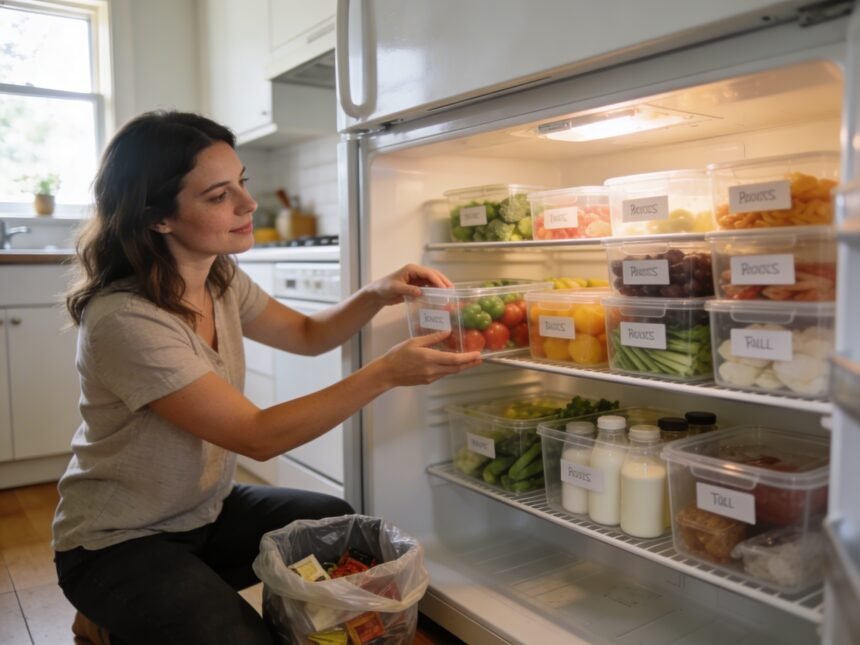
Now comes the system. The goal is to make the fridge function as a visible inventory rather than a storage space where things disappear. The tools are simple: a few clear shallow bins, ideally with handles, and a basic labeling approach. Clear bins are non-negotiable. Opaque bins just recreate the problem with extra steps. Shallow matters because deep bins allow items to stack and hide behind each other, which is the exact behavior you’re trying to prevent.
Assign each shelf a category based on how quickly those items need to be consumed. The top shelf, which is at eye level for most adults, is the “eat this first” zone. Everything on that shelf needs to be used within the next two to three days. Leftovers go here. Open containers go here. Anything that’s close to its use-by date goes here. The moment something moves to the top shelf, both eyes and brain register it as a priority every time the fridge opens. This is one of the most functional changes you can make to a fridge that currently has no system, because it turns a passive storage space into an active communication tool. If the top shelf has four containers on it, dinner is already decided. The approach to cutting food waste that saved real grocery money uses this same visual prioritization logic at the broader household level.
The middle shelf is for items that are fine for the next four to six days. Proteins like opened deli meat, eggs, cheese, meal-prepped items that are in good shape. The bottom shelf is for longer-lasting items: condiments with reasonable shelf lives, drinks, and anything packaged that doesn’t need to be consumed urgently. The produce drawers function best when they’re used correctly by category, high humidity for leafy greens and low humidity for fruits, but the more important change is committing to putting only what you’ll actually eat this week in there, not what you intended to eat or bought optimistically.
The label system can be as simple as a strip of masking tape and a marker on each bin: “Eat First,” “This Week,” “Staples.” High contrast, large enough to read at a glance, no interpretation required. You’re not labeling for a guest. You’re labeling for a tired version of yourself who opens the fridge at 6:30 p.m. with no mental bandwidth to make decisions. That person needs information that is immediate and obvious.
The weekly reset is where the system stays alive or dies. Without a consistent reset, bins drift, items migrate to the wrong zones, and the doom creeps back. The reset itself takes about seven minutes. Same time every week, ideally before the grocery run so you know what actually needs to be replaced rather than buying duplicates of things that were already there. Pull the “eat first” bin out, deal with everything in it, wipe the shelf, restock. Check the middle shelf. Move anything that’s getting close to the top bin. Pull anything in the produce drawers that’s headed south. This is the entire maintenance routine. Seven minutes. The only reason it becomes a bigger task is when it gets skipped for two or three weeks, which is how the doom fridge reforms.
For ADHD brains specifically, the hardest part of this maintenance is initiation, not the task itself. A seven-minute fridge check is not difficult once it’s started. The problem is that it requires a decision to start, and on a day when the executive function tank is already low, optional decisions don’t happen. Attaching the fridge reset to something that already reliably occurs removes the need for that decision. Right before Sunday dinner is prepped. Right when groceries are unloaded. Right after the kids go to bed on Thursday. Attach it to an existing anchor and it becomes part of that anchor rather than a separate task requiring its own initiation.
Sensory discomfort is a real barrier here that deserves to be named directly. For people who are sensitive to smell or texture, finding something in the back of the fridge that has turned is genuinely unpleasant in a way that’s not minor or dramatic. Wearing a pair of thin food-safe gloves during the reset, having the trash can positioned right next to the open fridge, using a damp cloth with a small amount of baking soda to neutralize odors as you go, and working quickly rather than pausing to investigate things you’re not sure about are all legitimate accommodations that make the task more physically manageable. If you associate fridge cleaning with an unpleasant sensory experience, reducing that experience is not avoidance. It’s system design.
If your household is losing real money to food waste every month, which most families are without realizing it, the fridge system is the single most impactful organizational change you can make in the kitchen. It costs almost nothing to implement. Clear bins run between $8 and $20 for a full set. Masking tape and a marker. A consistent seven-minute weekly window. The return on that investment shows up in your grocery bill within the first month. Buying fewer duplicates, wasting less produce, actually eating the leftovers you made, these small changes compound. The grocery strategy that cuts the bill without going boring works most effectively when the fridge is already organized well enough to support it, because a functional fridge is what makes the planning translatable into actual meals.
The doom fridge is not a personality trait. It’s a system failure in an environment that wasn’t set up to support how your brain works. Build the environment differently and the pattern changes on its own.