





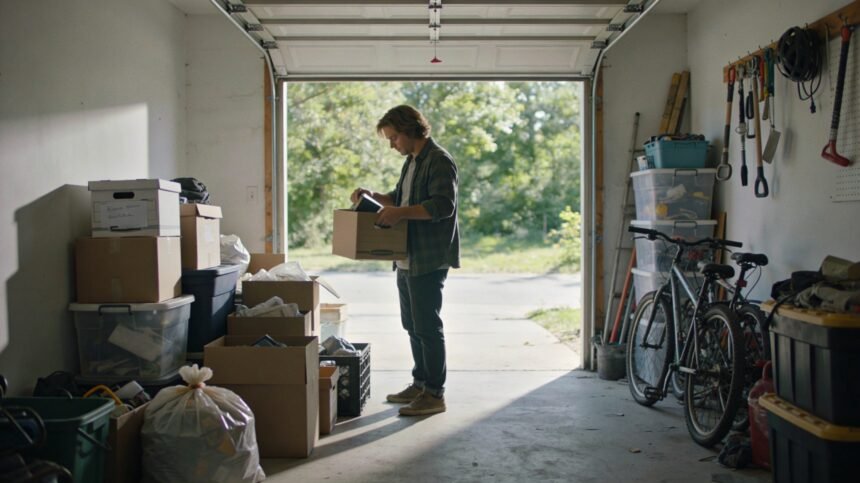
The garage declutter method I’m about to describe took one full weekend. Not a casual Saturday afternoon. A real two-day effort that started at 8am Saturday and wrapped up around 4pm Sunday, with a family dinner in between and a full donation run on Monday morning. I’m telling you the actual time investment upfront because nothing in home organization is more demoralizing than starting a project that was advertised as “quick” and hitting hour six still surrounded by boxes on the driveway.
The garage had become the kind of space that nobody went into voluntarily. Things got piled near the entrance or tossed through the door when there was nowhere else to put them. The lawnmower was in there somewhere. So were four holiday bins, a kayak paddle with no kayak, three different sizes of the same drill bit, and a bag of baseball equipment belonging to a kid who switched to soccer in 2023. Every time I opened that door I would look at it for about thirty seconds and then close it again. This went on for longer than I want to admit.
The method started before anything was touched or moved. Saturday morning, coffee in hand, I did a full walkthrough of the garage and wrote down everything I could identify in loose categories. Tools. Sports. Garden. Holiday. Automotive. Random large items. Unknown boxes. That exercise took about twenty minutes and it was genuinely useful because it revealed two things immediately: there were more tools than I thought and there were more unknown boxes than made any sense. Unknown boxes are boxes nobody opened at the last move or the move before that. If it sat through an entire move without being opened, there is almost certainly nothing in it that cannot be donated, recycled, or thrown away. I made a note to treat every unknown box as guilty until proven innocent.
The first rule of this garage declutter method is everything comes out. Not categorically, not box by box, everything. Pull it all out onto the driveway. This feels terrifying before you do it and immediately clarifying once you have. When everything is outside in daylight, the categories become obvious, the duplicates become obvious, and the things that have no business being in a garage become obvious. The camping stove that works fine. The set of patio furniture cushions with no corresponding furniture. The four cans of spray paint in colors that don’t match any wall in the house. In the garage they blend into the general chaos. On the driveway they’re impossible to ignore.
Work through the categories one at a time. All tools in one pile. Every single one, even the ones on the pegboard. Sort them by type: hand tools together, power tools together, fasteners and hardware in a separate container. Get rid of duplicates beyond one backup, dispose of anything broken beyond practical repair, donate anything you haven’t used in two years. This last rule is where most people stall because they think “but I might need this someday.” That thought has cost more garage space than any other single decision in household history. Two years is a generous threshold. If you haven’t needed it in 24 months, the probability of needing it next month is low enough to justify letting it go.
Sports equipment is emotionally loaded in a way tools aren’t because it’s connected to people, specifically to versions of people or phases of life that have passed. The bike your kid outgrew. The ski equipment from before the knee injury. The yoga mat from the January motivation that didn’t survive February. Each of these things represents a decision, and decisions are mentally tiring, which is exactly why this category gets put off. The approach that worked for me: anything that belongs to a current activity or a planned upcoming activity stays. Anything belonging to an activity nobody has done in over a year goes. The kayak paddle without a kayak went. The baseball bag went. The yoga mat that had genuinely never been unrolled went. Getting decisive with this category freed up more floor space than anything else in the whole process.
By Saturday afternoon the driveway was full, the garage was empty, and the sorting piles were taking shape: keep, donate, trash, and belongs elsewhere. That fourth category is important. A garage accumulates things that were brought out there temporarily and never came back inside, tools that belong in a kitchen drawer, kids’ art supplies, a bag of donated items that never made it to the car. Anything in the “belongs elsewhere” pile goes back inside during the Sunday reset, not before, because mixing garage reorganization with house reorganization is how both projects fall apart simultaneously.
Sunday morning was the actual organization work. Before putting anything back, the walls got addressed first. A pegboard went up on the main tool wall, which took about an hour including drilling and leveling. Two wall-mounted bike hooks got installed, which got the bikes off the floor and freed up a six-foot stretch of garage that had been inaccessible. A metal shelving unit, the freestanding kind from the hardware store that requires no drilling and takes about 45 minutes to assemble, went along the back wall. Those three additions changed the functional capacity of the garage more than any amount of sorting alone could have. Multifunctional storage solutions for small homes applies the same principle of going vertical to make more of any space, and it translates directly to a garage with limited floor room.
Things went back in by zone and by frequency of use. Frequently used tools on the pegboard at eye level. Power tools on the middle shelf of the metal unit. Holiday bins on the top shelf where they’re accessible but out of the way most of the year. Garden supplies in one corner with a dedicated hook for the garden hose. Automotive supplies on their own shelf with a labeled bin. The zone system sounds obvious but it’s the thing that makes the garage stay organized after the weekend is over, because when everything has a designated area, putting things back requires no decision. It just goes to its place.
The donation run on Monday morning was genuinely satisfying in a way that’s hard to describe until you’ve done it. Five garbage bags and eleven boxes left the property. The garage gained back roughly a third of its floor space. The car now parks inside for the first time in approximately three years. If you’re at the point in your household where the clutter has quietly won territory room by room, the one-room-at-a-time declutter method runs the same logic through the rest of the house in a way that’s manageable without requiring a full blowout weekend for every space.
The psychological shift was the part I didn’t fully anticipate. Walking past that garage door and opening it and seeing clear floor and labeled shelves and things that are there on purpose changed something in the house that I can’t fully explain. It’s quieter somehow. A source of low-grade stress that had been running in the background for years just stopped. That’s the thing about clutter, and what it does to your body and mind goes into this with more depth, but the short version is that an unresolved physical environment is a source of real mental load that you stop consciously noticing but never stop carrying. Until it’s gone. And then it’s very obvious.
Maintenance is simpler than the original project by many orders of magnitude. Ten minutes after any project to put tools back where they belong. A quick check before winter to rotate out the seasonal sports equipment. One pass through the holiday bins in late October to verify everything is labeled and accessible. That’s the whole maintenance plan. The zone system does the rest. The 5-minute evening reset that keeps the whole house from unraveling applies the same philosophy to the interior and the two together create a household that’s fundamentally easier to live in without requiring constant effort to maintain.
One weekend. The right sequence. Clear rules about what stays and what goes. That’s the whole method. It’s not complicated. It’s just the kind of project that requires committing to it fully for two days instead of doing it in guilty twenty-minute increments for the next four years.