








I Stopped Meal Planning Like Pinterest Told Me To (And Finally Made It Work)
I spent two years trying to meal plan like the internet told me to.
- I Stopped Meal Planning Like Pinterest Told Me To (And Finally Made It Work)
- The Opinion I’m Standing On
- Why Most Meal Plans Fail (And It Is Not You)
- Step 1: Plan Around What You Already Have
- Step 2: Keep A Running List Of Meals Your Family Will Actually Eat
- Step 3: Plan For Five Dinners, Not Seven
- Step 4: Embrace The Rotation
- Step 5: Batch Prep One Thing, Not Everything
- Step 6: Keep Backup Meals On Hand
- Step 7: Keep Your Kitchen Organized Enough To Function
- The Tools That Actually Help
- How I Actually Do The Weekly Plan
- What To Do When You Are Too Tired To Cook
- Getting Kids Involved (Without Losing Your Mind)
- What I Keep Telling Other Overwhelmed Parents
- When Meal Planning Just Is Not Happening
- The Bottom Line
Beautiful printables. Theme nights. Perfectly portioned freezer meals in matching containers. Recipes that required ingredients I had never heard of and could only find at specialty stores.
It was exhausting. And it never lasted more than two weeks.
The meal planning system that finally stuck looks nothing like those posts. There are no matching containers. There is no “Meatless Monday” or “Taco Tuesday.” There is just a loose plan, a lot of flexibility, and the acceptance that some weeks we are going to eat spaghetti three times.
Here is what actually works when you are tired, busy, and just trying to get food on the table.
The Opinion I’m Standing On
I think Pinterest meal planning is designed for people who have time, energy, and kids who eat vegetables without complaining.
Most of us do not live in that world.
We live in the world where someone forgets to tell you about the school project until 8pm. Where you get home late from work and everyone is already starving. Where the chicken you planned to cook has been in the fridge too long and now you have to pivot.
Real meal planning has to survive real life. It has to be flexible enough to handle chaos and simple enough that you can do it even when you are running on fumes.
Why Most Meal Plans Fail (And It Is Not You)
Most meal plans fail because they require you to be someone you are not.
They assume you have time to prep on Sunday. They assume your family will eat whatever you make without protest. They assume you will never be too tired to cook.
The meal plan that works for me is built on three truths:
- Some nights I will be too tired to cook anything complicated.
- My family has about seven meals they will eat without complaining.
- Plans will change, and that is okay.
Once I accepted those truths, everything got easier.
Step 1: Plan Around What You Already Have
I used to plan meals, make a grocery list, and then buy everything from scratch.
That is expensive and wasteful.
Now I start by looking at what is already in the house.
I open the fridge, the freezer, and the pantry. I write down what is actually in there. Then I build the meal plan around those ingredients.
Got chicken in the freezer? That is two meals. Got pasta and canned tomatoes? That is another one. Got ground beef and taco shells? Done.
This also saves money. When I finally got serious about budgeting our grocery spending, using what we had first was the biggest game changer.
I only buy what I actually need to fill in the gaps.
Step 2: Keep A Running List Of Meals Your Family Will Actually Eat
I have a note on my phone with about 15 meals my family will eat without complaining.
Spaghetti. Tacos. Grilled cheese and soup. Chicken and rice. Breakfast for dinner. Crockpot chili.
When I sit down to meal plan, I do not scroll Pinterest for new recipes. I just pull from the list.
New recipes are fine once in a while. But most weeks, I need food on the table, not a culinary adventure.
Knowing what works removes the decision fatigue.
Step 3: Plan For Five Dinners, Not Seven
I used to plan every single night. Then life would happen and the plan would fall apart and I would feel like a failure.
Now I plan five dinners. The other two nights are flex nights.
Flex nights are for leftovers, takeout, eating at someone else’s house, or throwing together whatever is in the fridge.
This takes so much pressure off. If we eat out one night, fine. If I am too tired to cook, we have leftovers. If plans change, we adjust.
Five meals is realistic. Seven is setting yourself up to feel bad.
Step 4: Embrace The Rotation
My family eats the same meals every two weeks.
That sounds boring, but nobody cares. Kids like predictability. Adults like not having to think.
I rotate through about ten dinners. One week we have spaghetti, tacos, and chicken stir fry. Two weeks later, we have them again.
It is not exciting. But it works. And it is way less stressful than trying to come up with something new every week.
Step 5: Batch Prep One Thing, Not Everything
I do not do full Sunday meal prep. I do not have the time or the energy.
But I do prep one thing.
Some weeks I chop all the vegetables for the week and store them in containers. Some weeks I cook a big batch of rice or pasta. Some weeks I brown ground beef and freeze it in portions.
One prep task makes weeknight cooking so much faster.
I am not spending three hours on Sunday cooking everything. I am spending 20 minutes making one part of the week easier.
Step 6: Keep Backup Meals On Hand
There will be nights when the plan falls apart.
I keep three backup meals in the house at all times:
- Frozen pizza
- Pasta and jarred sauce
- Eggs and bread for breakfast-for-dinner
These are not ideal. But they are better than the panic of having no plan and no food and everyone being hungry and cranky.
Backup meals are not failure. They are smart planning.
Step 7: Keep Your Kitchen Organized Enough To Function
If your kitchen is chaotic, meal planning feels impossible.
You cannot find the pan you need. You do not know what ingredients you have. Everything takes twice as long because you are digging through clutter.
I had to completely rethink how I organized our small space before meal planning could stick. Clear containers and labels made a huge difference.
You do not need a perfect pantry. You just need to know where things are and be able to find them when you need them.
The Tools That Actually Help
I do not use a meal planning app. I use a simple system:
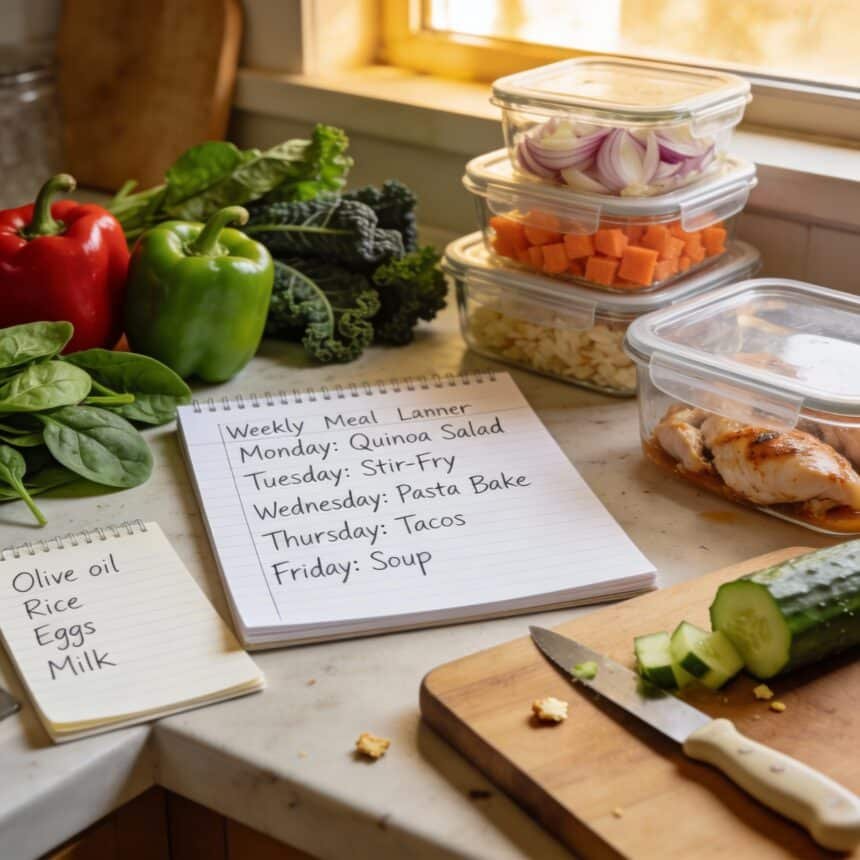
A meal planning notepad. I use this weekly meal planner pad on my counter. Seeing the week laid out visually helps me remember what is for dinner.
Good storage containers. Invest in quality airtight food storage containers. Prepped ingredients last longer when properly stored. Plus they stack neatly, which matters when fridge space is tight.
A slow cooker or Instant Pot. On busy days, these are lifesavers. Throw in ingredients in the morning, come home to dinner. I use this Instant Pot at least twice a week.
A good sharp knife. Prep work is miserable with dull knives. A quality chef’s knife makes chopping vegetables actually pleasant.
How I Actually Do The Weekly Plan
Every Saturday morning, I sit down with coffee and plan the next week.
It takes about 15 minutes.
Step 1: Check the calendar. Are there any nights with activities? Those nights get easy meals or leftovers.
Step 2: Check the fridge and pantry. What do we already have?
Step 3: Pick five meals from my list, based on what we have and what sounds good.
Step 4: Write them on the planner. I do not assign them to specific days. I just list five options for the week.
Step 5: Make a grocery list for anything I need to fill in the gaps.
That is it. Fifteen minutes. No stress.
What To Do When You Are Too Tired To Cook
Some nights you just cannot.
That is okay.
Options that are not ordering expensive takeout:
- Breakfast for dinner. Eggs and toast take five minutes.
- Quesadillas. Cheese and tortillas. Done.
- Rotisserie chicken from the grocery store with bagged salad.
- Sandwiches and fruit.
- Leftovers reheated.
You do not have to cook a full meal every single night. You just have to feed your family.
Getting Kids Involved (Without Losing Your Mind)
I used to do everything myself because it was faster.
But now I have my kids help with simple tasks.
Younger kids can wash vegetables, tear lettuce, set the table, or stir things that are not hot.
Older kids can chop soft vegetables with supervision, measure ingredients, or follow a simple recipe.
It is slower. It is messier. But they are learning, and I am not doing everything alone.
Plus, kids who help cook are more likely to actually eat the food.
What I Keep Telling Other Overwhelmed Parents
You do not need a perfect system. You need one that survives a Tuesday.
Same thing applies to communicating with your kids. It doesn’t have to be perfect. It just has to show up consistently.
Meal planning is not about being impressive. It is about reducing stress and getting food on the table without a meltdown.
If your plan is “tacos every Tuesday and spaghetti every Thursday,” that is fine. If your plan is “five easy meals and two flex nights,” that works too.
Do not compare your meals to someone else’s Instagram. Compare them to the alternative, which is chaos and expensive takeout and everyone being cranky.
When Meal Planning Just Is Not Happening
Some seasons of life are too chaotic for meal planning.
If you are in survival mode, that is okay.
Keep easy meals on hand. Rotate through the same few things. Do what you can.
You are not failing. You are triaging.
When life calms down, you can get back to planning. But right now, just feed your family and give yourself grace.
The Bottom Line
Meal planning does not have to look like Pinterest.
It does not have to be fancy, Instagrammable, or impressive.
It just has to work for your actual life, with your actual family, on your actual hard days.
Plan five meals. Use what you have. Keep it simple. Give yourself grace when it falls apart.
You are doing great. Even if dinner tonight is cereal.
As an Amazon Associate, I earn from qualifying purchases. This helps support Cozy Corner Daily at no extra cost to you.












What’s your secret to successful meal planning? Share below and check out my journey in the link! #MealPlanning #FoodPrep #CozyCornerDaily