







The meal prep content you’ve seen on social media is lying to you a little bit. Not on purpose, probably. But those Sunday meal prep videos where someone methodically chops twelve different vegetables, portions out five kinds of protein, and fills sixteen containers while their kitchen stays clean and organized, that’s not what meal prep looks like for most people. It’s definitely not what it looks like when your executive function is unreliable, when starting a multi-step task feels like trying to move through wet cement, or when the gap between “I should meal prep” and “I am actually meal prepping” is so wide that it never gets crossed at all.
The one-tray approach exists as a direct answer to that gap. Not a compromise, not a half-measure. A legitimate strategy for getting actual nutritious food prepped and ready during the weeks when the full-production meal prep version is simply not available to you.
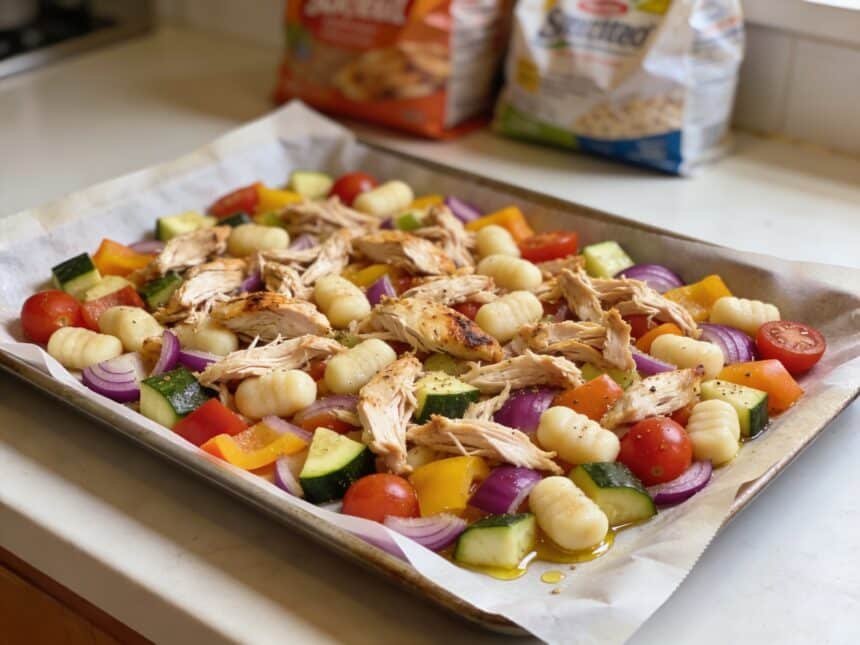
The premise is simple. Everything goes on one sheet pan. Pre-cut, pre-washed, or already cooked items only. The oven does the work. The sink stays nearly empty. Total active time is about ten minutes.
The grocery store has done more of the work for you than you’re currently using. Pre-washed, bagged salad greens take the same amount of time to open as a bag of chips. Pre-cut stir-fry vegetables are exactly as fast to pour onto a tray as chopped vegetables would be after 15 minutes of prep. Bagged gnocchi requires no prep at all and roasts on a sheet pan in 20 minutes into crispy, satisfying bites that work as a base for three different meals. Rotisserie chicken is one of the most underappreciated items in the grocery store for ADHD meal prep because it’s already cooked, already seasoned, already delicious, and can be pulled apart into portions in about four minutes with no tools required. The idea that using these shortcuts is “cheating” or doesn’t count as real cooking is a belief that is actively making your life harder and is worth letting go of entirely.
Here is what a full one-tray prep session actually looks like. You pick up a rotisserie chicken, two bags of pre-cut vegetables, one bag of shelf-stable gnocchi, and a bag of pre-washed leafy greens. At home, you line a large sheet pan with parchment. You pour the vegetables onto one half. You scatter the gnocchi on the other half. You drizzle olive oil over both sides, add salt and whatever seasoning you have nearby, and slide the pan into a 425-degree oven for 22 minutes. While that’s in the oven, you pull the rotisserie chicken apart into rough portions in a container. You don’t need it to be pretty. You need it to be available. When the pan comes out, you have a roasted vegetable and gnocchi base that can be combined with the chicken in four or five different ways across the week. Sheet pan dinners built this way feed a family well without spending much and take a fraction of the effort of traditional meal prep.
The one-pan rule for the week means that your decisions at mealtime are nearly eliminated. You open the fridge. You see the containers. You assemble rather than cook. Monday the chicken goes over the roasted vegetables with a spoonful of pesto from a jar. Tuesday the gnocchi goes into a bowl with the greens and a drizzle of olive oil and lemon. Wednesday the chicken gets wrapped in a tortilla with a handful of the greens. The base is the same. The combinations rotate. This is the mechanic that makes low-effort meal prep actually satisfying rather than repetitive, and it works because the friction point of deciding what to eat has already been resolved. You’re not deciding. You’re assembling.
One of the most useful additions to the one-tray prep is a protein component that requires zero additional effort. A can of white beans tossed with olive oil and roasted on the corner of the same sheet pan becomes a high-protein addition to anything during the week. Canned chickpeas roasted the same way are crunchy, satisfying, and work as a topping for the greens when you want something that feels more complete. Neither of these requires a separate pan or a separate time window. They ride along on the existing tray, in the same oven, at the same temperature. If adding them to the tray takes 60 seconds, which it does, they are worth doing.
For households managing ADHD, the principle that matters most in this system is that every decision was made at the grocery store, not at 6 p.m. when the energy for decisions is gone. Which vegetables, which protein, which base carb: all of that was settled before you came home. At home, your only job is to turn the oven on and open some bags. That shift, from in-kitchen decision-making to pre-purchase decision-making, is the actual hack. Not the specific food. Not the specific combination. The timing of the decision, before hunger and fatigue are in the picture. The ADHD-friendly meal planning approach is built entirely on this same logic of front-loading decisions to the low-stakes part of the week.
When you only use one pan, cleanup drops to near zero. Parchment means the pan wipes clean in thirty seconds. The containers the grocery store items came in are mostly recyclable. If you’ve historically avoided meal prep because the cleanup afterward negated any time you saved, this system changes that equation completely. An empty sink at the end of a prep session is its own reward for a brain that uses visual environment as a stress signal.
Scaling this up doesn’t require more effort. It requires slightly more sheet pan space or a second pan run in the same oven. If you have a family of four, two pans running simultaneously produces four times the food for two times the prep work, which is still ten active minutes. Families who rotate a small set of reliable dinner options each week can assign their one-tray prep session as the Sunday base that covers at least three of those five dinners, reducing the number of from-scratch cooking sessions during the week to two or fewer.
The one-tray system is not going to produce the kind of elaborate, varied meal prep content that gets engagement on social media. That’s fine. It’s going to produce food that is actually available in your fridge when you need it, that required minimal effort and created minimal mess, and that you’re realistically going to eat instead of letting it expire on the middle shelf. Real meal prep success is measured by what gets eaten, not by what looks impressive at 10 a.m. on Sunday.










What’s your favorite grocery store shortcut? Check out these meal prep tips! #MealPrep #ADHD #CozyCornerDaily