




Sunday at four in the afternoon is either the moment you have dinner handled for the next five days or the moment you start quietly negotiating with yourself about whether cereal is a reasonable Wednesday option. The difference is not talent or time. It is a four-hour block with a plan, and the plan itself fits on an index card. The component method: cook proteins, grains, and vegetables separately, then combine them in five different ways across the week. Nothing elaborate. Just food that is already done when the 6 p.m. scramble begins.
Why the Component Method Works Better Than Cooking Full Meals
Cooking five complete meals on Sunday sounds efficient and exhausts everyone by Tuesday when they are eating the same dish for the fourth time. The component method solves the monotony problem by producing flexible ingredients rather than fixed dishes.
A batch of cooked shredded chicken is not a meal yet. It becomes tacos Monday, a grain bowl Tuesday, chicken soup Wednesday, a quesadilla Thursday, and fried rice Friday. The same protein, five different experiences. The same principle applies to every component you prep: roasted vegetables become a side dish, a wrap filling, a soup addition, or a scrambled egg mix-in depending on the night.
This approach also reduces food waste because every prepped component can be repurposed rather than being tied to a single dish that no one wants again. The batch cook once, eat five ways method is the same philosophy applied to specific recipes. The Sunday formula is the system that makes those recipes possible every week.
The Four-Hour Sunday Block
Four hours sounds long but the active work is only about ninety minutes. Most of the time is spent waiting for things to cook while you do something else. The oven runs unattended. The grain pot simmers without attention. You are present for the assembly and the tasting, not for the cooking itself.
The sequence that runs everything in parallel:
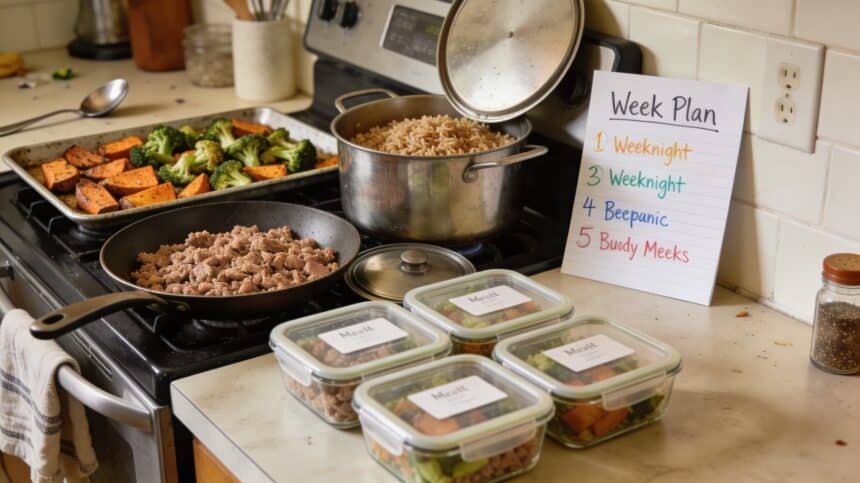
- Hour one: Oven at 400 degrees. Sheet pans of vegetables go in. Start the grain on the stovetop. Begin browning the ground protein
- Hour two: Vegetables come out, second batch goes in if needed. Grain finishes and rests. Slow cooker chicken starts if you are doing a longer-cook protein. Begin portioning and labeling containers
- Hour three: All cooking wraps up. Everything cools slightly. Pack proteins, grains, and vegetables into separate labeled containers. Write the week’s dinner plan on the index card
- Hour four: Optional second protein finishes in slow cooker. Wash the dishes. Prep any overnight items like overnight oats or marinating proteins for later in the week
The Sunday fridge reset happens in this same window, clearing the old before the new goes in, which keeps the fridge organized and prevents the components from getting buried under unrelated leftovers.
What to Prep Each Sunday
Every Sunday formula needs four categories:
One main protein (enough for three dinners):
Choose based on what is on sale and what your family will eat across multiple formats. Ground turkey or beef: brown it with salt, pepper, and garlic and it becomes tacos, pasta sauce, or stuffed peppers. Shredded chicken: slow cook two pounds of thighs with broth and seasoning, shred, and use in bowls, wraps, soup, or rice dishes. Slow cooker chicken thighs four ways and rotisserie chicken stretched across five dinners both cover this protein category in more detail.
One secondary protein (enough for two dinners):
Hard-boiled eggs, cooked shrimp, or seasoned canned beans elevated with aromatics. These cover the nights when the main protein runs out or the family wants something lighter.
One grain (enough for the full week):
Brown rice, white rice, farro, or quinoa depending on your preference. Cook a full pot, roughly three cups dry, which produces about nine cups cooked. That covers sides, grain bowls, and fried rice across five nights without ever running out mid-week. Potatoes roasted on a sheet pan work as the grain substitute for families who prefer them.
Two sheet pans of roasted vegetables:
Pick three vegetables that roast at similar temperatures and times. Broccoli, sweet potatoes, and bell peppers at 400 degrees for 25 minutes is a reliable combination. Zucchini, cherry tomatoes, and onions is another. Season with olive oil, salt, and garlic powder. Two full sheet pans produce enough for sides four to five nights with some left over for eggs or grain bowls at breakfast.
The Five-Dinner Formula
With the components prepped, building five distinct weeknight dinners takes five to fifteen minutes each rather than thirty to forty-five:
| Night | Dinner | Components Used |
|---|---|---|
| Monday | Taco bowls | Ground turkey, rice, roasted peppers, beans |
| Tuesday | Grain bowl with chicken | Shredded chicken, farro, roasted broccoli, sauce |
| Wednesday | Sheet pan chicken stir fry | Shredded chicken, rice, roasted vegetables, soy sauce |
| Thursday | Pasta with meat sauce | Ground turkey, jarred marinara, boxed pasta |
| Friday | Fried rice | Rice, eggs, remaining roasted vegetables, soy sauce |
Thursday is the only night that uses pantry staples rather than exclusively prepped components, which is intentional. By Thursday the family often wants something that feels slightly different, and a pasta night using the prepped meat sauce accomplishes that without any additional prep.
The fridge clean-out stir fry formula and clean-out-the-fridge soup both use the last of the week’s components on Friday or Saturday before the Sunday reset, eliminating waste from any components that were not fully used.
Sauces as the Secret to Variety
The fastest way to make the same components feel like five different meals is to change the sauce rather than the ingredient. Two tablespoons of different sauce is what separates a chicken grain bowl from a chicken burrito bowl from a chicken peanut noodle bowl.
Prep two or three sauces on Sunday alongside the components and store them in small jars in the fridge door:
- Garlic soy sauce: Soy sauce, sesame oil, minced garlic, rice vinegar, honey. Takes three minutes, covers Asian-inspired dishes all week
- Cilantro lime crema: Sour cream, lime juice, garlic, cilantro, salt. Three minutes, covers taco night, burrito bowls, and quesadillas
- Simple tomato base: A can of crushed tomatoes with garlic, olive oil, and Italian seasoning, simmered for ten minutes. Covers pasta night and can double as a pizza sauce for a quick Friday option
Having sauces ready shifts the dinner experience from eating prepped components to feeling like a real cooked meal, which is the difference between a system the family tolerates and one they actually look forward to.
Connecting to the Grocery Budget
The Sunday formula reduces grocery spending in three ways simultaneously: it eliminates the weeknight panic buy when there is nothing ready and someone orders delivery, it ensures every ingredient purchased on Saturday is actually used across the week, and it makes it possible to buy proteins in larger quantities when they are on sale because you have a system to use them rather than freezing them indefinitely.
With grocery prices continuing to climb in 2026, a family that shops once with a component plan and wastes almost nothing is spending significantly less than a family that shops reactively and throws away a third of what they buy. The meal plan on a budget guide handles the shopping side; the Sunday formula handles the cooking side. Both together are what feeding a family of four on a tighter monthly grocery budget actually looks like in practice.
Adding Breakfast to the Block
A Sunday prep block that also covers breakfasts for the week eliminates the morning scramble as completely as the dinner scramble. The breakfast components take the least time and the most stress off the most chaotic hour of the day:
- Freezer breakfast burritos assembled Sunday afternoon and frozen means three minutes in the microwave covers school morning breakfast for the entire week
- Overnight oats prepped in five jars Sunday night covers five mornings without any cooking at all
- Hard-boiled eggs made in the same batch as the dinner protein provides the high-protein breakfast the week needs without any additional cooking time
The Sunday formula is four hours once a week. What it removes is thirty to forty minutes of decision-making, scrambling, and mild panic six nights out of seven. That math always works in the formula’s favor.










What’s your go-to meal prep recipe? Check out this formula for a whole week’s worth of meals! #MealPrep #HealthyEating #CozyCornerDaily