






My son asked me where money comes from last week. I said, “from the ATM.” He said, “but who puts it in there?” I panicked. I mumbled something about the bank. He looked at me like I was speaking another language.
That’s when I knew I’d failed. My ten-year-old thinks money is magic. And I’m the one who taught him that.
So I did what I always do when I mess up: I researched. I talked to other parents. I made a plan. And now I’m going to share it with you.
But first, let me tell you what didn’t work. The piggy bank. The “save, spend, give” jars. The lectures. The worksheets. My kids tuned it all out. Because it was abstract. Money was abstract to them.
What worked? Making it concrete. Making it real. Making it about their lives. Not mine.
Toddlers (Ages 2-3): The Basics
At this age, they don’t get money. But they get “mine.” So that’s where you start.
We use a clear jar. Not a piggy bank. A jar they can see in. Every time they get a coin (from the tooth fairy, from grandma), it goes in the jar. They can see it fill up. That’s the lesson: things have value. You collect them.
We also talk about “ours” vs “mine.” When we’re at the store, I say, “this is our money. We need to buy food for our family.” It plants the seed that money is finite. It’s not endless.
Preschool (Ages 4-5): The Exchange
This is when they start to get that money buys things. So we practice.
We give them a small allowance. $1 a week. Not tied to chores. Just because. Then we let them spend it. At the dollar store. At the candy aisle. Wherever.
The first time my son spent his whole dollar on one candy bar, I wanted to intervene. I wanted to teach him to save. But I didn’t. He learned. He ate that candy bar for three days. He got sick of it. Next time, he bought three smaller things. That’s the lesson.
We also play store at home. I give them fake money. They buy toys. They count out the coins. It’s practice. It’s concrete.
Early Elementary (Ages 6-8): The Three Jars
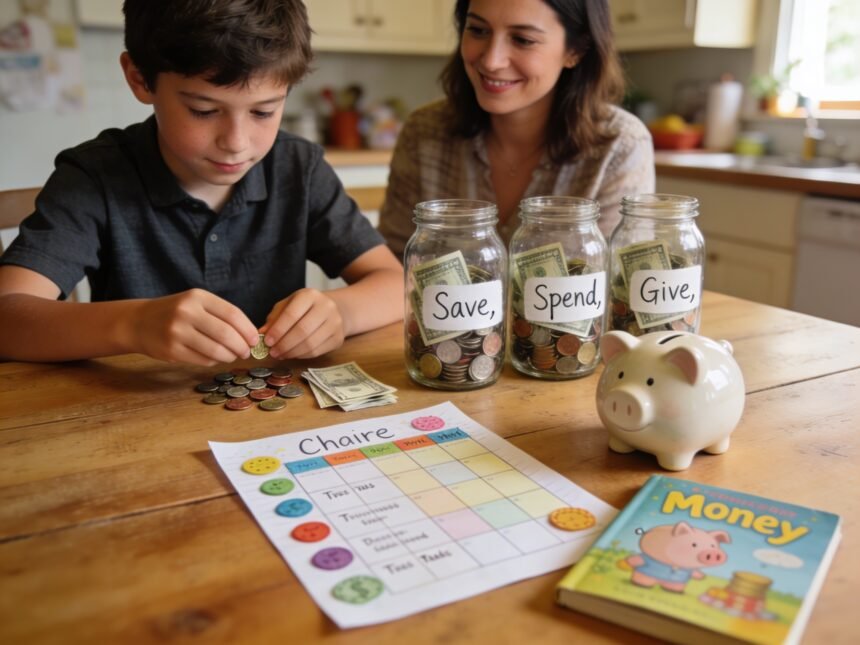
Okay, now they can handle more. We use three jars: Save, Spend, Give.
But here’s the twist: they control it. I don’t tell them how much goes in each. They decide. If they want to put it all in Spend, that’s their choice. And they live with the consequences.
My daughter put everything in Give for a month. She gave it all to church. Then she wanted a toy. I said, “you gave your money away.” She learned. It was her money. Her choice. Her lesson.
We also introduce earning. Chores for money. Not the basics (making their bed, cleaning their room). Those are family contributions. But extra chores? Mowing the lawn, washing the car. Those pay.
We have a chore chart. It’s simple. It lists the chores. It lists the pay. They do the chore, they get the money. No negotiation. No “but I did it last week.” It’s clear. It’s fair.
Upper Elementary (Ages 9-10): The Budget
This is where it gets real. They have more wants. They have more access to stuff. So we introduce budgeting.
My son wanted a $50 video game. He had $12 in his Spend jar. I said, “how are you going to get the rest?” He thought about it. He decided to do extra chores for a month. He saved his allowance. He bought it.
That was a proud moment. He delayed gratification. He worked for something. He budgeted.
We also talk about wants vs needs. When we’re at the store, I point things out. “Do we need this cereal, or do we want it?” “Do we need these shoes, or do we want them?” It gets them thinking.
Middle School (Ages 11-13): The Bank Account
Now they’re ready for a real bank account. Not a savings account. A checking account. With a debit card.
I know, that sounds scary. But here’s why: they need to learn before they’re adults. Before they have rent. Before they have credit card offers.
We opened a joint account. I can see everything. They can spend up to $20 a week without asking me. Over $20, they need to talk to me. It’s a training wheels approach.
We also talk about fees. I show them the bank statement. I point out the ATM fee. The overdraft fee. I explain why we avoid them. It’s real life. It’s concrete.
High School (Ages 14-18): The Real World
This is when you hand over the keys. They need to budget for their own clothes. Their own phone bill. Their own fun money.
My nephew is 16. He works part-time. He pays for his gas. He pays for his phone. He saves for college. He has a budget. He sticks to it. Because he had practice. Because we started small.
We also talk about credit. I explain how credit cards work. I explain interest. I explain why you don’t buy something you can’t pay off at the end of the month. It’s sobering. It’s necessary.
The Mistakes I Made
Let me tell you what didn’t work. Shaming them for spending. Lecturing them about saving. Not letting them make mistakes.
The worst was when my son spent his whole allowance on a toy car that broke in a week. I was so mad. I wanted to say “I told you so.” But I didn’t. I let him feel it. He learned. He was more careful next time.
Another mistake: not talking about our own money. I thought I was protecting them. I was actually hiding reality. Now I talk about our budget. I talk about why we can’t afford something. Not in a scary way. In a matter-of-fact way.
The Resources That Actually Work
I mentioned the book “The Opposite of Spoiled.” It’s good. It’s practical. It’s not preachy.
There’s also a game called “Money Bags.” It’s a board game. It’s for kids 7 and up. It teaches counting, saving, spending. We play it on Friday nights. It’s fun. They learn.
For teens, the app “Greenlight” is solid. It’s a debit card for kids. You can set limits. You can assign chores. You can teach investing. It’s $5 a month. But it’s worth it for the peace of mind.
The Conversation Starters
If you’re stuck, here are some questions that work:
For little kids: “What do you think money is for?” “Where do you think money comes from?”
For older kids: “How do you think we decide what to buy?” “What would you do if you had $100?”
For teens: “How do you think credit cards work?” “What do you think it means to be rich?”
The key is no judgment. No lectures. Just conversation. Let them think. Let them ask questions. Let them be wrong. That’s how they learn.
The Final Word
Teaching kids about money is not about making them finance experts. It’s about giving them the tools to make good choices. It’s about letting them make bad choices in a safe environment. It’s about being honest about our own mistakes.
I failed at this for years. I’m not failing anymore. And my kids are better for it. They get it now. They understand that money is finite. That choices have consequences. That saving is a choice, not a punishment.
That’s the goal. Not perfection. Just progress.
If you need more help, I wrote about how we talk about money in front of our kids. It’s a real conversation. Not a lecture. That’s what works.
I’m going to go check my son’s bank account. He thinks I don’t look. I do. It’s my job. That’s what joint accounts are for.