






January always feels like a fresh start, doesn’t it? New year, new possibilities, clean slate.
- Category 1: Duplicate Kitchen Items
- Category 2: Clothes That Don’t Actually Fit
- Category 3: Mismatched Storage Containers and Lids
- Category 4: Under-Bed Clutter
- Category 5: Orphaned Socks and Underwear
- The Donation Strategy That Made It Easy
- What I Didn’t Declutter (And Why That’s Okay)
- The Unexpected Mental Clarity
- The One-In-One-Out Rule Going Forward
- How My Family Responded
- The Stuff I Almost Kept But Didn’t
- The Tools That Made It Manageable
- The Areas I’m Tackling Next
- What I Learned About My Relationship With Stuff
- The Cost vs. Value Equation
- How It Changed My Shopping Habits
- The Before Photos I Wish I’d Taken
- What I’d Tell Someone Starting This
- The Breathing Room I Didn’t Know I Needed
Except my house didn’t get the memo. By January 2nd I was tripping over Christmas decor boxes that hadn’t made it back to storage, holiday gifts we didn’t actually need, and approximately six months worth of accumulated stuff I’d been ignoring since summer.
I kept seeing those “New Year, New You” posts about total home transformations. Complete decluttering overhauls. Minimalist makeovers where people got rid of half their possessions.
That felt overwhelming. I didn’t want to Marie Kondo my entire life. I just wanted to be able to walk through my living room without stepping on something.
So instead of trying to declutter everything, I picked five specific categories. Not rooms, not entire areas. Just five TYPES of things that were taking up space and mental energy.
By the end of January, my house felt completely different. Not empty, not minimalist, just… breathable. Like I’d been living in a too-tight jacket and finally unzipped it.
Category 1: Duplicate Kitchen Items
I started in the kitchen because that’s where I spend the most time and where clutter impacts me most.
I had three can openers. Four cheese graters. Two identical sets of measuring cups. Why? Because I kept buying replacements when I couldn’t find the original in my messy drawers.
I went through every drawer and cabinet and pulled out duplicates. Kept the best version of each item, donated or tossed the rest.
Then I used these clear storage bins to organize what was left. Everything visible, everything accessible, nothing hidden in the back where I’d forget about it and buy another one.
The difference was immediate. Drawers that had been jam-packed suddenly had space. I could find what I needed without digging. And I stopped buying duplicate items because I could actually SEE what I already owned.
This connected to the system I wrote about in the ADHD-friendly kitchen drawer organization. Visual organization prevents the duplicate-buying cycle.
Getting rid of duplicates didn’t mean getting rid of things I used. It meant getting rid of redundancy that was creating clutter without adding value.
Category 2: Clothes That Don’t Actually Fit
This one hurt a little, honestly. I had a whole section of my closet dedicated to “someday” clothes. Jeans from before I had kids. Shirts that were technically my size but fit weird. Dresses I wore once and never reached for again.
I was keeping them for hypothetical future versions of myself. Thinner me. Dressier me. Whatever me.
But present me needed closet space. And every time I opened my closet and saw those clothes, I felt bad about myself for not being the person who could wear them.
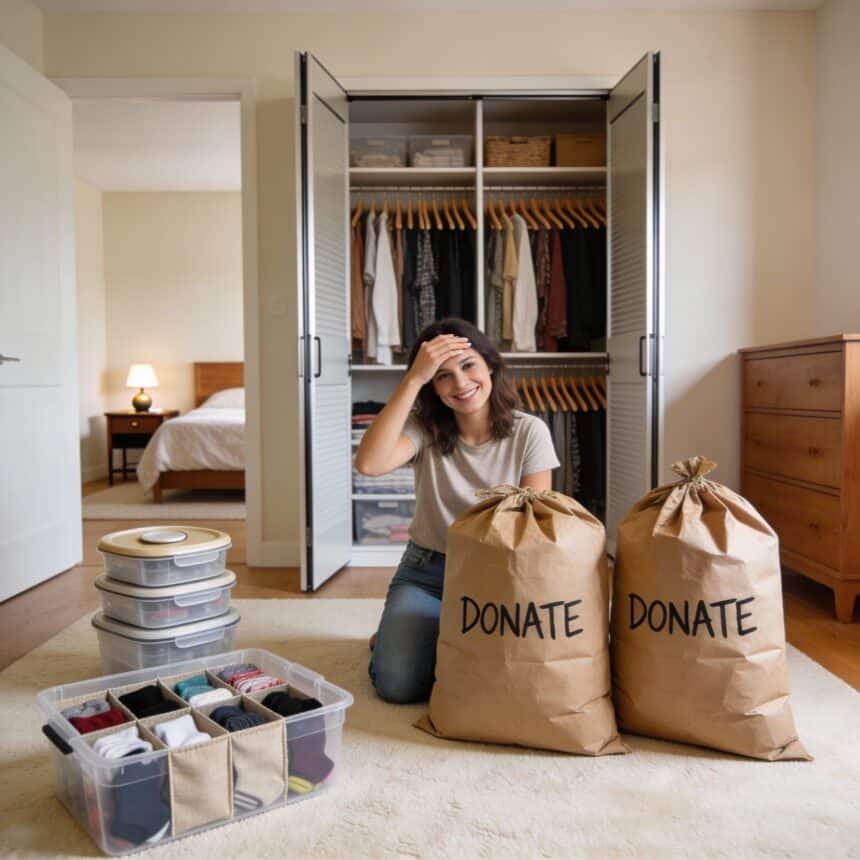
I filled two heavy duty donation bags with clothes that didn’t fit my actual current life. Dropped them at a donation center. Done.
What was left? Clothes I actually wear. Clothes that fit my body NOW. Clothes that make me feel good instead of guilty.
My closet has space now. Getting dressed in the morning takes less time because I’m not digging through things I can’t wear anyway. And I don’t feel that little pang of shame every time I look at my clothes.
This was harder emotionally than I expected. Letting go of those smaller sizes felt like admitting something. But once they were gone, I felt lighter. Not physically lighter, just… relieved.
Category 3: Mismatched Storage Containers and Lids
This might be the most satisfying category I tackled. The Tupperware cabinet was a disaster. Random containers with no matching lids. Lids with no matching containers. Warped plastic from the dishwasher. Stained containers I’d never use for leftovers.
I dumped the entire cabinet out on the floor. Matched containers with lids. Anything without a match went straight to recycling.
What was left, I organized in these drawer organizers so lids and containers stayed together. No more avalanche when I opened the cabinet. No more digging for a lid that didn’t exist.
I also realized I didn’t need 30 storage containers for a family of three. I kept 10 sets in various sizes. That’s it. If we somehow need more than 10 containers of leftovers at once, we have bigger problems.
The cabinet has space now. I can grab a container and lid in seconds. And I’m not stressed every time I open it expecting chaos.
This ties into what I learned in the day I got sick of tripping over stuff and took back my small space. Sometimes you just need to eliminate the chaos points.
Category 4: Under-Bed Clutter
I’d been using the space under our bed as a catch-all for things I didn’t know what to do with. Gift bags. Out-of-season clothes. Random boxes. A broken humidifier I kept meaning to fix.
It was invisible, so I ignored it. But every time I vacuumed or dropped something that rolled under the bed, I’d see the mess and feel stressed.
I pulled everything out. Most of it went straight to trash or donation. What I actually wanted to keep, I put in these under-bed storage containers with labels.
Now what’s under the bed is intentional. Out-of-season bedding. Extra pillows for guests. That’s it. No random clutter, no things I’m avoiding dealing with.
The visual difference is minimal. You still can’t see under the bed. But the mental difference is huge. I know what’s there. It’s organized. It’s not a source of hidden stress anymore.
Plus the containers have wheels, so I can pull them out easily when I need something. No more crawling under the bed and dragging out mystery boxes.
Category 5: Orphaned Socks and Underwear
I know this sounds ridiculous, but the sock drawer was driving me crazy. Mismatched socks I kept hoping would reunite. Underwear with stretched-out elastic I never wore. Socks with holes I kept meaning to darn but never did.
Every morning I’d dig through this mess trying to find two matching socks that didn’t have holes. It was such a small thing, but it was annoying EVERY. SINGLE. DAY.
I threw out all the orphan socks. All the damaged socks. All the underwear I never reached for. Kept only the stuff I actually wore.
Then I organized what was left with these sock drawer dividers. Socks in one section, underwear in another, organized by type.
Now getting dressed takes 30 seconds instead of 5 minutes of frustrated digging. Such a small change. Such a big impact on my daily mood.
I wrote about this approach in the school morning routine that ended our chaos. Removing small daily frustrations adds up to much smoother mornings.
The Donation Strategy That Made It Easy
One of the reasons I’d avoided decluttering before was the hassle of getting rid of stuff. Donation centers with limited hours. Having to bag things up and then leave bags sitting around for weeks before actually donating them.
This time I put the donation bags in my car immediately. Like, the same day I filled them. Then I swung by the donation center during my regular errands instead of making it a special trip.
The key was having the heavy-duty donation bags that could handle sitting in my car for a few days without ripping. Regular trash bags would’ve torn and made a mess.
I also gave myself permission to throw things away instead of donating them if they were damaged or stained or just not donation-worthy. Keeping trash because I felt guilty throwing it away was not helping anyone.
Donation centers don’t want your broken stuff or stained clothes anyway. Letting go of the guilt around that made the whole process easier.
What I Didn’t Declutter (And Why That’s Okay)
I didn’t touch books. I didn’t go through paperwork. I didn’t organize the garage or the basement or any of the big overwhelming areas.
This wasn’t about perfection. It was about making my daily life easier by removing the things that frustrated me most often.
The kitchen duplicates, the clothes that didn’t fit, the Tupperware chaos, the under-bed mess, the sock drawer disaster. Those were my pain points. Those were what I addressed.
Everything else can wait. Maybe I’ll tackle it next month. Maybe I won’t. Either way is fine.
I used to think decluttering had to be this all-or-nothing transformation. Now I know it can be targeted. Fix what’s broken. Leave what’s working.
This mindset shift came from the weekly routine that keeps me from burning out. You don’t have to fix everything at once. Sustainable change happens in small pieces.
The Unexpected Mental Clarity
Here’s what I didn’t expect. Decluttering these five categories made me feel mentally clearer.
I wasn’t constantly low-key stressed about my messy Tupperware cabinet anymore. I wasn’t avoiding opening my closet because I felt bad about the clothes. I wasn’t frustrated every morning looking for socks.
Those were tiny stressors. But they were DAILY stressors. Removing them created space in my brain for other things.
I had more energy for actual important stuff instead of constantly feeling drained by small annoyances.
This connects to what I learned from the evening routine that saved my sanity. Environmental stress impacts mental wellbeing more than we realize.
The One-In-One-Out Rule Going Forward
To prevent re-accumulation, I made a new rule. For every one item that comes in, one item goes out.
Buy new jeans? Donate old jeans. Get a new storage container? Toss an old mismatched one. Receive a gift? Consider what it’s replacing.
This keeps the clutter from building back up. It also makes me more intentional about bringing new things into my house.
Do I really need this if it means getting rid of something else? Sometimes yes. Often no.
The rule isn’t rigid. I’m not measuring items or getting obsessive. It’s just a general principle that keeps me mindful.
I wrote about this in stopping the Amazon overspending spiral. Being intentional about acquiring stuff prevents both clutter and financial waste.
How My Family Responded
My husband noticed immediately. “Did you clean?” Not really, I just got rid of stuff we didn’t need. “It feels bigger in here.” Yeah, that’s what happens when you remove clutter.
My kids were less thrilled when I asked them to go through their toys using the same principle. But they did it, and honestly their rooms look better too.
Decluttering isn’t just my job. Everyone who lives here contributes to the clutter, so everyone can contribute to reducing it.
That said, I didn’t touch anyone else’s stuff without permission. I decluttered MY clothes, the communal kitchen items, shared spaces. Their personal items are theirs to manage.
Setting that boundary helped everyone feel more willing to participate instead of defensive.
The Stuff I Almost Kept But Didn’t
There were a few items I hesitated over. The dress I wore to a wedding five years ago that I’ll probably never wear again but has sentimental value. The kitchen gadget I got as a gift that I never use but feel guilty donating.
I took pictures of them. Then I donated them anyway.
The memory isn’t in the object. I still have the photo if I want to remember the dress. And keeping a kitchen gadget I never use isn’t honoring the gift, it’s just creating clutter.
This was hard. I’m sentimental. But I also want to live in a functional space, not a storage unit for memories.
The photos give me a way to remember without the physical burden. It’s not perfect, but it’s working so far.
The Tools That Made It Manageable
Having the right storage solutions for what I kept made all the difference.
The clear storage bins meant I could actually see what I owned. The donation bags made getting rid of stuff easy. The drawer dividers kept small items organized. The under-bed containers turned wasted space into useful storage.
I spent about $65 on all these organizational tools. Worth every penny for the stress reduction and increased functionality.
Some people can declutter without buying anything. I needed tools that worked with my brain and my space. That’s okay.
This ties into what I learned about ADHD-friendly organization. The right tools make maintenance possible instead of just theoretically doable.
The Areas I’m Tackling Next
Now that these five categories are done, I’m feeling motivated to tackle more.
Next month I’m thinking paperwork and mail. The pile on my desk is getting out of hand.
After that, maybe books. I have shelves full of books I’ll never read again taking up space.
But I’m not rushing it. One category at a time. One month at a time. Slow progress that sticks beats fast decluttering that rebounds.
I’m using the same approach from the 10-minute closing shift. Small consistent actions over time create big changes.
What I Learned About My Relationship With Stuff
I kept things for so many reasons that had nothing to do with actually using them.
I kept duplicates because I was disorganized. I kept clothes that didn’t fit because I felt bad about my body. I kept broken things because I felt wasteful throwing them away. I kept gifts I didn’t like because I felt obligated.
None of that was serving me. It was just creating clutter and stress.
Letting go wasn’t about the stuff. It was about letting go of guilt, obligation, and the fantasy versions of myself I thought I needed to maintain.
Present me deserves a functional home more than hypothetical future me needs to hold onto things “just in case.”
The Cost vs. Value Equation
I didn’t track exactly how much stuff I got rid of, but it was probably hundreds of dollars worth of items if I added up what I’d originally paid.
That felt wasteful at first. All that money spent on things I ended up donating or tossing.
But keeping them wasn’t getting that money back. It was just filling my house with expensive clutter.
The sunk cost fallacy applies to household items too. The money’s already gone. Keeping the stuff doesn’t change that. It just adds ongoing stress to past financial mistakes.
Better to learn the lesson and move on with a clearer space.
I wrote about this in the brutally honest budget that finally worked. Past spending mistakes teach future spending wisdom.
How It Changed My Shopping Habits
Seeing how much stuff I got rid of made me way more careful about bringing new things in.
Do I really need this? Where will I store it? What problem does it solve? Am I buying it to solve an actual problem or an emotional one?
I’m shopping less impulsively now. Waiting before buying. Using that reusable shopping list from my Amazon overspending system.
Decluttering showed me how easy it is to accumulate stuff I don’t actually need. Now I’m much more intentional about acquisition.
Prevention is easier than decluttering.
The Before Photos I Wish I’d Taken
I didn’t take before photos of most areas because I was embarrassed about how bad they looked.
Now I wish I had them for comparison. The transformation feels huge to me, but I can’t fully show it.
If you’re starting a decluttering project, take the before photos even if they’re embarrassing. You don’t have to share them. But you’ll want them later for perspective.
Progress is easier to see when you can compare where you started to where you ended up.
What I’d Tell Someone Starting This
Don’t try to declutter your whole house in January. Pick a few categories that cause you daily frustration and start there.
Get the organizational tools BEFORE you declutter so you’re ready to organize what you keep.
Donation bags in the car immediately. Don’t let them sit around your house for weeks.
Give yourself permission to throw things away if they’re not donation-worthy.
Take before photos even though they’re embarrassing.
And remember, you can’t organize clutter. Sometimes you just need to get rid of stuff first.
The Breathing Room I Didn’t Know I Needed
My house isn’t minimalist now. It’s still full of stuff. But it’s full of stuff we actually USE instead of stuff we’re storing “just in case.”
The difference is breathing room. Visual space. Mental space. The ability to find what I need without digging through what I don’t.
I didn’t realize how much the clutter was weighing on me until it was gone. Now I notice when things start accumulating again because I remember what it feels like to have space.
This January reset wasn’t about transformation. It was about creating a home that works for the life I actually live instead of the life I think I should be living.
And honestly? That feels better than any minimalist Instagram aesthetic ever could.
As an Amazon Associate, I earn from qualifying purchases. This means if you click a product link and make a purchase, I may receive a small commission at no extra cost to you. I only recommend products I actually use or would use myself.










What’s one thing you’ve decluttered that made a big difference? Check out these tips! #Declutter #HomeGoals #CozyCornerDaily