


I opened my junk drawer yesterday and found seven micro-USB cables. Seven. I don’t even own anything that uses micro-USB anymore. But there they were, tangled up with lightning cables and USB-C cables and chargers for devices I probably threw away three years ago.
- The Cable Situation Was Out Of Control
- Sorting Everything By Type
- The Ziplock Bag Method
- The Cable Organizer Case For Travel
- Labeling Made The Biggest Difference
- Getting Rid Of Duplicates Was Hard
- The Mistake I Almost Made
- Maintaining The System
- Why This Tiny Declutter Felt So Good
- What I’d Tell Someone Else Doing This
Every time I buy something rechargeable, it comes with a charging cable. Phone, tablet, kids’ headphones, electric toothbrush, wireless earbuds, you name it. And I never throw the cables away because what if I need them someday? So they all end up in a drawer becoming one giant tangled mess that I have to dig through every time I need a specific cable.
Yesterday I finally dealt with it. Took me maybe 30 minutes and now I can actually find what I need without wanting to scream.
The Cable Situation Was Out Of Control
I dumped everything out on my kitchen table. Every charging cable, every wall plug, every random cord from the junk drawer, the desk drawer, the kitchen drawer, all of it. It was honestly embarrassing how many I had.
Micro-USB cables from old Android phones and tablets. Lightning cables from various iPhones and iPads. USB-C cables from newer devices. Random proprietary cables for specific gadgets. Wall plugs with one port, two ports, fast charging, regular charging. Adapters I didn’t even recognize.
Most of them I didn’t need anymore. Either the device was long gone or I had multiple cables for the same thing. But I’d been keeping everything because I didn’t want to throw away something I might need later.
The problem is when you keep everything, you can’t find anything. Having seven micro-USB cables doesn’t help you if they’re all tangled in a drawer and you can’t tell which is which.
Sorting Everything By Type
First step was sorting. I made piles. All the lightning cables in one pile. USB-C in another. Micro-USB in another. Wall plugs together. Weird proprietary cables for specific devices together.
Just seeing everything sorted made it obvious what I could get rid of. Did I really need seven micro-USB cables when I don’t own anything that uses them? No. I kept two just in case and the rest went in a bag to donate.
Same with lightning cables. I had probably ten of them. I kept four, one for each place I regularly charge devices. Bedroom, kitchen, living room, my bag. The rest went in the donation bag.
USB-C cables I kept more of because that’s what most of our current devices use. But even then I didn’t need eight of them.
For the weird cables that go to specific devices, I only kept the ones where I still owned the device. If I couldn’t immediately identify what it was for, it went in the donation bag. If I haven’t used it in a year, I’m not going to suddenly need it now.
The Ziplock Bag Method
Once I’d sorted and purged, I needed a way to keep everything organized so it didn’t just become a tangled mess again.
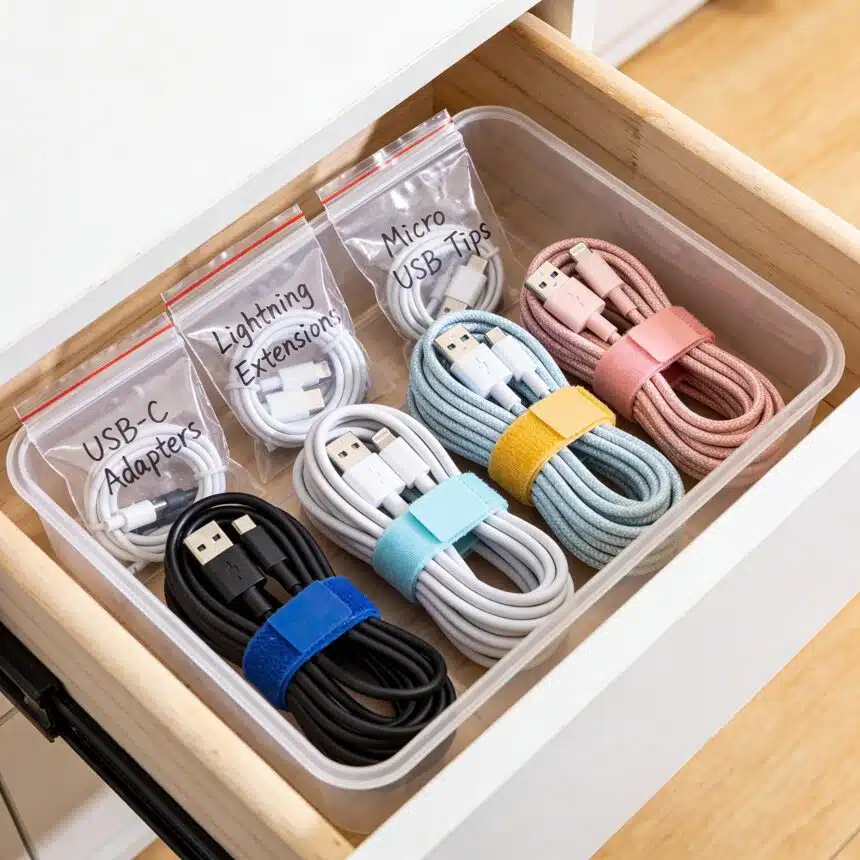
I used sandwich bags to separate everything by type. One bag for lightning cables. One for USB-C. One for the couple micro-USB cables I kept. One for wall plugs. One for device-specific cables.
I also used velcro cable ties to bundle each individual cable before putting it in the bag. This keeps them from tangling with each other inside the bag. The velcro ones are way better than zip ties or rubber bands because you can reuse them and they don’t damage the cables.
I wrote on each bag with a Sharpie. “Lightning Cables.” “USB-C.” “Wall Plugs.” Super simple, but now I can grab the exact bag I need without dumping everything out.
All the bags went back in my junk drawer. But now instead of a tangled nightmare, I have organized bags that I can actually see and access.
The Cable Organizer Case For Travel
For cables I use regularly or take with me places, I got a cable organizer case. The MATEIN one has elastic loops and mesh pockets so everything has a specific spot.
I keep my everyday charging cables in there. The lightning cable I use at my desk, a USB-C cable, a wall plug with multiple ports, my Apple Watch charger, earbuds charging cable. Everything I use regularly is in this one case.
When I travel, I just grab the whole case and I know I have everything I need. No more frantically searching for cables the morning we’re leaving for a trip.
The case also keeps everything protected. Cables last longer when they’re not getting tangled and bent and crushed at the bottom of a bag.
Labeling Made The Biggest Difference
I thought just sorting would be enough. But labeling is what actually made the system stick.
I used my label maker to label each ziplock bag and also to label some of the cables themselves. The Nelko one connects to your phone with Bluetooth so you can make labels that actually look decent.
For device-specific cables, I labeled what device they go with. “Kindle,” “Kids Tablet,” “Camera.” Now I can instantly identify what each cable is for without having to test it.
Labels create accountability. When the bag says “Lightning Cables” you can’t just shove random other cables in there. It forces you to maintain the system.
This is the same concept I talk about in the closet organization system that ended my morning chaos. Labels make organization stick because they create clear homes for everything.
Getting Rid Of Duplicates Was Hard
I struggled with getting rid of so many cables. What if I need them someday? What if a device breaks and I need a backup cable?
But here’s the thing. If something breaks, I can buy a new cable. They’re not expensive. Keeping seven backup cables just in case is not helpful when they’re creating chaos in my drawer and I can’t find the one I actually need right now.
I kept reasonable backups. Two extra lightning cables, a couple extra USB-C, one or two of the older types just in case. But I got rid of probably 60% of what I had.
All those cables went in a donation bag. Schools and libraries and community centers often need charging cables. Someone will use them. They don’t need to sit in my drawer forever.
The Mistake I Almost Made
I almost bought one of those fancy cord organizer systems with all the compartments and special slots. But I stopped myself because I know myself. If the system is too complicated or too specific, I won’t use it.
Ziplock bags work because they’re simple and flexible. If I get a new type of cable, I can just add a new bag. If I need to reorganize, I can easily change things around.
Fancy systems look great on Instagram but they’re often not practical for real life. Simple and functional beats perfect and complicated every time.
If you’re dealing with other areas of clutter, check out how to start decluttering when you’re completely overwhelmed. Same principle applies. Start small, keep it simple, make it maintainable.
Maintaining The System
The key to keeping this organized is putting things back where they belong. When I’m done charging something, the cable goes back in its designated bag. When I unpack from a trip, cables go back in the organizer case.
I do a quick audit every few months. Are there new cables that need to be added? Are there old cables I’m still keeping that I don’t need anymore? This prevents the drawer from becoming chaos again.
I also have a rule now. When I buy something new that comes with a charging cable, I evaluate whether I actually need to keep it. If I already have three cables that work with that device, I donate the new one immediately instead of adding it to the collection.
Why This Tiny Declutter Felt So Good
This was maybe 30 minutes of work. Not a huge project, not a massive declutter. Just organizing one category of stuff.
But it felt amazing. Every time I open that drawer now and can immediately find what I need, I feel successful. Every time I grab my travel case and know I have everything I need for a trip, it reduces stress.
Small wins matter. You don’t have to reorganize your entire house to make progress. Sometimes sorting one drawer is enough.
The other thing is this was completely free except for the organizer case, and I already had ziplock bags and velcro ties. You don’t need to buy a bunch of stuff to get organized. You just need to sort what you have and create a simple system.
If you’re looking at other small areas you can tackle, the pantry organization method that actually stays organized uses the same approach. Sort, purge, create zones, label everything.
What I’d Tell Someone Else Doing This
Dump everything out first. You need to see the full scope of what you’re dealing with. Sorting in the drawer doesn’t work because you’ll miss stuff.
Be ruthless about getting rid of duplicates. You don’t need seven of anything. Keep what you use plus reasonable backups, donate the rest.
Use whatever organization method actually works for you. Ziplock bags work for me. Maybe a divided drawer organizer works better for you. Maybe you want everything in one big cable case. Do what fits your space and habits.
Label everything. This is what makes the system stick long-term.
And give yourself credit for doing it. This is real progress even if it’s small. Every organized drawer is one less source of frustration in your daily life.
Amazon Disclosure:
As an Amazon Associate, I earn from qualifying purchases. This means if you click on an Amazon link and make a purchase, I may receive a small commission at no extra cost to you. I only recommend products I actually use and believe will help you.
For the cleaning products and tools mentioned here, Amazon has everything you need delivered to your door.





