







I used to yell at my kids constantly.
- Why Yelling Doesn’t Actually Work
- The 5-Step Method That Actually Gets Kids to Listen
- Step 1: Get Close and Get Their Attention First
- Step 2: Use Positive Instructions Instead of “Stop” or “Don’t”
- Step 3: Give Them a Moment to Process
- Step 4: Be Specific About What You Want
- Step 5: Follow Through Every Single Time
- The One Change That Made the Biggest Difference
- What About When You’re Really Frustrated?
- What If Your Kid Still Won’t Listen?
- How Long Does It Take to See Results?
- What About Different Ages?
- My Kids Still Ignore Me Sometimes
- Frequently Asked Questions
- Start With One Change This Week
Not because I wanted to. Not because I thought it was good parenting. But because it was the only thing that seemed to work.
I’d ask them nicely to put on their shoes. Nothing. I’d ask again. Nothing. I’d ask a third time. Still nothing. Then I’d yell, and suddenly they’d move.
So I kept yelling. And I hated myself for it. I’d apologize after, promise to do better, then find myself yelling again the next day because nothing else got through to them.
Then someone taught me a different method. A way to get kids to actually listen without raising my voice. And it sounded too good to be true.
But I tried it. And it worked. Not perfectly every time, but way more often than yelling ever did.
Here’s exactly what changed and how you can do it too.
Why Yelling Doesn’t Actually Work
I thought yelling worked because my kids would finally do what I asked after I yelled.
But here’s what was actually happening. They weren’t listening to my words. They were responding to the volume and the anger. They moved because they were startled or scared, not because they understood or cooperated.
And the more I yelled, the less effective it became. They got used to it. My “normal voice” stopped registering at all. They learned to tune me out until I hit a certain volume level.
I was training them to ignore me unless I yelled.
Plus, I felt terrible. Guilty. Like I was failing as a parent. The yelling was stressing me out just as much as it was stressing them out.
There had to be a better way.
The 5-Step Method That Actually Gets Kids to Listen
This method came from a parenting expert I saw in a video. I was skeptical, but I tried it. Within a week, I was yelling maybe once or twice instead of ten times a day.
It’s not magic. It requires patience. But it works so much better than yelling ever did.
Step 1: Get Close and Get Their Attention First
This is the mistake I made for years. I’d yell instructions from across the room or from another room entirely.
“PUT YOUR SHOES ON!”
“COME EAT DINNER!”
“STOP HITTING YOUR BROTHER!”
From 20 feet away. While they were distracted. With zero eye contact.
No wonder they didn’t listen. They probably didn’t even hear me. And if they did, it was easy to ignore a voice coming from somewhere else while they were focused on playing.
Here’s what works instead:
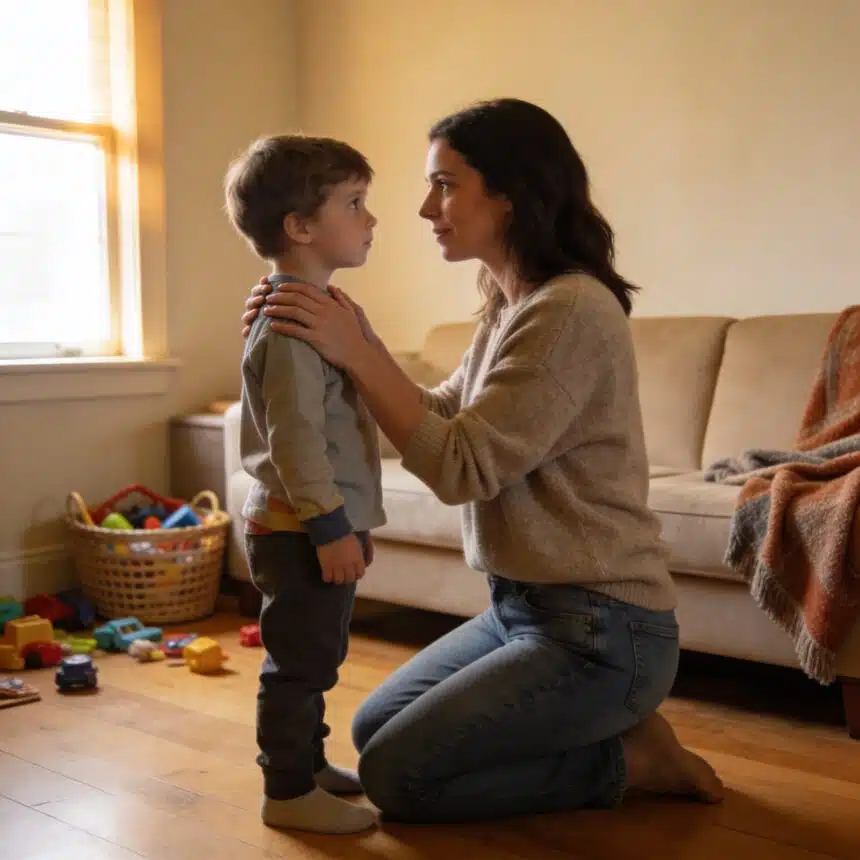
Walk over to your child. Get close. Within arm’s reach.
Get down to their eye level. Kneel or sit if they’re small.
Make physical contact. Put a hand on their shoulder or arm. Not grabbing, just gently touching.
Say their name and wait for eye contact.
Only speak once you have their attention.
This sounds like more work than yelling from across the room. And it is. But it actually gets results, which means you don’t have to repeat yourself five times.
I started doing this with my five-year-old when I needed him to get ready for school. Instead of yelling “PUT YOUR SHOES ON” from the kitchen, I’d walk to where he was playing, kneel down, put my hand on his shoulder, make eye contact, and say calmly, “It’s time to put your shoes on.”
It worked probably 80 percent of the time. Which is way better than the 20 percent success rate I had with yelling.
Step 2: Use Positive Instructions Instead of “Stop” or “Don’t”
I used to say a lot of “don’t” and “stop” commands.
“Stop running!”
“Don’t touch that!”
“Stop whining!”
The problem is, kids’ brains don’t process negatives well. When you say “don’t run,” their brain hears “run.” They have to work extra hard to understand what you actually want them to do.
Positive instructions tell them exactly what to do instead:
Instead of “Stop running,” say “Please walk.”
Instead of “Don’t touch that,” say “Hands in your pockets.”
Instead of “Stop whining,” say “Use your normal voice.”
It’s the same message, but it’s clearer. You’re telling them what to do, not what not to do.
This one change made such a difference. My kids responded faster because they knew exactly what I wanted.
Step 3: Give Them a Moment to Process
This was hard for me at first because I wanted immediate compliance.
But kids need a second to process what you said, stop what they’re doing, and transition to the new task.
Adults need this too, honestly. If someone interrupted me while I was focused on something and demanded I immediately do something else, I’d be annoyed and resistant.
So after I give an instruction, I wait. I count to five in my head before saying anything else.
Often, by the time I get to four or five, they start moving.
If I don’t wait and instead immediately repeat myself or get frustrated, they shut down. But if I give them that processing time, they usually cooperate.
Step 4: Be Specific About What You Want
Vague instructions don’t work with kids.
“Clean your room” is too big. They don’t know where to start. They get overwhelmed and do nothing.
“Be good” means nothing. What does “good” even mean to a four-year-old?
Specific instructions work way better:
Instead of “Clean your room,” say “Put the Legos in the bin.”
Instead of “Get ready for bed,” say “Brush your teeth, then put on pajamas.”
Instead of “Be nice to your sister,” say “Use gentle hands.”
Break big tasks into one specific action at a time.
I used to tell my kids “Get ready for school” and then get mad when they were still in pajamas 10 minutes later.
Now I say “Put on your clothes,” wait until that’s done, then “Eat your breakfast,” then “Brush your teeth,” then “Put on your shoes.”
One task at a time. Way more effective.
Step 5: Follow Through Every Single Time
This is the hardest part. And it’s why a lot of parents give up and go back to yelling.
If you give an instruction and your child doesn’t follow through, you have to follow through.
That means:
If you said “It’s time to put toys away,” and they’re still playing five minutes later, you walk over, get their attention again, and calmly say “I asked you to put the toys away. Let’s do it now.” Then you stand there and make sure it happens.
If they still refuse, there’s a consequence. No screen time. Early bedtime. Loss of a privilege. Whatever consequence makes sense in your house.
But you can’t threaten consequences and not follow through. That teaches kids to ignore you because you don’t mean what you say.
Following through is exhausting. Especially at first. It’s way easier to just yell and give up.
But after about two weeks of consistently following through, my kids started listening the first time way more often. Because they learned I meant what I said.
The One Change That Made the Biggest Difference
Out of all five steps, getting close and making eye contact before speaking was the game changer.
I spent years yelling instructions from across the house and wondering why my kids didn’t listen.
Once I started walking over to them, getting down to their level, and speaking calmly with eye contact, everything changed.
It takes more effort upfront. But it saves so much energy in the long run because you’re not repeating yourself ten times or yelling.
What About When You’re Really Frustrated?
I’m not going to lie and say I never yell anymore. I still do sometimes, especially when I’m stressed or tired or someone’s about to get hurt.
But here’s what helps:
When I feel the urge to yell, I pause. Take a breath. Count to three.
Then I walk over to my kid instead of yelling from where I am.
Sometimes just that walk over to them gives me enough time to calm down.
If I do yell, I apologize after. I say “I’m sorry I yelled. I was frustrated, but I shouldn’t have yelled. Next time I’ll try to stay calm.”
Kids need to see that adults mess up too and take responsibility for it.
And honestly? The less I yell, the less frustrated I feel overall. Because the method actually works, so I’m not stuck in that cycle of repeating myself and getting more and more angry.
What If Your Kid Still Won’t Listen?
This method works way better than yelling, but it’s not 100 percent effective 100 percent of the time.
Sometimes kids still don’t listen. Here’s what I do:
If they’re having a meltdown or tantrum: I don’t try to reason with them. I stay calm, keep them safe, and wait it out. We can talk after they’re calm.
If they’re outright defiant: There’s a consequence. Loss of privilege, time-out, early bedtime, whatever fits the situation.
If it’s happening constantly: I look at the bigger picture. Are they hungry, tired, overstimulated? Do they need more connection time with me? Is something else going on?
Sometimes the “not listening” is actually a sign of an unmet need, not defiance.
I learned a lot about this from the parenting change that made my kids actually listen: The parenting change that made my kids actually listen.
How Long Does It Take to See Results?
I saw improvement within the first week. Not perfect, but better.
By week two, I was yelling way less.
By week three, my kids were responding to calm instructions most of the time.
The key is consistency. If you do this method sometimes and yell other times, it won’t work. You have to commit to trying it for at least two weeks straight.
Also, your kids will test you. They’ll ignore you to see if you really mean it. That’s normal. Just keep following through.
What About Different Ages?
This method works for toddlers through elementary-age kids. I’ve used it with my three-year-old and my eight-year-old.
For toddlers (2-3 years): Keep instructions super simple. One step at a time. Lots of patience. They’re still learning to understand and follow directions.
For preschoolers (4-5 years): They can handle slightly more complex instructions. Still break big tasks into smaller steps.
For school-age kids (6+): They understand more, but they’re also more likely to argue or negotiate. Stay calm and follow through.
The core method (get close, make eye contact, be specific, follow through) works for all ages. You just adjust your expectations based on development.
My Kids Still Ignore Me Sometimes
Yeah, mine too.
This method isn’t about creating perfectly obedient robots. It’s about reducing the daily battle and the constant yelling.
Some days are better than others. Some kids are more strong-willed than others.
But even on hard days, this method works better than yelling. Because yelling just makes everyone more stressed and doesn’t actually solve the listening problem.
Frequently Asked Questions
Why do kids ignore their parents?
Kids ignore parents for a few reasons: they’re distracted and genuinely didn’t hear you, they’re testing boundaries to see if you’ll follow through, they don’t understand what you want them to do, or they’re trying to assert independence. Often it’s not defiance, it’s developmental. Getting their attention first and being specific helps.
How do I stop yelling at my kids?
Pause before you yell. Take a breath. Walk over to your child instead of yelling from across the room. Get eye contact. Speak calmly. Follow through with consequences instead of escalating to yelling. It takes practice, but the more you do it, the less you’ll feel the urge to yell.
What age do kids start listening without yelling?
Most kids can start following simple instructions around age 2, but they need you to be very clear and patient. By age 4-5, they should be able to follow multi-step instructions if you break them down. But kids don’t automatically “start listening” at a certain age. You have to teach them by being consistent.
Is it normal to yell at your kids every day?
It’s common, but it’s not healthy for you or them. If you’re yelling daily, it means the current approach isn’t working and you need a different method. This doesn’t make you a bad parent. It just means you need better tools, which is what this article is for.
What do you do when your child completely ignores you?
Walk over to them. Get down to their level. Touch their shoulder. Make eye contact. Say their name and wait. Then give your instruction calmly. If they still ignore you after you have their attention, follow through with a consequence. Don’t repeat yourself five times or yell.
How do you discipline without yelling?
Use calm, firm consequences. If your child doesn’t listen after you’ve given a clear instruction, there’s a consequence (time-out, loss of privilege, early bedtime, whatever makes sense). State the consequence calmly once, then follow through. No threats, no yelling, just consistent follow-through.
Start With One Change This Week
You don’t have to implement all five steps perfectly right away.
Pick one. The easiest one for most people is getting close and making eye contact before speaking.
Try it for three days. See what happens.
I bet you’ll notice your kids actually listen more when you’re physically close and have their attention before you speak.
Once that becomes a habit, add another step. Then another.
Before you know it, you’re yelling way less and your kids are cooperating way more.
It won’t be perfect. Parenting never is. But it’ll be better.
And you’ll feel better too because you’re not spending all day yelling and feeling guilty about it.
If you’re struggling with other parenting challenges, I’ve written about what finally worked for us here:
- The night my teen finally opened up
- How we talk about money in front of our kids
- The weekly routine that keeps me from burning out
And if you want help with reducing screen time battles (another huge listening issue), check out my guide: The screen time system that actually stops meltdowns.
But you don’t need anything else to start. Just walk over to your kid next time instead of yelling from across the room. Get their attention. Speak calmly.
See what happens. I think you’ll be surprised.
You’ve got this.
For parenting books and resources on this topic, Amazon has a solid selection worth browsing.













What strategies have worked for you? Check out these tips! #ParentingAdvice #KidsListening #CozyCornerDaily