


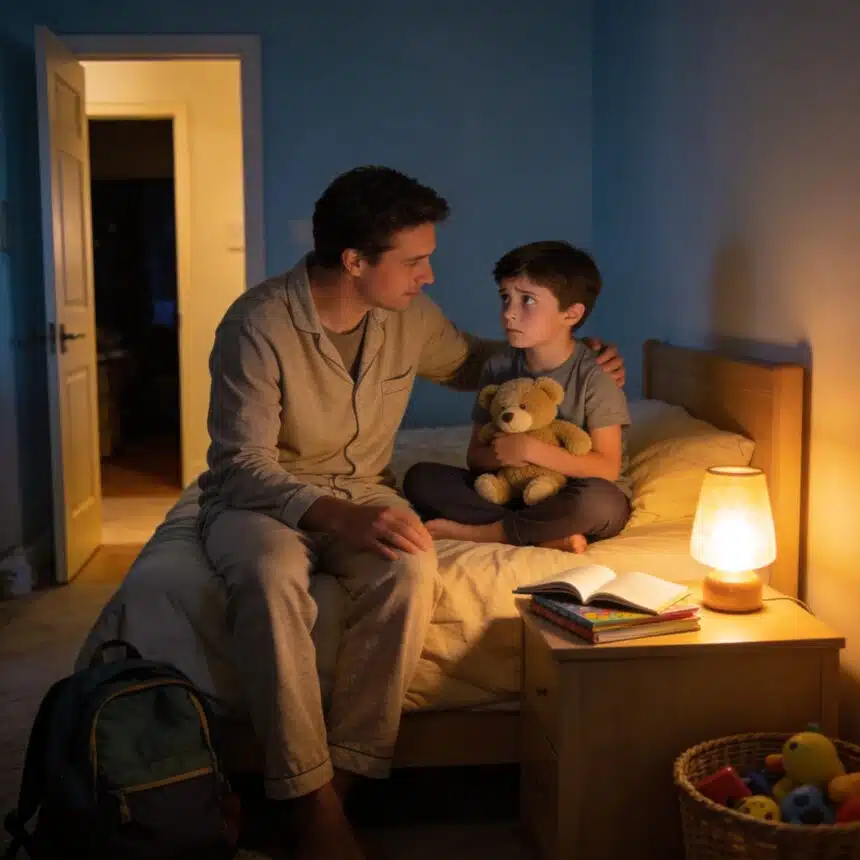
Is My Child’s Anxiety Normal? How to Help Worried Kids at Home
My daughter started crying one night because she was convinced a tornado was going to hit our house.
- Is My Child’s Anxiety Normal? How to Help Worried Kids at Home
- What “normal” kid worry looks like
- When worry starts looking like anxiety
- What causes anxiety in kids?
- Step 1: Validate their feelings without reinforcing the fear
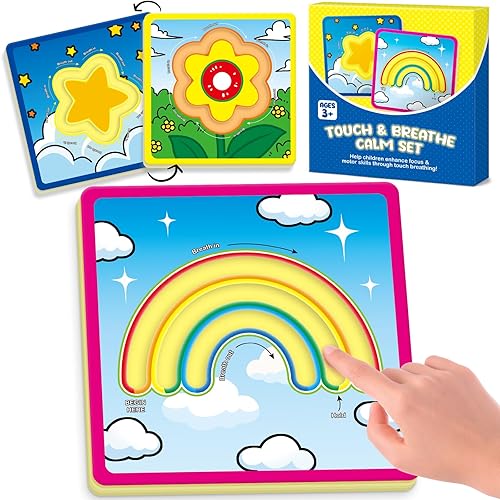
- Step 2: Teach them simple calm‑down tools they can use themselves
- Step 3: Help them face fears in tiny steps, not all at once
- Step 4: Create predictable routines and a calm home environment
- Step 5: Use books and workbooks to externalize the worry
- Step 6: Know when to bring in outside help
- Take care of your own stress too
- You’re not imagining it, and you’re not alone
We don’t live anywhere near tornado country. There was no storm warning. It was a clear Tuesday evening. But she was spiraling, asking over and over if we were safe, if the windows would break, if we needed to hide.
I didn’t know what to do. Was this normal kid worry? Was she watching too much news? Was this anxiety I needed to take seriously?
If you’ve ever wondered the same thing, you’re not alone. Anxiety in kids is way more common than most of us realize, and figuring out what’s “normal” versus what needs help can feel impossible when you’re in the middle of it.
Let me walk through what I’ve learned about childhood anxiety, how to tell when it’s crossing into something bigger, and what you can actually do at home to help your worried kid feel safer.
What “normal” kid worry looks like
All kids worry sometimes. That’s developmentally appropriate and honestly kind of healthy. It means their brain is learning to identify risks and plan ahead.
Normal worry usually:
- Comes and goes based on real situations (a test, a new school, meeting new people)
- Gets better with reassurance or distraction
- Doesn’t take over their whole day
- Doesn’t stop them from doing regular kid stuff like playing, sleeping, eating
Examples of normal worry:
- Being nervous before a big game or performance
- Feeling sad or scared after watching a scary movie
- Worrying about a friendship or whether a teacher likes them
- Asking questions about death or bad things happening after hearing about them
You can usually talk them through it, give them a hug, and they move on pretty quickly.
When worry starts looking like anxiety
Anxiety is different. It’s worry that sticks around even when there’s no real threat, or it’s way bigger than the situation calls for.
Signs that worry might be tipping into anxiety:
- Constant “what if” questions that don’t stop even after you answer them
- Physical symptoms like stomachaches, headaches, trouble sleeping, or throwing up before school
- Avoidance: refusing to go places, try new things, or be away from you
- Meltdowns or tantrums that seem way out of proportion
- Needing constant reassurance but never feeling reassured
- Rigid routines where any change causes panic
My daughter’s tornado worry wasn’t a one‑time thing. She started asking about disasters every night. Fires, earthquakes, break‑ins, car accidents. The questions were endless and my answers never helped for more than five minutes.
That’s when I realized this wasn’t just normal kid worry. Her brain was stuck in a loop.
If your child’s worry is interfering with daily life, school, sleep, friendships, or family stuff, it’s worth paying attention to. You’re not overreacting. You’re noticing a pattern.
What causes anxiety in kids?
Anxiety can come from a lot of places, and it’s usually not one single thing.
Some common factors:
- Genetics: if you or your partner have anxiety, your kid is more likely to struggle with it too
- Temperament: some kids are just wired to be more sensitive and cautious
- Big life changes: moving, divorce, new sibling, school transition, losing a loved one
- Scary or stressful events: even things that seem small to us can feel huge to a kid
- Overscheduling and pressure: too many activities, school stress, high expectations
Sometimes there’s no clear reason. Their brain just processes worry differently.
Knowing the “why” can help, but it’s not required to start helping them. You can work on calming their nervous system and teaching coping tools even if you don’t have all the answers yet.
Step 1: Validate their feelings without reinforcing the fear
This is the hardest balance to find.
You don’t want to dismiss their worry (“you’re fine, stop worrying”), but you also don’t want to feed it (“oh no, you’re right, that is scary”).
Instead, try validation plus calm confidence:
- “I can see you’re really worried about that.”
- “Your brain is trying to protect you, even though we’re safe right now.”
- “It’s okay to feel nervous. I’m here with you.”
Then follow up with gentle redirection or a coping tool instead of endless reassurance.
If you keep answering the same “what if” question over and over, their brain learns “I need to keep asking to feel safe,” and the loop gets stronger.
This is similar to what you do with toddler tantrums in how to handle toddler tantrums without losing your mind. You stay calm, you acknowledge the feeling, but you don’t let the emotion run the show.
Step 2: Teach them simple calm‑down tools they can use themselves
Anxious kids need tools they can reach for when their brain is spiraling, not just mom or dad saying “it’s fine.”
Some that worked for us:
Deep breathing
Teach them “belly breathing” where they breathe in slowly through the nose, hold for a couple seconds, then blow out like they’re blowing up a balloon. Do it with them at first. Practice when they’re calm so it’s easier to use when they’re not.
The 5‑4‑3‑2‑1 grounding trick
Name 5 things you see, 4 things you can touch, 3 things you hear, 2 things you smell, 1 thing you taste. This pulls their brain out of the worry spiral and back into the present moment.
Worry time
Set aside 10 minutes a day where they can say all their worries out loud or write them down. Outside of that window, when a worry pops up, you say “let’s save that for worry time.” It sounds weird but it actually helps their brain stop the constant loop.
Physical movement
Jumping jacks, a quick walk, dancing to one song. Anxiety is stuck energy. Moving helps release it.


Step 3: Help them face fears in tiny steps, not all at once
When kids are anxious, they avoid the thing that scares them. That feels safer in the short term, but it teaches their brain “that thing really is dangerous.”
The fix is gradual exposure. You help them face the fear in super small, manageable steps.
Example: if your kid is scared of the dark:
- Step 1: Leave the hallway light on and door open
- Step 2: Hallway light on, door cracked
- Step 3: Night light in their room, door cracked
- Step 4: Night light only, door closed
- Step 5: Very dim night light
You move at their pace, celebrate each small win, and never force them into full panic mode.
Same idea if they’re scared of new situations, separation, or specific places. Break it into the smallest possible steps and build confidence slowly.
This approach mirrors what you do with homework battles in kid won’t do homework: what actually works. Tiny steps, consistency, and celebrating effort over perfection.
Step 4: Create predictable routines and a calm home environment
Anxious kids do better when life feels predictable.
That doesn’t mean rigid or boring. It just means they know what’s coming next and the basics of their day are stable.
Things that help:
- Consistent bedtime and morning routines
- A visual schedule or family calendar they can check
- Giving warnings before transitions (“in 10 minutes we’re leaving”)
- Keeping your own stress in check as much as possible (they pick up on your energy)
If your evenings are chaotic, that adds to their anxiety. A simple routine like the 10‑minute closing shift that makes mornings peaceful can calm the whole house, not just you.
And if mornings are a nightmare, the school morning routine that ended the chaos gives everyone a more predictable start, which lowers anxiety across the board.
Step 5: Use books and workbooks to externalize the worry
Sometimes talking directly about anxiety feels too big or too personal for kids. Books and workbooks let them see it from the outside.
There are tons of great kids’ books about worry, anxiety, and big feelings. Reading them together opens the door for conversation without it feeling like an interrogation.
Workbooks for anxious kids often have:
- Simple CBT exercises (reframing worried thoughts)
- Drawing prompts
- Breathing and grounding exercises
- Ways to name and track feelings
My daughter responded way better to a workbook than to me asking her a million questions. It gave her something to do with the anxiety instead of just feeling it.


Step 6: Know when to bring in outside help
You can do a lot at home, but sometimes anxiety needs more support than a parent can give alone.
Consider talking to your pediatrician or a child therapist if:
- Anxiety is getting worse, not better
- It’s affecting school performance or friendships
- They’re having frequent meltdowns or panic attacks
- Physical symptoms are intense (constant stomachaches, trouble eating or sleeping)
- You feel like you’re out of tools and nothing is working
Therapy for anxious kids, especially something like CBT (Cognitive Behavioral Therapy), can be life‑changing. A good therapist gives kids concrete skills and helps parents support them better at home.
There’s zero shame in getting help. You’re not failing if you need a professional. You’re being a smart, proactive parent.
If money is tight and therapy feels out of reach, some schools have counselors, some communities have sliding‑scale clinics, and there are online therapy options now too. It’s worth exploring.
You can also lean into resources like books for parents of anxious kids to get strategies and reassurance that you’re not alone in this.



Take care of your own stress too
Parenting an anxious kid is exhausting.
You’re answering the same questions over and over. You’re managing meltdowns. You’re lying awake at night wondering if you’re doing this right. And your own anxiety is probably spiking because of all of it.
You can’t pour from an empty cup, and anxious kids are incredibly tuned in to your stress levels.
So build in tiny pockets of calm for yourself:
- A 5‑minute reset before bed like the evening routine that saved my sanity
- Protect one part of your week using something like the weekly routine that keeps me from burning out
- Read something that helps you feel less alone, like your Quietly Becoming or Mindful Moments guides
You modeling calm, even imperfectly, teaches your kid more than any breathing exercise ever could.
You’re not imagining it, and you’re not alone
If you clicked on this article, you already care deeply about helping your child. That matters.
Childhood anxiety is real. It’s not something they’ll just “grow out of” if you ignore it, but it’s also not a life sentence. With the right tools, support, and patience, anxious kids can learn to manage their worry and build resilience.
Start small:
- Validate their feelings without feeding the fear
- Teach one or two simple calm‑down tools
- Build predictable routines that lower daily stress
- Use books or workbooks to make anxiety less scary
- Get outside help if things aren’t improving
You don’t have to fix it all today. You just have to show up, stay calm, and keep trying.
Your worried kid is lucky to have you figuring this out with them.
For parenting books and resources on this topic, Amazon has a solid selection worth browsing.






How do you usually help a worried child? Check out this guide for more tips! #ChildAnxiety #Parenting #CozyCornerDaily