


It does not start as a fight about the dishes. It starts as a glance. A specific one, the kind that says I cannot believe this is still here, delivered over the sink at 7 p.m. by someone who has been carrying something unspoken since Tuesday. By the time words come out both people are defending a position neither of them wanted to take, and the dishes are still sitting there. The Chore Harmony System does not fix the dishes. It makes the argument about the dishes unnecessary, because both people already know what belongs to whom and why.
Why the Dishes Argument Is Really About Visibility
Research out of UC Berkeley consistently shows that it is not just the unequal division of labor that damages relationships. It is the invisibility of that labor to the partner who is not doing it. When one person feels like they are carrying more than their share and the other person genuinely does not see it, both people are telling the truth from inside their own experience. That gap between perception and reality is where resentment grows, and no amount of good intentions closes it without a shared system that makes contribution visible to both sides.
When you and your partner see mess differently is one of the most common relationship friction points in households with different sensory thresholds, ADHD, or simply different upbringings around cleanliness. The Chore Harmony System does not try to change how either person perceives mess. It creates an agreed-upon structure that operates independently of perception.
The Four-Step Setup
Step one: List every household task completely
Sit down together with a blank sheet of paper and write every task the household requires, including the ones that are invisible. Not just vacuuming and laundry, but scheduling appointments, tracking when the car needs service, buying birthday cards for extended family, noticing when the toilet paper is low and adding it to the list, planning meals, and remembering which kid has what event this week.
The invisible tasks matter more than the visible ones in most households. Studies consistently show that women in dual-income households carry a disproportionate share of the cognitive labor, meaning the mental tracking and planning, even when physical chores are more evenly split. Writing everything down is often the first moment both partners genuinely see the full weight of what is being managed.
The mental load of home repairs and the mental load of neurodivergent parenting both live in this invisible category. If either applies to your household, make sure both are on the list.
Step two: Categorize by energy type
Not all chores require the same kind of effort. Sort everything into two columns:
- High-energy tasks: Require sustained focus, physical stamina, or executive function. Deep cleaning, cooking a full meal from scratch, grocery shopping, lawn mowing, managing school paperwork
- Low-maintenance tasks: Can be done on autopilot or in short windows. Switching laundry, unloading the dishwasher, wiping counters, taking out trash, a quick bathroom reset
This distinction matters for ADHD households especially. Pairing high-energy people with high-energy tasks and protecting low-maintenance windows for lower-bandwidth moments creates a sustainable system rather than one that burns out whoever has less margin that week.
Step three: Assign based on preference, capacity, and equity
This is the conversation most couples avoid but the one that determines whether the system holds. A few principles that help:
- Lead with preference first. Tasks someone actively does not mind doing belong with them. Resentment around a chore is often proportional to how much the person doing it would rather not be doing it
- Consider capacity honestly, not theoretically. Who works longer hours this season? Who handles more of the child logistics? Equity does not always mean equal. It means both people feel the load is fair given the full picture
- Assign complete ownership of categories rather than individual tasks. One person owns laundry from start to finish. Not “whoever has time” because that defaults to whoever has the lower tolerance for the pile
- Rotate the tasks that nobody wants quarterly so resentment does not calcify around any single chore
Step four: Build the shared dashboard
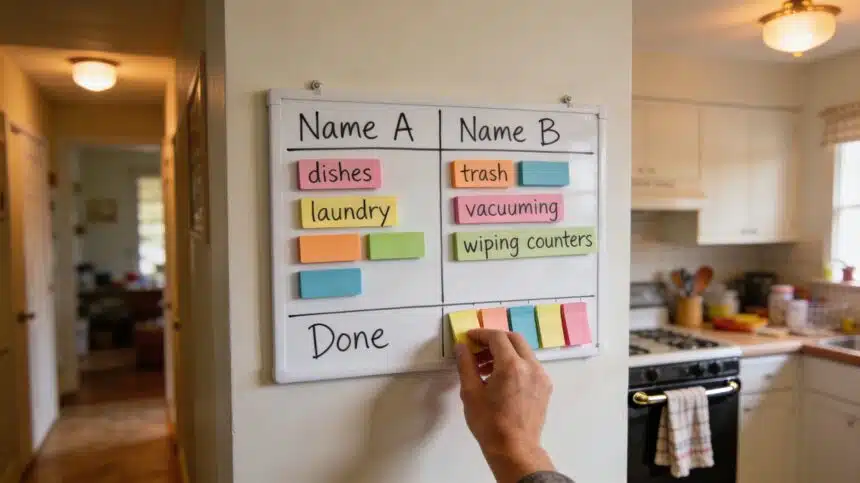
The dashboard makes every assignment visible to both people without requiring a conversation each time. A physical whiteboard with magnetic task tiles works best for most households because it sits in a high-visibility spot and requires a physical action to update, which the brain registers as completion in a way that a phone notification does not.
Each person’s name sits at the top of a column. Their assigned tasks live below as tiles. A Done row at the bottom receives completed tiles. At a glance, anyone in the household can see what has been handled and what is still pending without asking or checking in.
Shared digital calendars built for ADHD couples handle the scheduling layer, the appointments, the school events, the car service reminders. The physical dashboard handles the recurring household maintenance layer. Both together cover the full picture.
The High-Energy Sprint and Low-Dopamine Maintenance Model
One of the most relationship-friendly adjustments you can make to the chore system is explicitly separating the heavy work from the daily maintenance so neither partner is expected to operate at the same output level every day.
Designate one day per week, usually a Saturday or Sunday morning, as the high-energy sprint window. This is when the deep cleaning, the meal prep, the organizing projects, and the heavier maintenance tasks happen. Both partners work together during this window, which transforms the most draining work into something that builds connection rather than breeds resentment.
The rest of the week runs on low-maintenance habits: the five-minute evening reset, the 15-minute daily cleaning routine, and the quick resets that keep the household functional between sprint days. These are assigned individually because they tend to be brief and location-specific.
Involving Kids
Children who grow up seeing household labor as a shared household responsibility rather than something adults manage invisibly develop a fundamentally different relationship with domestic work as adults.
Age-appropriate chores on the shared dashboard give kids visible ownership. A section of the whiteboard with their names and age-matched tasks makes the contribution concrete rather than vague. Collaborative household chores as family bonding reframes the whole category from obligation into participation, which changes how kids respond to it over time.
Sibling room-sharing conflicts often ease once shared space zones and clear responsibilities are mapped out visually. The same principle that reduces the couple’s dishes argument reduces the sibling cleanup argument: visible ownership removes the “I didn’t know it was mine” defense.
When the System Slips
Every chore system slips during hard weeks: illness, a work sprint, a family crisis, a stretch of bad sleep. The Chore Harmony System is not a tool for grading each other’s performance. It is a default to return to, not a standard to be held against.
Build in a monthly five-minute check-in to review the board together. Not a performance review. Just a practical conversation: Is this division still working? Has anything shifted in our schedules? Does anything need to move? That conversation, held at a neutral time rather than in the middle of a frustration, keeps the system current and prevents it from quietly becoming one-sided again as life changes around it.
The overstimulated mom evening reset and low-energy evening rhythm are worth having ready for the weeks when the sprint day did not happen and the maintenance has slipped. They serve as a low-pressure re-entry point that gets the household functional again without requiring either partner to feel like they failed.
A household where both people see the full load, agree on who carries what, and trust that the system is fair is not a perfectly clean household. It is a household where the labor does not quietly damage the relationship doing it. That is the actual win.
For parenting books and resources on this topic, Amazon has a solid selection worth browsing.







What chores do you struggle with most? Check out this system for some helpful ideas!