






If you have tried meal planning a hundred times and always end up back at takeout, this is for you.
- Why Traditional Meal Planning Fails With ADHD
- Step 1: Create A “Never Think” Dinner List
- Step 2: Do A 10 Minute Weekly Plan, Not A 60 Minute One
- Step 3: Let Your Pantry Do Some Of The Thinking
- Step 4: ADHD Friendly Meal Prep That Takes 30 Minutes Or Less
- Step 5: Build In “Emergency” ADHD Meal Nights
- Step 6: Set Up Your Kitchen To Support Your Brain
- How To Start Today
Every Sunday, I used to sit down with a pretty printable, write an ambitious week of Pinterest dinners, and swear this was the week I would get my life together.
By Wednesday, I would be staring into the fridge with zero motivation, no energy to cook what I had planned, and a strong urge to order pizza.
If you live with ADHD, you already know why.
Most meal planning advice was not built for ADHD brains. It expects you to remember a dozen steps, make a lot of decisions all at once, and execute them perfectly when you are tired and overwhelmed.
ADHD meal planning needs to be something completely different.
It needs:
- Fewer decisions
- More defaults
- Built in flexibility for low energy days
Let me walk you through the simple ADHD friendly system I use now that actually feeds my family without making me hate my kitchen.
Why Traditional Meal Planning Fails With ADHD
Standard meal planning often looks like this:
- Collect recipes
- Pick 7 different dinners
- Write a detailed grocery list
- Shop once for everything
- Cook what you planned on the day you planned it
On paper, it is efficient. For an ADHD brain, it is a trap.
Here is what usually happens:
- Step 1 and 2 feel fun, so you get ambitious
- Step 3 takes forever and you get distracted halfway through
- Step 4 becomes overwhelming in the store because the list is long
- Step 5 fails because the day you planned a complicated recipe is the day your kid brings home a surprise project or you get an email from school that derails everything
The problem is not that you are irresponsible. The problem is that this system requires:
- Long term memory
- Consistent energy
- Zero surprises
Which is the opposite of real family life, with or without ADHD.
ADHD meal planning needs to assume:
- You will forget what you planned
- Some days you will have brain fog and no energy
- You will get bored of complicated recipes very fast
So instead of building your plan around recipes, we are going to build it around patterns, defaults, and tiny bits of prep.
Step 1: Create A “Never Think” Dinner List
The first step is to stop reinventing the wheel every week.
You probably already have meals your family eats all the time. The kind you could throw together half asleep. Those are gold.
Make a “never think” list of 5 to 10 dinners that:
- Use ingredients you almost always have
- Do not take more than 20 to 30 minutes
- Nobody in your house actively hates
Write them on paper and stick it inside a cabinet, or keep them in a note on your phone.
Examples:
- Tacos or burrito bowls
- Pasta with jarred sauce plus a bag salad
- Breakfast for dinner
- Sheet pan chicken and veggies
- Soup and grilled cheese
If you want ideas, I share some of our favorite low effort repeats in 5 dinner recipes we rotate every week and 20 minute weeknight dinners with simple ingredients.
Think of this list as your ADHD meal planning backbone. Most weeks, you are going to cook from here.
Step 2: Do A 10 Minute Weekly Plan, Not A 60 Minute One
Instead of spending an hour planning every detail, aim for ten focused minutes.
Here is what that looks like.
1. Look at your real week
Grab your calendar and notice:
- Which nights are super busy
- Which nights you are likely to be exhausted
- Which night is your “most energy” night
Busy night might mean activities, late work, or solo parenting. Low energy night might be after a long meeting day or therapy day.
2. Assign dinners by energy level
Now match your dinners to your energy, not to the day of the week in theory.
For example:
- Most energy night: one new or slightly more involved recipe
- Medium nights: 2 familiar “never think” dinners
- Low energy nights: 2 very easy backups like sheet pan meals or breakfast for dinner
You can pull ideas from one pot dinners for when you are too tired to think and sheet pan meals that feed a family under 25.
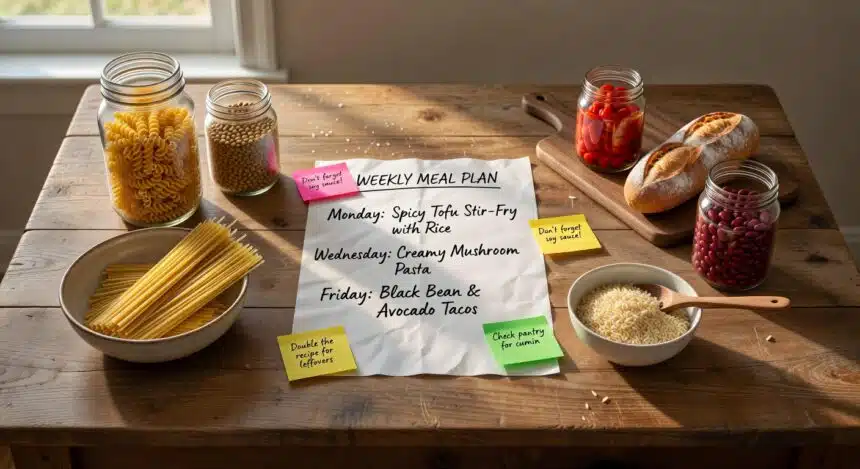
Write it down simply:
- Mon: Tacos
- Tue: Soup and grilled cheese
- Wed: Slow cooker chicken
- Thu: Breakfast for dinner
- Fri: New recipe
That is it. No need to map snacks, lunches, and sides down to the last carrot. You are giving your brain a skeleton, not a cage.
If groceries are especially tight, pair this with the system from meal plan on a budget when groceries are expensive. The same structure works beautifully with budget meals.
Step 3: Let Your Pantry Do Some Of The Thinking
ADHD meal planning is so much easier when your pantry and freezer are set up with “starters” that can become many different meals.
Instead of planning around recipes, plan around building blocks.
Stock a few versatile bases
Aim to keep on hand:
- Grains: rice, pasta, tortillas
- Proteins: canned beans, tuna, frozen chicken, ground meat
- Sauces: jarred marinara, salsa, curry paste, teriyaki
- Freezer helpers: frozen veggies, frozen fruit, frozen bread
These are the same basics I focus on in how to stock your pantry on a budget.
Then, when you look at what you have, ask:
- What grain do I have
- What protein do I have
- What flavor do I have
That combination becomes dinner.
For example:
- Rice + canned beans + salsa = burrito bowls
- Pasta + jarred sauce + frozen veggies = easy pasta night
- Tortillas + leftover chicken + cheese = quesadillas
When your pantry is set up like this, you are never truly “out of food,” even if you did not execute your plan perfectly.
Step 4: ADHD Friendly Meal Prep That Takes 30 Minutes Or Less
If meal prep makes you picture three hours of chopping and color coded containers, forget that.
ADHD meal prep should be:
- Short
- Visual
- Impactful
You are not prepping full meals. You are prepping friction removers.
Pick one tiny prep session
Once a week, ideally on your highest energy day, set a 30 minute timer and prep only what makes the rest of the week easier.
Some ideas:
- Chop onions and store in a jar
- Cook a big batch of rice
- Brown ground meat and freeze in portions
- Wash and cut a few grab and go veggies
I walk through a version of this in my guide to batch cooking for families. The key is that you stop when the timer goes off.
Prep breakfast or lunch, not just dinner
Sometimes where ADHD brains fall apart is mornings. If that is you, put your prep energy there.
You could:
- Make freezer breakfast burritos
- Do a simple lazy person soup meal prep for your lunches
- Prep overnight oats in jars
If breakfast and lunch are handled, dinner feels less like the entire weight of feeding your family sits on that one hour.
Step 5: Build In “Emergency” ADHD Meal Nights
Even the best ADHD meal planning system will meet weeks where everything falls apart.
Instead of pretending that will not happen, plan for it.
Create a no think shelf
Dedicate one small space in your pantry or freezer to “emergency dinners.”
These should be:
- Shelf stable or freezer friendly
- Ready in 15 minutes or less
- Totally acceptable as a meal
Think:
- A jar of pasta sauce and a box of pasta
- Frozen pizza and a bag salad
- Boxed soup and grilled cheese fixings
This is different from your regular pantry. These are backup plans you do not touch unless the day really went sideways.
Pair this with ideas from no spend grocery week swaps and easy pantry meals from what you already have so you are using what you buy.
Use theme nights to reduce decisions
Give at least one or two nights a theme, for example:
- Pasta night
- Soup and sandwich night
- Breakfast for dinner night
On those nights, you do not choose from everything. You choose within the theme. Less decision making means less chance to bail out and order takeout.
Step 6: Set Up Your Kitchen To Support Your Brain
Your environment can work for you or against you. ADHD meal planning gets easier when your kitchen is not a constant obstacle course.
A few simple tweaks:
- Keep your most used pots and pans where you can reach them without thinking
- Store spices and oils near the stove, not in a crowded cabinet across the room
- Use shallow bins or drawer dividers so you can see what you have at a glance
This is the same principle I use in my ADHD friendly kitchen drawer organization system. If you cannot see it, you will not use it.
If you want more help turning your kitchen into a space that actually works with your brain, my digital guide The ADHD Kitchen Organization System That Actually Works walks you through it step by step.
How To Start Today
You do not need to wait until Sunday to overhaul your ADHD meal planning.
Pick one small starting point:
- Make your “never think” dinner list of 5 meals
- Look at your calendar and match dinners to your real energy this week
- Set up one tiny 30 minute prep session for chopped veggies or cooked rice
- Create an emergency dinner shelf with two backup meals
That is it.
You are not aiming for a perfectly planned week. You are aiming for “future me does not have to stare into the fridge in tears wondering how to feed everyone tonight.”
ADHD brains are not bad at meal planning. They just need a different kind of plan.







What’s your go-to meal for busy nights? Check out these ADHD-friendly tips! #MealPlanning #ADHDFamily #CozyCornerDaily