



A loud kitchen wears on you faster than people realize. It is not always the big noises either. Sometimes it is the repeat noises that do the damage. Cabinet doors banging shut. Hinges clicking crookedly. That one loose door that never closes right and gives a sharp little clatter every single time someone touches it. On paper, it sounds minor. In real life, those small kitchen noises pile up all day until the room feels more aggressive than it should.
That was exactly what was happening in our house. One cabinet under the sink had gotten loose slowly, the way these things always seem to happen. At first it was a little wobble. Then the door stopped lining up right. Then it started hitting the frame with a hard, ugly sound every time it closed. Soon another cabinet joined in. Before long, the kitchen had this constant soundtrack of tiny slams and off-kilter clacks that made the whole space feel more stressful than it needed to be.
The good news is that loose cabinet hinges are one of those fixes that look more annoying than they really are. And in a sensory-heavy room like the kitchen, fixing them can change the feel of the whole space fast. I am not exaggerating. When cabinet doors stop jerking, slamming, scraping, and shifting, the room gets quieter in a way your body notices almost immediately.
The first thing to understand is that cabinet door noise is usually not random. It tends to come from a few common issues. The hinge screws have loosened. The screw holes have stripped out and no longer hold tightly. The hinge plate has shifted. The door is slightly misaligned and hits where it should not. Or the cabinet is technically closing, but with no soft barrier, so every close ends in a sharp wood-on-wood sound. Once you know that, the fix stops feeling mysterious.
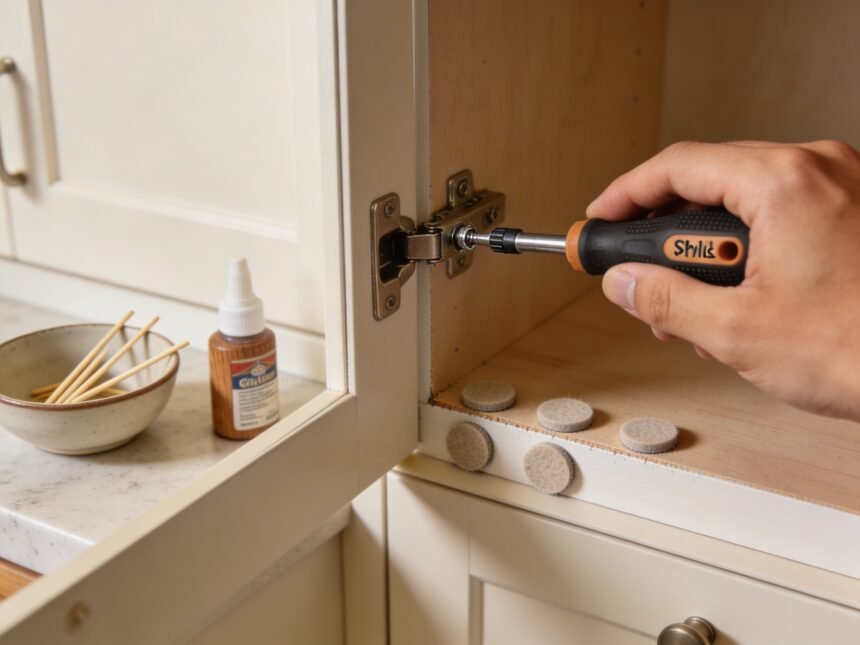
I always start simple. Open the cabinet and check the screws first. Sometimes the whole problem is just loose hardware. A couple of turns with a screwdriver can improve the door more than you expect. But if the screw keeps turning without tightening, that usually means the hole is stripped. That is where the toothpick and wood glue trick comes in, and honestly, it is one of my favorite low-effort home fixes because it feels almost suspiciously easy.
You pull the screw out, put a little wood glue on a few toothpicks, push them into the stripped hole, break them off flush, let the glue set up a bit, and then reinsert the screw. That tiny repair gives the screw something solid to grip again. It is not fancy. It is not a dramatic “before and after” project. It just works. And that is exactly the kind of repair I trust most in a busy house. The same practical energy is what makes fixing sticky doors and squeaky floors with what you already have so satisfying too. You use what is already around, solve the actual annoyance, and move on with your life.
If the hinge itself is not holding alignment, you may also need to adjust the mounting plate or hinge screws slightly until the door sits straighter. Most modern cabinet hinges have small adjustment screws that let you shift the door side to side or in and out a little. It can take a few tries, but it is usually very manageable. You do not need to become a cabinet installer. You just need patience for five extra minutes and a willingness to tweak instead of forcing the door shut and hoping it gets its life together on its own.
Once the cabinet is structurally sound again, felt bumpers make a bigger difference than people expect. Those tiny adhesive dots are not exciting, but they are excellent. They soften the contact point so the door closes with a quieter, duller finish instead of that hard jolt that travels through the whole kitchen. This is especially helpful if you live with kids, busy mornings, distracted cooks, or anyone who closes cabinets like they are finishing an argument. One little felt dot can take a cabinet from “sharp and irritating” to “fine, normal, barely noticeable.”
That matters a lot more in kitchens than in other rooms because the kitchen already carries so much sound. Dishes. Water. Microwave beeps. Fridge hum. Pans. Drawer slides. Voices. If the cabinets are noisy too, the room starts feeling crowded on a sensory level even when it looks fine. That is why this kind of repair fits into the same bigger picture as organizing cleaning supplies so they actually get used and the kitchen cleaning routine that stopped a kitchen from being a disaster zone. A functional kitchen is not only about what you see. It is also about how the space sounds and feels while you are in it.
One thing I noticed after fixing ours was that I stopped bracing for the noise. That sounds dramatic until you realize how often you really do tense up around repetitive household sounds. When a cabinet is always about to slam, your nervous system learns that rhythm whether you want it to or not. Once the hinges were tight and the bumpers were on, the kitchen felt gentler. The movement stayed the same, but the impact changed. That is a small home win with a surprisingly big emotional payoff.
This fix is also great because it is approachable. You do not need a full repair kit or a giant shopping trip. A screwdriver, toothpicks, wood glue, and felt bumpers will solve a lot. And that is part of why I think these practical home repairs matter so much. They lower the amount of background irritation a house creates. The same logic shows up in simple home repairs every parent should learn, home repairs you can do with zero experience, and the home repairs you really cannot keep ignoring. A lot of home peace is built on small repairs handled early.
I also think kitchens deserve more sensory attention than they usually get. People talk about kitchen organization and kitchen cleaning, which matters, of course. But sound, friction, and repeated minor annoyances matter too. A cabinet that closes badly is not only a cabinet problem. It is a room-mood problem. It chips away at the sense that the kitchen is under control. If you are already dealing with overstimulation, that kind of repeated noise lands even harder.
That is why I like pairing this kind of fix with a few other quieting moves if the kitchen still feels “too much.” Soft-close bumpers on drawers if possible. A clear landing spot for clutter so doors are not getting shoved around in frustration. Easier access to daily-use items so people are not yanking open the wrong cabinet five times. Those small systems matter. They fit right in with the ADHD kitchen drawer organization system and organizing a small kitchen with zero extra storage. The smoother the room works, the less rough energy it throws back at you.
Another benefit is that fixing hinges early can prevent worse wear later. A misaligned cabinet door puts strain on the hinge, the mounting point, and the cabinet frame. Ignore it long enough and you may move from “annoying noise” to “why is this whole door trying to fall off in my hand?” I prefer catching it well before that stage. It is cheaper, easier, and less irritating.
And there is something satisfying about using a humble fix to solve a problem that had been wearing on the whole family. Toothpicks and glue are not glamorous. Felt bumpers are not glamorous. But when the kitchen suddenly closes more softly and the harsh little sounds disappear, you feel the difference right away. It is practical peace. That is the best kind.
This is also the sort of repair that works well during a normal week because it does not demand a giant block of time. You can do one cabinet. Then another later. You do not need a whole Saturday. That matters in real homes, especially if you are already juggling too much. A repair that asks little but gives back quickly is exactly the kind of project I want more of.
So if your kitchen has started sounding more chaotic than it needs to, I would not ignore the cabinet doors just because the problem feels small. Tighten the screws. Rebuild stripped holes with toothpicks and wood glue. Adjust the hinge if the door sits crooked. Add felt bumpers so every close lands softer. Then stand back and notice how much calmer the room feels. Not because anything dramatic changed, but because one small source of daily friction is finally gone. In a busy home, that kind of quiet matters more than people think.