



Your heating bill is probably higher than it needs to be right now. Not because your furnace is broken or your insulation sucks, but because there’s a dirty rectangle of pleated paper sitting in your air return vent making your entire system work way harder than it should.
- Why A Dirty Filter Costs You Money
- How Often You’re Actually Supposed To Change It
- Where The Filter Even Is
- Buying The Right Filters
- Setting Reminders That Actually Work
- The Mistake That Made It Worse
- What Else I Learned About HVAC Maintenance
- Teaching The Kids To Do This
- The Winter Bill Comparison
- Why Nobody Talks About This
- The Quick Version If You’re Overwhelmed
That rectangle costs about $5 to replace and takes maybe three minutes to change out. But most people, including me until last winter, forget it exists for months at a time. And that forgetfulness costs real money.
Last February our heating bill hit $210 for the month. We live in a normal-sized house in Texas where it doesn’t even get that cold. Something was wrong. I checked the thermostat, made sure windows were closed, all the obvious stuff. Everything seemed fine.
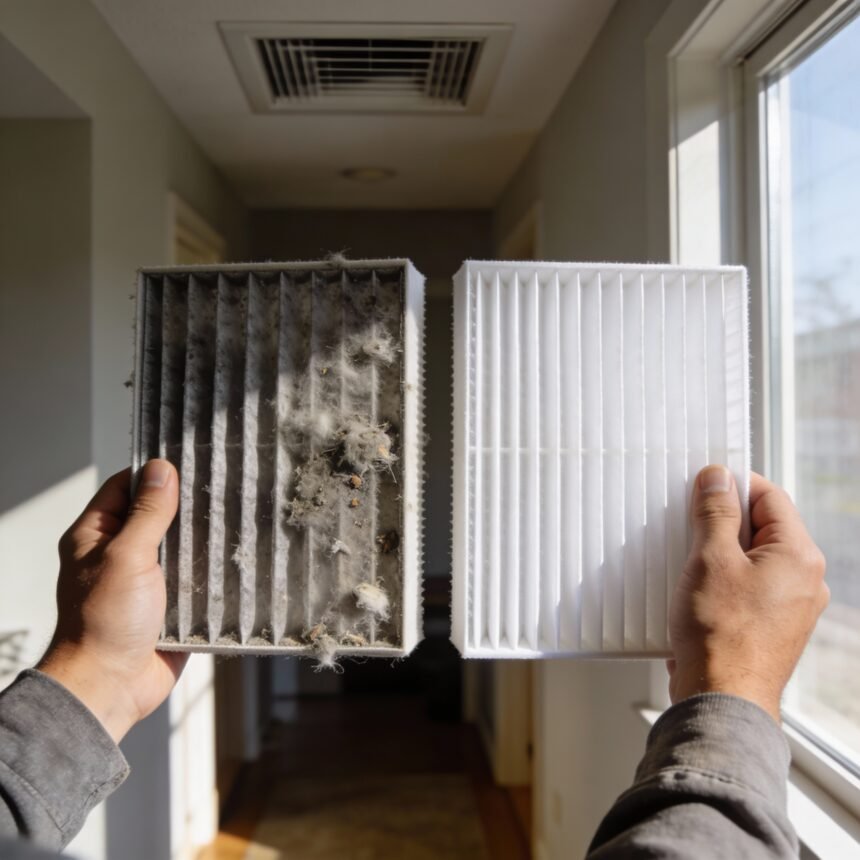
Then my dad came over and asked when we last changed the furnace filter. I had no idea. I couldn’t even remember where the filter was located. He pulled it out and it was disgusting. Completely clogged with dust and dirt and probably dog hair. He said this was why our bill was so high.
We changed the filter. The next month’s heating bill was $178. The month after that, $172. Same house, same usage, $30 to $40 less per month just from changing a filter. Over the whole winter that’s easily $150 to $200 wasted because I didn’t change a $5 filter.
Here’s everything I learned about why this matters and how to actually stay on top of it.
Why A Dirty Filter Costs You Money
When your HVAC filter is clogged, air can’t flow through it properly. Your system has to run longer and work harder to push air through that blockage to heat or cool your house to the temperature you set.
Running longer means using more energy. Using more energy means higher bills. A dirty filter can increase your energy costs by 5 to 15 percent depending on how bad it is. For us that was clearly in the $30 to $40 a month range during winter when the heater was running constantly.
It also puts strain on your system. Making it work harder shortens its lifespan. HVAC repairs and replacements cost thousands of dollars. Changing a filter regularly prevents some of that wear and tear.
Plus dirty filters don’t actually filter the air properly anymore. All that dust and allergens and stuff just gets recirculated through your house. So you’re paying more money to breathe dirtier air. Great.
The filter’s job is to catch all that stuff before it gets to your HVAC system and before it gets blown back into your house. When it’s full, it can’t do that job anymore. You have to change it.
How Often You’re Actually Supposed To Change It
The standard answer is every three months. Every 90 days, change your HVAC filter. Mark it on your calendar, set a reminder, just do it.
But that’s the baseline for an average household. If you have pets, you should change it more often. We have a dog and the filter gets covered in dog hair way faster than three months. Now we change ours every two months.
If you have allergies or asthma, more often is better. If you run your HVAC constantly, more often. If you’re doing construction or renovation and there’s dust in the air, way more often.
The real answer is check it monthly and change it when it looks dirty. Pull the filter out, hold it up to a light. If you can’t see light through it clearly, it needs to be changed. That’s the test.
For us, every two months is the sweet spot. It’s dirty enough to need changing but not so clogged that it’s costing us money or damaging the system.
Where The Filter Even Is
This sounds dumb but I genuinely didn’t know where our HVAC filter was located. Nobody ever showed me and I never thought to look for it.
Most houses have the filter in one of a few places. Either in the air return vent, which is usually a large grate on a wall or ceiling. Or in the furnace unit itself if you have a basement or utility closet.
Ours is in the air return vent in the hallway ceiling. There’s a grate that pops off and the filter slides out. Takes two seconds once you know where it is.
If you don’t know where yours is, look for the big vent that sucks air in. Not the vents that blow air out, the one that pulls it in. That’s probably where your filter is. Or check near your furnace unit.
You can also google your address plus “HVAC filter location” and sometimes you’ll find diagrams or info for your specific house model if it’s a newer development.
Once you find it the first time, take a picture of it with your phone so you remember where it is. Also measure the filter size because you’ll need to know that when you buy replacements.
Buying The Right Filters
Filters have sizes printed on the edge. Something like 16x25x1 or 20x20x1. You need to buy the exact same size or it won’t fit properly.
You can buy filters at any hardware store, big box store, or online. They range from like $3 for the cheapest ones to $30+ for fancy ones with better filtration.
The cheap basic ones work fine for most people. You don’t need to spend $25 on a filter unless you have specific air quality needs. The mid-range ones around $8 to $12 are usually plenty good.
I buy a pack of them at a time so I always have replacements on hand. If I have to go to the store to buy a filter every time I need to change it, I’ll procrastinate and not do it. Having a stack in the garage means there’s no excuse.
Some people get filters on a subscription service where they’re automatically delivered every few months. That works too. Whatever makes it easiest for you to actually change them regularly.
The main thing is don’t cheap out so much that you’re buying filters that fall apart or don’t filter well. But you also don’t need top-of-the-line hospital-grade filters for a normal house.
Setting Reminders That Actually Work
Knowing you should change your filter every two or three months is useless if you forget to actually do it. You need a system to remind yourself.
I tried setting a recurring reminder on my phone calendar but I’d dismiss it and forget about it immediately. That didn’t work.
What works for me now is writing the date on the filter itself with a Sharpie when I change it. “Changed 12/15/25.” Then I can see at a glance when it was last changed without having to remember.
I also have a recurring task in my to-do list app that pops up on the first of every other month. “Check HVAC filter.” Not change it necessarily, just check it. If it looks dirty, I change it. If it’s still okay, I leave it another month.
My husband set a reminder on his Google Home. On the 15th of every other month, it reminds him out loud “Check the HVAC filter.” That works for him because he hears it while he’s home.
Find whatever reminder system you’ll actually pay attention to. Calendar notification, sticky note on the bathroom mirror, recurring to-do, alarm on your phone, whatever. Just have something because you will forget otherwise.
The Mistake That Made It Worse
When I first learned about changing filters, I was eight months overdue. The filter was absolutely disgusting. So I changed it and felt very accomplished.
Then I forgot about it again for another six months. Because I didn’t have a system. I just changed it once and assumed I’d remember to do it again. I did not remember.
The mistake was thinking I’d naturally remember to do this every few months. I don’t naturally remember to do anything every few months. I need reminders and systems or it doesn’t happen.
This is the same thing that happened with simple home repairs. Learning how to do the thing is only half the battle. Building the habit of actually doing it regularly is the other half.
What Else I Learned About HVAC Maintenance
Changing the filter is the main thing you can do yourself, but there’s other maintenance too. You’re supposed to get your whole HVAC system serviced by a professional once a year.
They check everything, clean the coils, make sure it’s running efficiently, catch problems before they become expensive repairs. This costs maybe $100 to $150 but it’s worth it.
We started doing annual HVAC service last fall. The technician found a couple minor issues and fixed them before they became major problems. He also showed me how to clean the outdoor condenser unit which was covered in leaves and dirt and definitely not helping efficiency.
Regular professional maintenance plus changing the filter regularly means your system lasts longer and runs cheaper. It’s preventative instead of reactive.
If you’re working on staying on top of home maintenance stuff in general, check out 5 home repairs I finally learned to do myself. Similar concept of small regular maintenance preventing expensive problems.
Teaching The Kids To Do This
My older kid is almost a teenager and I’m teaching them how to change the filter. Partially because I want help, but mostly because this is life skills stuff they need to know before they move out someday.
We did it together last time. Showed them where the filter is, how to pop the grate off, how to slide the old one out and the new one in making sure the arrows point the right direction. They can do it themselves now.
When they eventually have their own place, they’ll know to change the HVAC filter regularly. They won’t be like me, clueless and wasting money for years because nobody taught them.
Same reason we teach them about how we talk about money. These practical life things matter and schools don’t teach them.
The Winter Bill Comparison
Last winter before I started changing filters regularly, our heating bills for December through February averaged about $205 a month. This winter with regular filter changes, we averaged $168.
That’s $37 a month difference. Over three months that’s $111 saved just from changing filters. The filters themselves cost maybe $8 each, so $24 total for three months.
That’s $87 net savings for basically no effort. And that’s just winter. We also run the AC in summer and the same principle applies. Dirty filter makes it work harder, clean filter makes it run efficiently.
Over a full year of regular filter changes, we’re probably saving $200 to $300 on utility bills compared to when I never changed them. That’s real money.
If you’re looking for other ways to reduce monthly bills, check out living paycheck to paycheck. Lots of small changes that add up to real savings.
Why Nobody Talks About This
HVAC filters are boring. They’re not interesting. Nobody makes content about changing your furnace filter because it’s not exciting or dramatic.
But boring maintenance stuff saves money. Changing filters, cleaning refrigerator coils, checking for leaks, all the unglamorous home maintenance things that nobody talks about are often the things that make the biggest financial difference.
Pinterest and Instagram are full of pretty organization projects and aesthetic home improvements. Those are fun but they’re not saving you $200 a year on utility bills.
The mundane maintenance tasks are what actually matter for keeping your home running efficiently and keeping your costs down. They’re just not cute or shareable so people don’t talk about them much.
The Quick Version If You’re Overwhelmed
If all of this feels like too much information, here’s the short version.
Find your HVAC filter. It’s probably in a large air return vent or near your furnace. Pull it out and look at it. If it’s dirty, change it. If you don’t have a replacement, buy some in the right size.
Set a reminder on your phone for two or three months from now to check it again. When the reminder goes off, check the filter. If it’s dirty, change it. Reset the reminder for another two to three months.
That’s it. That’s the whole thing. Check it every couple months, change it when it’s dirty, save money on your heating and cooling bills.
It’s not complicated. It’s just something you have to remember to actually do. And now you know.