







I stared at our electric bill in December and couldn’t figure out why it was so high. We hadn’t changed anything. Same routines, same house, same number of people. But the bill was $40 more than last winter.
- What Phantom Power Actually Is
- The Five Things I Unplugged
- The Power Strip Strategy
- What I Didn’t Unplug
- Calculating If It’s Worth It
- Teaching The Kids About Energy Waste
- The Bigger Picture On Our Electric Bill
- Why This Was Easier Than I Expected
- The One Month Challenge
- What I Wish I’d Known Sooner
- The Reality Check
I started googling “why is my electric bill so high” and kept seeing this term. Phantom power. Energy vampires. Devices that are technically “off” but still drawing electricity 24/7 just by being plugged in.
I thought that sounded like one of those things people exaggerate to sell you stuff. But the more I read, the more it made sense. All those little lights and displays on devices that are supposedly off? They’re using power. And it adds up.
The average household wastes $100 to $200 a year on phantom power. That’s basically throwing away money for literally nothing. No benefit, no use, just wasted electricity because stuff is plugged in.
So I did an experiment. I unplugged five specific things that I knew we weren’t using constantly. And our next electric bill dropped $15. The month after that, another $14 lower. It actually worked.
What Phantom Power Actually Is
Okay so here’s what’s happening. When you turn off your TV with the remote, it’s not actually off. It’s in standby mode so it can receive the signal from the remote when you turn it back on. That standby mode uses electricity.
Same with phone chargers. You unplug your phone but leave the charger plugged into the wall? It’s still drawing power even though nothing’s connected to it. Not a ton, but it’s constant, 24 hours a day, 365 days a year.
Gaming consoles are terrible for this. Even in “rest mode” they’re using power to stay ready for updates or quick startup. Printers sitting there doing nothing but keeping their display lit. Coffee makers with digital clocks. Cable boxes that are never actually off.
It’s called phantom power because you can’t see it happening. The device looks off. But it’s quietly pulling electricity all the time.
The Department of Energy says this can account for 5 to 10 percent of your home’s electricity use. For us that was costing about $15 to $20 a month that we didn’t need to spend.
The Five Things I Unplugged
I didn’t go crazy and unplug everything in my house. I’m not living like it’s 1950. But I identified five things that were easy to unplug and we wouldn’t miss having them on standby.
First was the TV in our bedroom. We don’t watch it every day, maybe a couple times a week. But it was plugged in 24/7 just sitting there. Now I plug it in when we’re actually going to use it and unplug it when we’re done. Takes two seconds.
Second was phone chargers. We had chargers plugged in all over the house even when we weren’t charging anything. Kitchen, living room, bedrooms. I unplugged all of them and we now just plug them in when we’re actually charging a phone. It’s not inconvenient at all.
Third was the gaming console. My kids were leaving it in rest mode constantly so it could download updates. I changed the setting so it actually turns off, and we only plug it in when they’re playing. They complained for about two days and then got used to it.
Fourth was the coffee maker. Ours has a digital clock that was running 24/7. We don’t need a clock on the coffee maker when we have phones and an actual clock on the wall. I plugged it into a power strip with an on/off switch so I can turn it on when I’m making coffee and off when I’m done.
Fifth was the printer. We print maybe once a week but the printer was on constantly with its little display lit up. Now it stays unplugged until we actually need to print something.
Those five changes took maybe 10 minutes to implement and we saved $15 a month. That’s $180 a year. For doing basically nothing.
The Power Strip Strategy
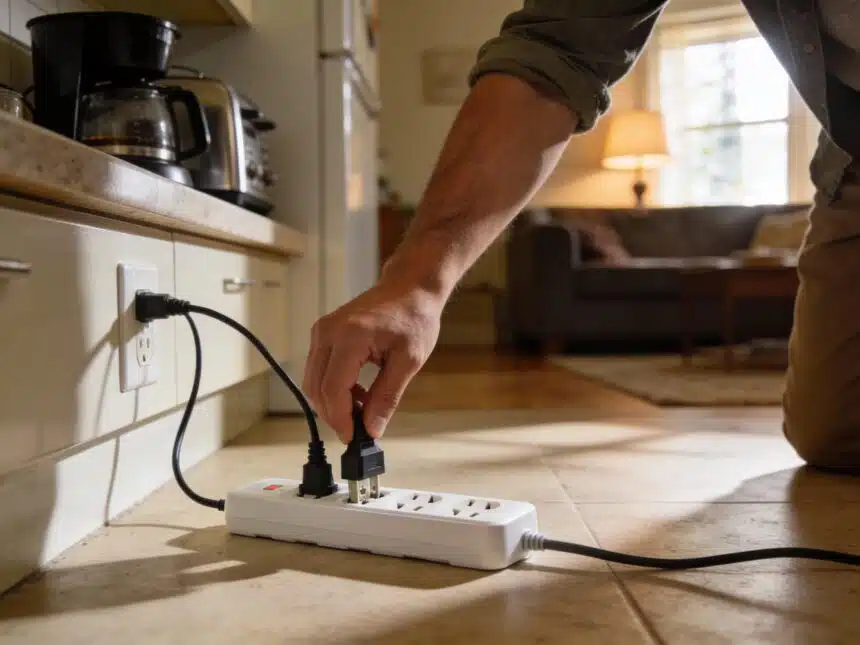
The easiest way to handle phantom power is using power strips with on/off switches. Plug multiple devices into one strip, then flip the switch off when you’re not using them.
I put one behind our entertainment center. TV, streaming stick, sound bar, all plugged into one strip. When we’re done watching TV, I flip the switch. Everything’s off. No phantom power.
Another one at my desk for computer stuff. Monitor, printer, desk lamp. Flip the switch at the end of the day, everything’s actually off.
You can get power strips with timers too if you want to automate it, but honestly the manual switches work fine for us. It’s one extra step that takes one second.
The key is putting the power strip somewhere accessible so you’ll actually use it. If it’s behind furniture where you can’t reach it, you won’t turn it off. I learned that the hard way with the first one I bought.
What I Didn’t Unplug
I’m not unplugging the refrigerator or the WiFi router or things that genuinely need to stay on. That would be stupid. And uncomfortable.
Some devices also lose their settings if you unplug them completely, which is annoying. Our microwave resets its clock every time it loses power, so I leave that plugged in because I don’t want to reset it daily.
The goal isn’t to unplug everything and live in the dark ages. The goal is to unplug the things that don’t need to be on standby and won’t cause you any real inconvenience.
I also didn’t unplug things that are actually convenient to have on standby. Like the TV we watch every day in the living room. I’m not unplugging and replugging that every single day. That would drive me crazy and I wouldn’t stick with it.
This is about finding the balance between saving money and not making your life harder. If unplugging something would be a genuine hassle, leave it plugged in. There are enough easy wins that you don’t need to make it painful.
Calculating If It’s Worth It
I didn’t measure every single device to see exactly how much power it was using because honestly I don’t have a meter for that and I didn’t want to spend money to save money. But you can find general estimates online.
Phone chargers that are plugged in but not charging anything use about 0.26 watts. That’s not much individually but if you have five chargers plugged in all over your house, it adds up over a year.
Gaming consoles in rest mode can use 10 to 15 watts. Cable boxes use 15 to 50 watts even when “off.” Desktop computers in sleep mode still use 20 to 40 watts.
You can do the math if you want. Take the wattage, multiply by how many hours it’s plugged in, divide by 1000 to get kilowatt hours, multiply by your electric rate. Or you can just unplug some stuff and see if your bill goes down, which is what I did.
For me, knowing I’m saving $15 a month is enough. I don’t need to know exactly which device is responsible for exactly how many cents. I just know the total went down and that’s what matters.
Teaching The Kids About Energy Waste
My kids thought I was being ridiculous at first. “Mom why do we have to unplug the charger, it’s so annoying.” But then I showed them the electric bill and explained that leaving stuff plugged in costs real money that we could spend on other things.
Now they’re actually pretty good about it. They unplug their chargers when they’re done. They turn off the gaming console completely instead of leaving it in rest mode. It became a habit after a couple weeks.
I think it’s good for them to understand that electricity isn’t free and that small choices add up. We talk about money pretty openly in our house because I want them to actually understand how budgets work before they move out and have to figure it out themselves.
If you’re trying to teach your kids about money management, check out how we talk about money in front of our kids. It’s been really helpful for making money lessons feel normal instead of scary or taboo.
The Bigger Picture On Our Electric Bill
Unplugging phantom power devices was just one part of getting our electric bill under control. We also started changing our HVAC filters regularly, which I’ll admit we were terrible about before. A dirty filter makes your system work way harder and use more energy.
We also started actually turning off lights when we leave rooms, which sounds obvious but we were bad about it. And we switched most of our bulbs to LEDs over time as the old ones burned out.
All these small changes together dropped our electric bill by about $40 a month from where it was. The phantom power piece was probably $15 of that. The rest came from the other stuff.
If you’re looking at ways to save money overall, not just on electricity, the strategies in living paycheck to paycheck with a family might help. We used a bunch of those same tactics to get our budget under control.
Why This Was Easier Than I Expected
I thought unplugging stuff would be annoying and I’d stop doing it after a week. But it actually became automatic pretty fast. Now I don’t even think about it. When I’m done using something, I unplug it or flip the power strip. It’s just part of the routine.
The trick was only changing things that didn’t affect my daily convenience. I didn’t unplug things I use constantly. I only unplugged things we use occasionally or that have obvious times when they’re not in use.
If you’re trying to build new habits that stick, especially around home routines, check out the evening routine that saved my sanity. Same concept, make the changes small enough that they don’t feel like work.
The One Month Challenge
If you’re skeptical about whether this actually saves money, try it for one month. Look at your current electric bill, unplug five things that are easy to unplug, and see what next month’s bill looks like.
Pick things you don’t use every day. Extra TVs, chargers that are always plugged in, gaming systems, printers, whatever makes sense for your house. Put them on power strips if that makes it easier to manage.
Track what you unplugged so you know what changed. Then when your next bill comes, you’ll know if it made a difference. For us it was immediately obvious. The bill dropped and stayed lower.
Even if you only save $10 a month, that’s $120 a year. That’s a decent chunk of money for basically no effort. And if you’re already trying to cut spending in other areas, this is one of the easiest ways to shave a few dollars off a regular bill.
If you’re looking for more ways to cut monthly expenses without feeling deprived, check out no buy month saved 340 without feeling deprived. Different approach but same goal of keeping more money in your account.
What I Wish I’d Known Sooner
I wish someone had told me about phantom power years ago. We’ve been throwing away probably $180 a year for who knows how long just because I didn’t know this was a thing.
I also wish I’d known how easy it would be. I avoided doing this because I thought it would be complicated or inconvenient. It’s neither. It’s literally just unplugging stuff when you’re not using it.
The other thing I didn’t realize is that this is better for the devices too. Constant standby power can actually shorten the lifespan of electronics. They’re not meant to be in standby mode 24/7 forever. Giving them actual breaks is healthier for the device.
So you’re saving money AND potentially making your electronics last longer. Win-win.
The Reality Check
Look, $15 a month isn’t going to change your life. If you’re struggling financially, this alone won’t solve everything. But it’s one small piece of a bigger strategy to stop wasting money on things that don’t matter.
Every small saving adds up. $15 here, $20 there on something else, before you know it you’ve freed up $100 a month that can go toward something that actually improves your life. Or into savings. Or paying down debt. Whatever your priority is.
The point isn’t that unplugging five things will fix your budget. The point is that there are probably lots of small leaks in your spending that you’re not even aware of. Finding them and plugging them gives you more control over where your money actually goes.
This was one of the easiest changes I made and it’s still working more than a year later. I don’t even think about it anymore, it’s just automatic. And every month that electric bill is $15 lower than it used to be.










What are your top energy-saving tips? Check out how I saved $15 a month! #EnergyEfficiency #MoneySavingTips #CozyCornerDaily post_url