





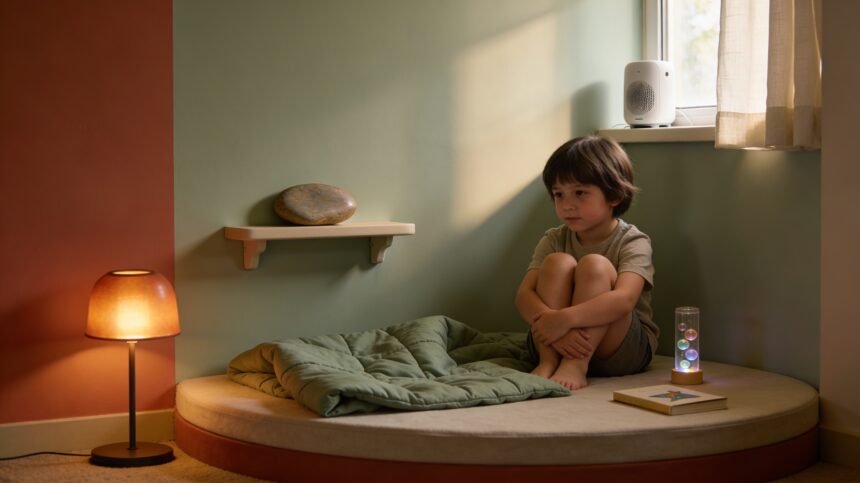
The sound of the TV blending with the hum of the refrigerator. The tag in a shirt collar that has been unbearable since 9 a.m. The overhead light that is technically fine and somehow also too much. A conversation happening in the next room while someone is trying to read. For a neurodivergent brain, the home that is supposed to be the quietest place can be the loudest, and when the sensory stack builds without relief, the whole household feels it. The meltdown, the shutdown, the snapping at someone who did not deserve it: all of these are what overload looks like after it has been running quietly for hours.
Building a sensory-friendly home does not require a renovation or an occupational therapist’s budget. It requires understanding what your household’s specific sensory triggers are and removing them one by one, starting with the places that cause the most friction.
Understanding the Sensory Stack
Sensory overload is cumulative. One buzzing light on its own is manageable. One buzzing light plus a scratchy couch cushion plus a loud notification sound plus the smell of whatever is cooking plus three people talking at once is a crisis. The brain has a threshold, and neurodivergent brains reach it faster and with less obvious input than neurotypical brains do.
The goal of sensory-friendly home design is not to eliminate all sensation. It is to reduce the background noise so the threshold is not perpetually hovering near its limit. A home that gives the sensory system regular relief throughout the day is one where meltdowns are less frequent, self-regulation is more available, and everyone has more bandwidth for the things that actually matter.
What clutter does to your body and mind speaks directly to this. Visual complexity is a sensory input that runs constantly and consumes attention even when you are not aware of it. A cluttered room is a louder room for a neurodivergent brain, which is why visual decluttering is often the fastest first step before anything structural changes.
Lighting: The Highest-Impact Change
Fluorescent lighting is one of the most consistently reported sensory triggers across autism, ADHD, and sensory processing differences. The subtle flicker, the color temperature, and the uniformity of fluorescent and harsh LED light keep the nervous system in a mild state of alertness that makes sustained calm difficult to reach.
The replacement is warm-toned, dimmable lighting throughout the home, especially in bedrooms and living spaces:
- Replace overhead fixtures with warm white bulbs (2700K to 3000K) that emit stable, flicker-free light
- Add dimmable lamps to every main living area so lighting intensity can be adjusted without overhead lights
- Use string lights or low LED strips in calm-down zones for an even softer light option
- Program smart lights to dim automatically in the evening as part of the wind-down routine
Smart lighting upgrades with no-drill installation make the full lighting overhaul possible for renters and anyone who cannot modify fixtures. A smart bulb in an existing lamp that dims on a schedule costs under fifteen dollars and makes a measurable difference in evening regulation for both children and adults.
Sound Management
Sound is the second most reported sensory challenge in neurodivergent households. Unlike lighting, you cannot turn off ambient sound entirely. But you can reduce it and create zones where predictable quiet is available.
Practical adjustments that make a real difference:
- Rugs on hard floors: Fabric surfaces absorb sound significantly. A rug in the living room and hallway reduces the echo and clatter that hard floors amplify
- Sound machine or white noise in bedrooms: Consistent background sound masks the unpredictable sounds from outside the room, the neighbor’s TV, the street, the hallway, that are often more disruptive than consistent noise
- Soft-sided storage bins: Hard plastic bins clang and rattle when used. Fabric bins eliminate that sound entirely during daily cleanup without any other change
- Door draft stoppers and weatherstripping: Reducing outside noise intrusion is often overlooked in sensory planning but makes a consistent difference in households near busy streets
The evening routine that stops sensory meltdowns is most effective when the physical environment supports it. A sound-reduced bedroom with warm lighting and a white noise machine is doing half the regulation work before the routine even begins.
Texture and Touch Throughout the Home
Tactile input is deeply personal and varies significantly between neurodivergent individuals. Some people need soft, smooth surfaces to feel regulated. Others need deep pressure input through weighted items. Some need varied textures for stimulation. The key is knowing your household members’ specific profiles rather than applying a one-size approach.
General principles that work broadly:
- Bedding and seating in natural fibers: Cotton, bamboo, and linen are softer against skin and more breathable than synthetic materials, which can feel scratchy or hot under sensory sensitivity
- Weighted blankets in calm zones: Consistent deep pressure calms the nervous system for most people with sensory processing differences and is one of the most evidence-supported sensory tools available
- Remove tags from everything: Tag removal is a small habit that eliminates a persistent daily irritant that can color an entire morning before it starts
- Couch and chair slipcovers in smooth fabrics: Rough upholstery textures can make sitting uncomfortable enough to increase baseline dysregulation over the course of an evening
The allergy-proof bedroom reset pairs naturally with sensory-friendly bedding choices since hypoallergenic materials are often also gentler against sensitive skin.
Creating Calm Zones
Every neurodivergent household benefits from at least one designated calm-down space: a corner, a closet, a specific chair, a nook under the stairs, any place that is consistently low stimulation and available when the sensory stack is getting high.
The calm zone is not a punishment space. It is a regulation resource. Framing it that way to children from the beginning changes how they use it. A child who goes to the calm corner voluntarily when they feel overloaded is self-regulating. A child sent there as a consequence is just isolated.
- Soft, dimmable or low lighting
- Minimal visual clutter, no busy patterns or bright colors
- One or two tactile comfort items: a weighted blanket, a smooth stone, a fidget tool
- A white noise machine or noise-canceling headphones if sound is the primary trigger
- A clear signal that it is theirs to use when they need it
DIY window film softens a corner by diffusing the light entering it without blocking the view, which works particularly well for calm corners near windows.
Organization for Neurodivergent Brains
Sensory-friendly home design and ADHD-friendly organization are deeply overlapping. Both require reducing the number of decisions a brain has to make in the environment, lowering the visual noise, and making the right action easier than the wrong one.
- Color-coded organization: Assigning each family member or category a color reduces cognitive load at storage time. Everything belonging to one child goes in the blue bin. No decision required
- Clear bins with large labels: Visible at a glance, scannable without opening, readable from across the room
- Consistent zones for everything: Items that wander between locations create low-level anxiety for neurodivergent brains that remember where things were yesterday and are now confused about why they moved
The doom fridge reset for sensory-friendly systems applies the same logic to the kitchen. The ADHD-friendly laundry system reduces the overwhelm of one of the highest-friction household tasks. The ADHD Kitchen Organization System That Actually Works goes deeper into the kitchen specifically, where sensory and executive function challenges tend to collide most often.
For Neurodivergent Couples
Shared homes where both partners have different sensory profiles require honest negotiation about what each person needs the home to feel like. One person’s relaxing ambient music is another’s constant background noise. One person’s cozy warm lighting is another’s too-dim strain.
The approach that works: each partner gets at least one space that is configured specifically for their sensory profile without compromise. The shared spaces are negotiated toward the lower-stimulation baseline, since it is easier to add stimulus than to escape one. Sharing the mental load of a neurodivergent household includes acknowledging that sensory accommodation is a real need, not a preference, and building the home around that honesty.
Sibling room-sharing zones bring the same negotiation framework to shared children’s rooms. Clear visual zone boundaries reduce the daily conflict about whose space is whose and give each child a sensory anchor in a shared environment.
A home that supports regulation is one where everyone has enough margin to be kind. That is not a small thing. That is the whole point.