




Home security gets sold like it has to be complicated. More apps. More subscriptions. More battery alerts. More devices that somehow make you feel less secure because now you are managing a whole second invisible household made of notifications and charging problems. I wanted something simpler. I wanted the house to feel safer without turning the maintenance of that safety into its own source of stress.
That is why solar-powered security is such a practical middle ground. It gives you a quieter, lower-maintenance way to strengthen the perimeter without adding one more set of batteries to remember, replace, or discover dead right when you need them. When the placement is good and the setup is thoughtful, solar sensors and lights can do a lot of quiet work in the background.
The first thing that matters is location. Solar devices are only as good as the light they receive. If you mount them in a spot that never gets decent charging, you are not building a sustainable system. You are building future annoyance. Entry points, side paths, garage approaches, and backyard access areas usually make the most sense, but the exact placement depends on how sunlight moves across your home through the day.
I like to think about security placement the same way I think about any smart home upgrade. It has to serve the actual rhythm of the household. Where do people approach from. Where do packages get dropped. Where is visibility weak. Where does the house feel darker or more exposed at night than it should. That practical approach connects really well with no-drill smart lighting upgrades for renters because both are really about reducing household friction with better light placement.
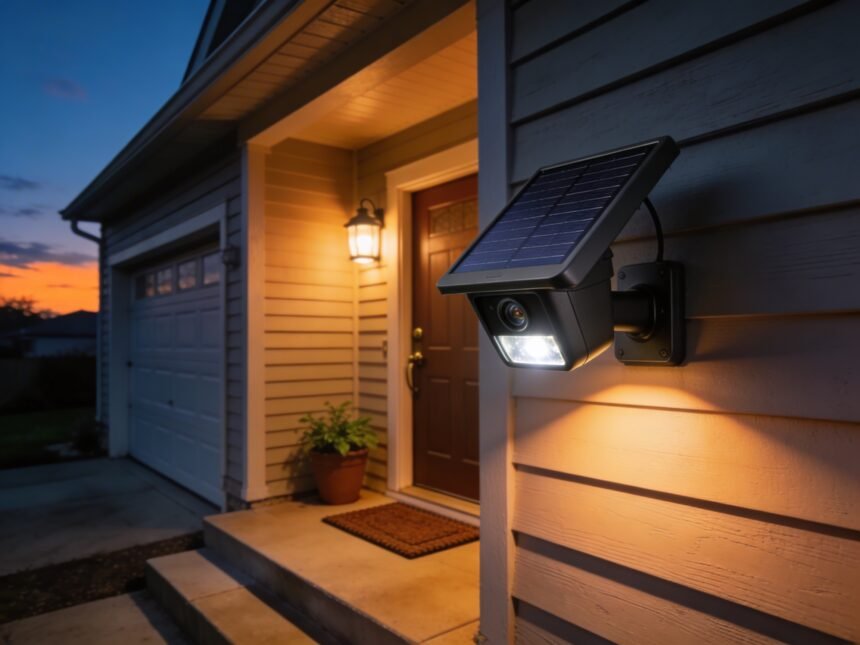
Solar-powered motion lights are usually the easiest win. They improve visibility, make movement more noticeable, and require far less ongoing maintenance than battery-dependent gadgets. Add a sensor or camera where it makes sense, and the setup becomes more useful without becoming a whole project-management job.
The sustainable part is not just the sun, though that helps. It is also the reduction in repeated battery waste, charger clutter, and dead-device surprises. I think people underestimate how much mental relief comes from a system that mostly takes care of itself. That same “set it up once, maintain it lightly” energy is why the low-effort humidity hack that stops hidden bathroom mold feels so good. Smart home improvements should lower mental load, not multiply it.
Maintenance still matters, of course. Solar panels need occasional wiping. Sensor angles need checking. Mounting points need to stay stable. But that kind of upkeep is pretty minimal, especially compared to the constant battery replacement cycle many people are stuck in with older security setups.
I also think solar security works best when it is integrated quietly rather than scattered impulsively. One device at the front entry, one by the driveway, one along a side path, one by a back gate, enough to create coverage without turning the exterior of the house into a tech experiment. The goal is reliable safety, not visual clutter.
Another thing that matters is realistic expectations. Solar-powered security lights are excellent for visibility and motion awareness, but they work best as part of a layered approach. Good locks still matter. Clear sight lines still matter. Knowing where your darker spots are still matters. Security gets more useful when it is thoughtful, not when it is flashy.
I also like how solar options fit into homes that are already trying to waste less and manage less. If you are paying attention to energy use, clutter, and simpler maintenance across the house, solar security feels like a natural extension of that mindset. It belongs with practical upgrades that quietly improve daily life, not with performative gadgets that make the house feel more complicated than before.
Placement around walkways and entry zones can also change how safe the home feels emotionally, not just technically. A well-lit side gate, a brighter porch approach, or a back path that no longer disappears into darkness after sunset can make the whole property feel more settled. That matters for families, for kids taking the trash out at night, for anyone coming home late, and honestly for peace of mind in general.
And yes, there is something satisfying about a home safety system that uses the environment intelligently instead of constantly demanding more stuff from you. Better light. Better visibility. Less battery stress. Less ongoing clutter. More trust that the house is paying attention at the edges while you get to focus on living inside it.
That is really the promise of a sustainable smart home at its best. Not endless gadgets. Just enough thoughtful support in the right places to make life feel steadier.