





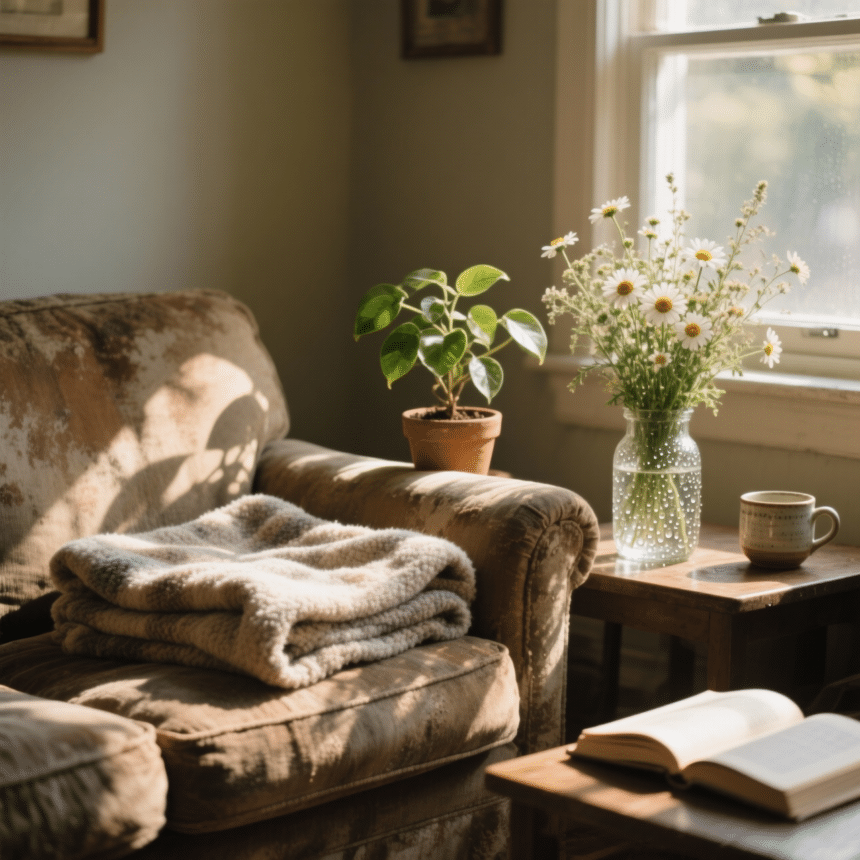
Spring home refresh ideas don’t have to carry the price tag that most home content makes you think they do. The transformations you see styled online are lit professionally, edited heavily, and often cost thousands before a single throw pillow lands in frame. The updates that actually make your home feel different on a random Thursday afternoon, when you walk in and just exhale instead of feeling your shoulders tense up, cost a fraction of that. And the effect, done right, is surprisingly close.
Start with light, because it’s the fastest and most overlooked lever in any room. Swap out any bulbs that have gone yellow or harsh for warm white LEDs in the 2700K to 3000K range. That cooler, bluish light that’s common in builder-grade fixtures feels clinical and flat. Warm white feels like evening and ease. Move floor lamps away from corners and position them near seating instead. If you have renters-grade overhead lighting that you can’t touch, a well-placed table lamp or plug-in wall sconce changes the feel of a room entirely for under $15. Smart lighting upgrades for renters with no drill required is worth looking at if your setup is restrictive, because there are genuinely good solutions available that don’t require a landlord’s permission or a drill.
Textiles are next. A $12 throw blanket draped over the arm of a couch immediately makes a room feel intentional rather than just functional. New throw pillow covers, not the pillows themselves, just the covers, can completely shift the color tone of a living room for under $20. This is one of the easiest seasonal swaps you can make. Swap out the heavy, darker covers from winter for something lighter, and the room literally reads as warmer weather. Also, wash the curtains. Most people never do this and curtains accumulate dust in a way that mutes a room’s color and makes the whole space feel heavier than it is. Clean curtains catch light differently and the difference is immediate.
Fresh flowers belong in this conversation because they work every single time without fail. Not a $40 grocery store arrangement. Just a $6 seasonal bunch cut short and dropped in a simple jar or a thrifted vase on the kitchen counter. The room feels lived in and cared for in a way that no amount of styling can replicate. It’s something small that, once you make it a habit, you notice immediately when it’s missing. If you want to take the plant thing further and do something that keeps growing and giving, vertical gardening in small spaces with indoor plants is a genuinely satisfying project that makes a wall or shelf feel like it belongs in your home rather than just in it.
Peel-and-stick solutions have improved dramatically and spring is the right time to tackle one of these if you’ve been sitting on the idea. Peel-and-stick backsplash for renters is one of the highest-impact, lowest-cost kitchen updates that exists right now. A few hours on a Saturday, no tools, no mess, and the kitchen looks genuinely different. The newer options have real texture and don’t bubble or peel the way earlier versions did. If you want to go room by room with this kind of update, peel-and-stick weekend makeovers under $100 has a broader range of options that are all renter-safe and reversible.
Cleaning the things you normally don’t clean is a free spring refresh and it works better than most paid updates. Wipe down baseboards. Clean the inside of the microwave. Polish the kitchen faucet and sink hardware. These are surfaces that collect grime slowly and go unnoticed until suddenly the kitchen just looks tired and you can’t figure out why. Spend 45 minutes on those overlooked spots and the room looks sharper without a single new purchase. Pair that with a proper spring cleaning checklist by room and you have a full reset plan that’s structured enough to actually finish.
Rearranging furniture is another free option that most people never try because moving things feels permanent even though it isn’t. Pull the sofa away from the wall by about 6 to 8 inches. It makes the room look styled rather than shoved into place. Try turning a chair toward the window instead of the TV for a secondary seating spot. It creates the illusion of a room with distinct zones, which is something designers charge a lot of money to do. In a smaller space, even rotating a rug slightly can change how the whole room reads. Before you spend anything on new decor, try moving what you already have. You might surprise yourself.
The entryway is one of the most impactful rooms to refresh because it sets the tone for your entire home and it’s usually one of the most neglected. A clear hook by the door, a small basket for shoes, a little mirror if the space allows it. That’s really all it takes for an entry to feel considered instead of chaotic. If yours currently doubles as a drop zone for backpacks, mail, and mystery items, the simple command center that keeps a family organized is a realistic model that doesn’t require a mudroom or any major installation.
Decluttering before you add anything new is non-negotiable as a spring refresh move. Cleared surfaces look bigger, cleaner, and more deliberate than any styling decision. When the visual noise is removed, what remains looks intentional. A room with 10 things displayed thoughtfully looks more expensive than a room with 40 things crowded together. What to declutter first for the biggest difference is the best starting point if you don’t know where to begin, because some removals make an instant visual impact and some don’t, and it helps to know the difference before you start pulling things off shelves. And if this whole house reset thing has been on your list for a while but never quite happens, The Broke Mom’s 30-Day Home Reset Guide moves through the whole house in a structured way that fits around a real schedule, not an imaginary one where you have eight free hours on a Saturday.
Scent is underrated as a refresh tool. It’s the first thing guests notice even before they see the room. A small wax melt or a $3 candle in a scent that reads as clean and light, linen, eucalyptus, citrus, makes a room feel fresher than it might actually be. This is especially useful in winter-heavy spaces that have been closed up for months and absorbed whatever they absorbed from cooking, pets, and daily life.
The honest advice is to start with one room, not the whole house. Pick the space you spend the most time in or the one that bothers you the most when you walk past it. Do the light. Wash the textiles. Clear the surfaces. Add one living thing. Move one piece of furniture. That’s a refresh that costs maybe $20 and an afternoon. Fixing builder-grade eyesores in a weekend takes this further if you want to tackle the things that have been quietly bothering you since you moved in. But the basics work, they cost almost nothing, and they’re available to you right now without waiting for the perfect day, the perfect budget, or the perfect version of your home.
Spring is the right time to look at your space with fresh eyes. Not to overhaul it, but to give it a little attention and let it give something back.