







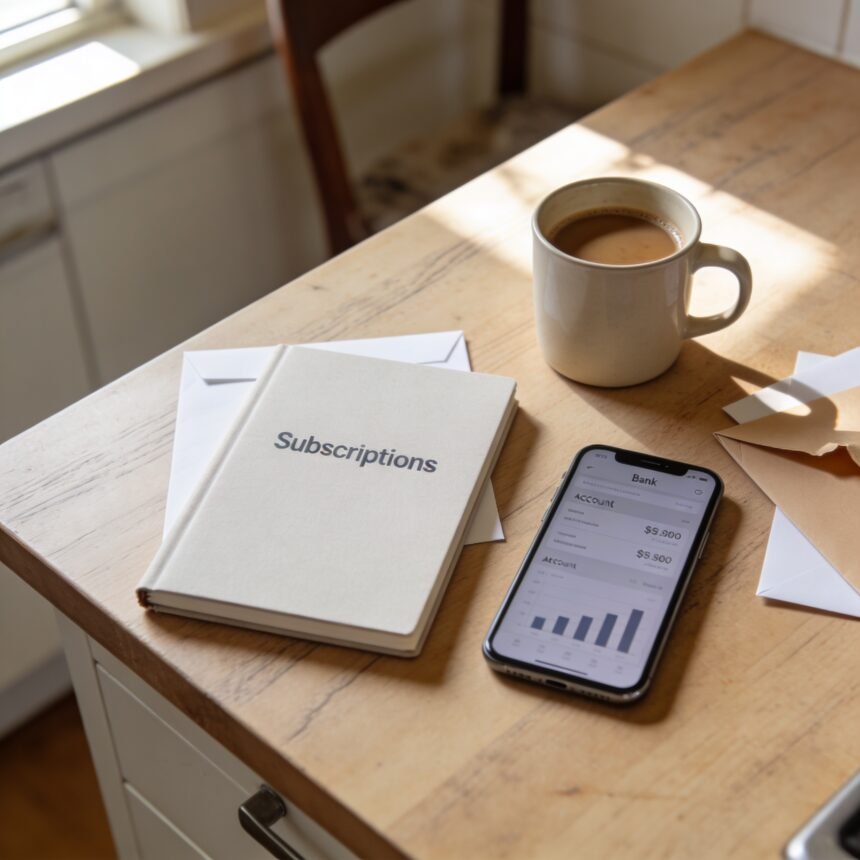
I found a subscription I didn’t remember signing up for.
- Why subscriptions are such a sneaky money problem
- The 30-minute subscription audit (simple, not dramatic)
- Step 1: Check your bank and card statements (where the truth lives)
- Step 2: Search your email for receipts and “welcome” emails
- Step 3: Check your phone subscriptions (Apple/Google)
- Step 4: Check PayPal recurring payments (people forget this one)
- Use this subscription audit template (copy it)
- The keep list rule (so you don’t overthink)
- Cancel scripts you can copy and paste
- Stop free trials from turning into surprise bills
- Do this today (10 minutes)
- What to do next after subscriptions
- FAQ
Not the obvious stuff like Netflix or Spotify. I mean one of those random charges with a name that sounds like a tech startup, and it hits your account like it’s been there forever. The amount wasn’t huge, but it was consistent. And that’s what made me mad. It wasn’t one bad day of spending. It was a silent leak, month after month, while I was trying to be “careful.”
So I did what most people do. I ignored it for a few weeks because life was loud and I didn’t have the energy to chase down a $9.99 mystery. Then I finally sat down, opened my statements, and found more. A couple were mine. A couple were “how did that even start?” One was a free trial that quietly became a paid plan while I was busy being a human.
That’s when I realized something: most people don’t have a “budget problem.” They have a visibility problem. Money is leaving in tiny predictable ways that are easy to miss until it starts feeling like you’re always behind.


If you feel like your money disappears but you can’t point to one big reason, do a subscription audit. This is one of the fastest “get money back” moves you can make without working extra hours or cutting your life down to rice and vibes.
And if you want proof this isn’t just you, read this one too: I found $127/month in subscriptions I forgot I had. That post is what finally made me stop pretending this was “not a big deal.”
Why subscriptions are such a sneaky money problem
Subscriptions are designed to feel harmless. They’re small amounts, spread out across the month, and they hit automatically. Your brain doesn’t register them as spending because the decision happened in the past. You signed up on a random day when you were tired, or curious, or just trying to solve a problem fast.
Then the subscription quietly renews when you’re focused on everything else. Bills, groceries, kids, work, life. Nobody wakes up excited to review recurring charges. That’s why subscription companies love recurring charges.
Also, the language around subscriptions is tricky. “Free trial.” “Cancel anytime.” “Start now.” It’s all framed like you can always handle it later. But later usually means you forget.
The goal here isn’t to cancel everything and live like a monk. The goal is to stop paying for things you don’t use and stop getting ambushed by renewals.
The 30-minute subscription audit (simple, not dramatic)
This is the plan. Do it once properly, and after that it’s a five-minute monthly routine.
What you need:
- Your bank app and credit card app
- Your email inbox
- Your phone subscriptions page (Apple/Google)
- A note (paper or Notes app)
Your goal: make one clean list of recurring charges and decide what stays.
Before we start, one important thing: don’t turn this into a shame spiral. This is not “look how dumb I was.” This is “I’m taking control.”
Step 1: Check your bank and card statements (where the truth lives)
Open your bank app and scan the last 30–60 days. If your bank has a filter for “recurring,” use it. If not, just scroll and look for patterns.
Look for:
- Charges that repeat monthly
- Charges that repeat yearly (these are painful because they’re bigger)
- Charges with weird names (parent companies)
- Small charges that started after a free trial
If you’re struggling to spot the patterns, this guide helps you think like a detective: how to find budget leaks when money keeps disappearing.
Quick tip: Don’t check just one account. If you have multiple cards, check them all. A lot of “forgotten” subscriptions hide on the card you rarely use because you signed up once and never touched it again.
Step 2: Search your email for receipts and “welcome” emails
Sometimes the subscription name on your bank statement is confusing. Your email usually shows the real brand name, the renewal date, and the plan type.
Search your email for these terms:
- receipt
- subscription
- trial
- renewal
- membership
- invoice
- welcome to
- payment successful
When you find one, copy the subscription name into your list. If you can’t find it in your bank statement, search for the billing descriptor too (some will show up under a different name).
Step 3: Check your phone subscriptions (Apple/Google)
This step catches subscriptions you don’t remember because they started as “just an app.”
iPhone: Settings → your name → Subscriptions
Android: Google Play → Payments & subscriptions → Subscriptions
Look for:
- Active subscriptions you haven’t used recently
- Annual renewals you forgot about
- Free trials with a future renewal date
Cancel what you don’t want. Most apps will still let you use the subscription until the end of the paid period, so you’re not “losing” anything. You’re just stopping the next charge.
Step 4: Check PayPal recurring payments (people forget this one)
If you’ve ever used PayPal to check out online, you may have recurring payments set up there. Even if you don’t remember doing it.
Go to PayPal → Settings → Payments → Manage automatic payments (wording varies).
Cancel anything you don’t recognize or don’t use. This one step alone has saved people real money.
Use this subscription audit template (copy it)
Paste this into Notes, Google Docs, or a notebook. The point is: one place where the truth lives.
| Subscription | Cost | Where billed | Last used | Keep / Cancel | Notes |
|---|---|---|---|---|---|
| Example: Streaming app | $12.99/mo | Visa ending 1234 | 2 months ago | Cancel | Cancel before 15th |
The keep list rule (so you don’t overthink)
Here’s my rule. It’s blunt, but it saves time:
If you haven’t used it in the last 14 days, cancel it or pause it.
You can always re-subscribe later if you truly miss it. But right now, if money is tight, you need your spending to be intentional.
If you want a bigger framework for this kind of decision-making, this one is worth reading: the brutally honest budget that finally worked for me. It’s not preachy, it’s realistic.
Cancel scripts you can copy and paste
You don’t owe a long explanation to cancel a subscription. Be clear, polite, direct.
Cancel message:
Hi, I’d like to cancel my subscription effective immediately. Please confirm the cancellation and that no further charges will occur. Thank you.
Refund request (recent charge, not used):
Hi, I was charged on (date) but I haven’t used the service. Can you refund the most recent charge or prorate the unused portion? I’m canceling today. Thank you.
Downgrade or pause request (if you still want it but cheaper):
Hi, I’m reducing monthly expenses. Do you offer a lower-cost plan or a pause option? If not, please cancel and confirm no further charges. Thank you.
Stop free trials from turning into surprise bills
This is the part that keeps you from repeating the cycle.
Pick one rule:
- Rule A: Cancel the trial immediately after signing up (you usually keep access until it ends).
- Rule B: Set a reminder for 2 days before renewal.
- Rule C: Use one dedicated “trial card” and keep it locked.
I prefer Rule A because it removes the fantasy of “future me will remember.” Future me is busy.
Do this today (10 minutes)
- Open your bank app and find 3 recurring charges
- Cancel 1 you haven’t used in the last 14 days
- Set 1 reminder for a free trial renewal
- Start your subscription list (even if it’s messy)
What to do next after subscriptions
Once subscriptions are handled, the next biggest leak for most people is online shopping. Not because you’re irresponsible, but because it’s too easy and it’s everywhere.
If Amazon is the main issue, start here: Amazon spending out of control? How to stop.
Subscriptions are quiet leaks. Shopping is the loud one. Handle both and your money starts feeling like it belongs to you again.
FAQ
What if I cancel and I need it later?
You can re-subscribe later. Canceling is not a lifetime decision. It’s a “not right now” decision.
What if the charge name doesn’t match the brand?
Search your email for receipts, then search that brand in your statement. If you still can’t identify it, call your bank and ask what merchant it’s tied to.
How often should I do this?
Once a month. Put it on your calendar. Five minutes once the first audit is done.











Have you checked for hidden charges lately? Click the link to make sure you’re not overpaying! #subscriptions #moneytips #CozyCornerDaily