





Every Pinterest cleaning schedule looks the same. Monday is bathroom day. Tuesday you tackle the kitchen. Wednesday means dusting. Thursday is for floors. By Friday you’re supposed to be caught up and ready for a relaxing weekend.
- Why Every Other Schedule Failed
- The System That Finally Worked
- The Daily Non-Negotiables (15 Minutes Total)
- Task 1: Kitchen Counter Reset (3 minutes)
- Task 2: Living Room Surface Sweep (3 minutes)
- Task 3: Entryway/Command Center (2 minutes)
- Task 4: One Load of Laundry (timing varies)
- Task 5: Bathroom Quick Wipe (4 minutes)
- Task 6: Before Bed Kitchen Check (3 minutes)
- The Weekly Rotation (Pick One Per Day)
- The “Worst Room First” Method
- What This Schedule Doesn’t Include
- How to Customize It for Your Life
- When Life Happens
- The Real Results After 6 Months
- Start With Just the Non-Negotiables
Sounds perfect, right? Except it never works. Your kid gets sick on Tuesday, so the kitchen doesn’t get cleaned. Now you’re behind. Wednesday rolls around and you’re still catching up from Tuesday, so dusting doesn’t happen. By Friday you’re stressed, behind schedule, and facing a weekend of catch-up cleaning instead of the relaxation you were promised.
That rigid system failed me at least a dozen times before I finally admitted it wasn’t going to work for real life. Real life doesn’t follow a preset schedule. Real life has sick kids, surprise work deadlines, Houston traffic that makes you late getting home, and days when you’re just too exhausted to care about dusting.
Here’s the flexible daily system that finally worked, even when life got messy.
Why Every Other Schedule Failed
The biggest problem with those Pinterest schedules is they’re too rigid. They assume every week looks the same and nothing unexpected ever happens. One missed day throws off the entire system, and suddenly you feel like a failure for not keeping up.
They also assign too many tasks per day. Deep cleaning the entire kitchen on Tuesday sounds reasonable until you remember you also have to make dinner, help with homework, do laundry, and handle whatever emergency pops up. The schedule doesn’t account for the fact that you have a life beyond cleaning.
Here’s a story from my friend Sarah, a Houston mom with three kids. She tried the Monday bathroom, Tuesday kitchen schedule and stuck with it for exactly one week. Week two, her youngest got strep throat on Monday. She spent Monday at the pediatrician, not cleaning bathrooms. Tuesday she was home with a sick kid, definitely not deep cleaning the kitchen. By Wednesday she felt so behind and guilty that she gave up entirely and didn’t clean anything for two weeks.
That all-or-nothing trap is real. If you can’t do it perfectly, you don’t do it at all. Then things get genuinely gross, you spend a whole Saturday catching up, and you swear you’ll stick to the schedule next week. Repeat forever.
The other issue is treating all tasks as equally important. Dusting the ceiling fan and wiping down the kitchen counter are both “cleaning,” but one matters way more for daily livability. Those schedules don’t differentiate between must-do maintenance and nice-to-have projects.
The System That Finally Worked
This system has three parts: daily non-negotiables, a weekly rotation, and permission to adjust. The daily non-negotiables happen every day no matter what. They take about 15 minutes total and keep your house at a baseline level of functional. The weekly rotation lets you tackle one bigger task per day, but you get to choose which one based on what actually needs attention. And permission to adjust means life happens and that’s okay.
The “worst room first” method handles the stuff that falls through the cracks. Every morning, identify which room looks the worst and spend 5 minutes there before doing anything else. This prevents any one area from becoming overwhelming.
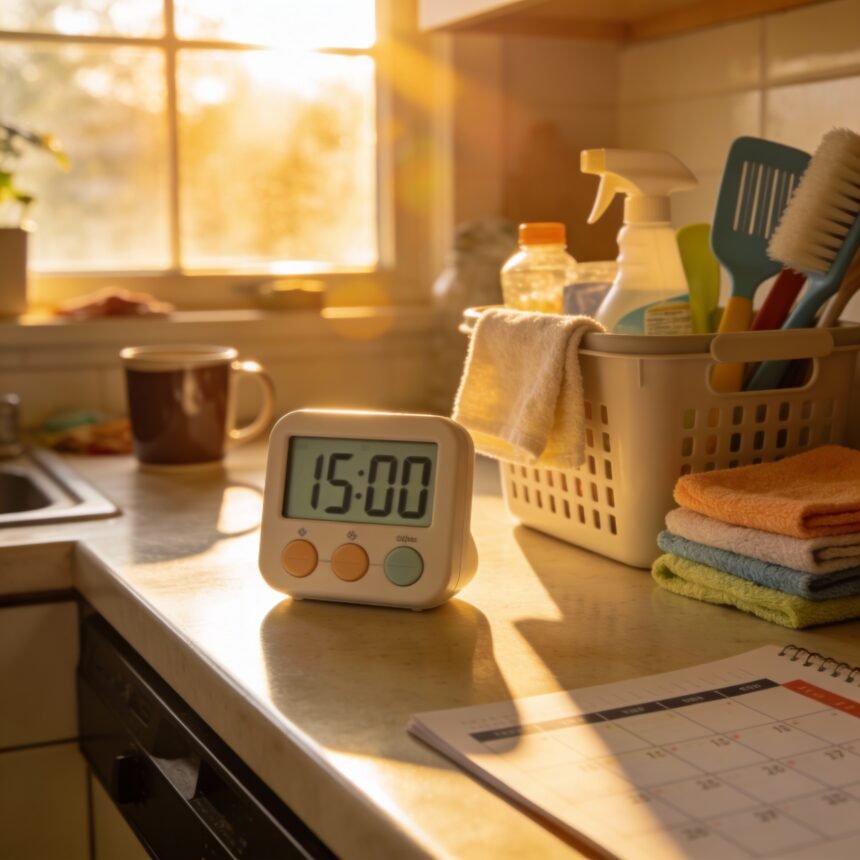
The 15-minute timer rule keeps you from falling into perfectionism or losing hours to cleaning. Set a timer. When it goes off, you’re done. Move on with your life.
Most importantly, you have permission to adjust. Sick kid? Do the bare minimum non-negotiables and skip the rotation task. Busy work week? Same thing. Weekend plans? Clean less, live more. The system flexes with your life instead of demanding your life flex around it.
The Daily Non-Negotiables (15 Minutes Total)
These six tasks happen every single day. They take 15 minutes combined if you stay focused, and they keep your house from descending into chaos. Even on your worst, most exhausted days, do these. Just these. Nothing else has to happen.
Task 1: Kitchen Counter Reset (3 minutes)
Clear everything off the counters. Put away food, stack dishes in the sink or load the dishwasher, wipe down all counter surfaces with Dawn dish soap and water using your OXO dish brush. Get the stovetop too if anything spilled.
Wipe down the sink. If it’s stained, sprinkle Bar Keeper’s Friend and scrub for 10 seconds. Rinse. The sink should be empty and the counters should be clear. That’s the reset point.
Load or unload the dishwasher depending on where you are in the cycle. If you don’t have a dishwasher, wash whatever dishes you can in the time you have and leave the rest to soak. Good enough.
A clear kitchen counter changes how the whole house feels. You can make breakfast, pack lunches, and cook dinner without moving piles of stuff first. This one task prevents kitchen chaos from spiraling.
Task 2: Living Room Surface Sweep (3 minutes)
Clear the coffee table of cups, remotes, mail, toys, and whatever else accumulated. Put things back where they belong or in a basket to deal with later. Fluff the couch cushions. Pick up any visible clutter from the floor and put it away.
If there are crumbs on the couch or floor, grab your handheld vacuum and suck them up. This takes 30 seconds and makes a huge difference.
The living room is usually the first thing you see when you come home and the space where you relax in the evening. Keeping it reset to neutral means you can actually relax instead of staring at mess.
Task 3: Entryway/Command Center (2 minutes)
Shoes go in the shoe basket or closet, not scattered by the door. Backpacks get hung up. Coats go on hooks. Mail gets sorted into the “deal with this” pile at your command center.
If you don’t have a command center yet, check out the simple command center that keeps our family organized. It’s basically a designated spot for all the paper, schedules, and stuff that flows in and out of your house.
The entryway sets the tone when you walk in the door. Tripping over shoes and backpacks first thing makes you feel like your house is out of control. Two minutes of putting things away prevents that.
Task 4: One Load of Laundry (timing varies)
Wash, dry, or fold one load. Never let laundry pile up to the point where you have six loads waiting. One load per day keeps it manageable. If you’re washing, move it to the dryer before bed. If you’re drying, fold it and put it away.
Keep a stash of microfiber cleaning cloths in rotation so you always have clean ones for your daily tasks. I wash mine with the regular laundry and they come out perfect.
Laundry doesn’t feel like cleaning, but staying on top of it prevents the Sunday night panic when you realize nobody has clean underwear for Monday.
Task 5: Bathroom Quick Wipe (4 minutes)
Wipe down the toilet (seat, lid, outside of bowl). Wipe the sink and counter. Quick mirror spot check, wipe if needed. That’s it. Four minutes.
This is the same system as how I clean my bathroom in 4 minutes step-by-step, which breaks down the exact process if you want more detail. The short version is: keep it simple, focus on the surfaces people actually touch, and do it daily so nothing gets gross.
Daily bathroom maintenance means guests can use your bathroom anytime without you panicking and doing a frantic pre-visit scrub.
Task 6: Before Bed Kitchen Check (3 minutes)
Right before you go to bed, do a final kitchen check. Counters should be clear. Sink should be empty or everything should be soaking for tomorrow. If the trash is full, take it out.
This is the same concept as the 5-minute kitchen reset that saves my mornings. You’re setting up tomorrow-you for success. Walking into a clean kitchen in the morning changes your entire day.
Coffee pot can be prepped if you drink coffee. Breakfast items can be set out so they’re easy to grab. The goal is waking up to a functional kitchen instead of last night’s disaster.
The Weekly Rotation (Pick One Per Day)
After your 15 minutes of daily non-negotiables, pick one deeper task from the weekly rotation. These take 10 to 15 minutes each. If you’re tired or busy, skip it. The daily non-negotiables already happened, so your house is functional. This is bonus credit.
Monday: Floors. Vacuum or sweep the main areas. Spot mop the kitchen if it needs it. Use your broom and dustpan set for quick sweeps. Fifteen minutes max. You’re not deep cleaning every corner, just hitting the high-traffic areas.
Tuesday: Bathrooms. Do the deeper version of the daily bathroom wipe. Scrub the shower with Bar Keeper’s Friend and a scrub brush. Wipe down bottles and products on the counter. Actually mop the floor instead of just spot cleaning.
Wednesday: Dusting. All surfaces, ceiling fans if needed, baseboards if you’re feeling ambitious. Use microfiber cloths slightly damp so they pick up dust instead of spreading it around. Fifteen minutes covers the main living areas.
Thursday: Kitchen Deep Clean. Wipe down appliances, clean the microwave (bowl of water with vinegar, microwave 5 minutes, wipe out), wipe cabinet fronts, scrub the sink with baking soda. The daily counter reset keeps the kitchen functional, but this tackles the stuff that builds up over time.
Friday: Catch-Up Day. Whatever got missed during the week, do it now. Or if everything’s done, take the day off. Seriously. If you did the daily non-negotiables all week, your house is already clean. Enjoy your Friday evening instead of cleaning.
Weekend: Optional Projects. Windows, organization, garage, whatever’s been bothering you. These are projects, not maintenance. Only do them if you want to and have time. The house is already clean from the daily system.
The “Worst Room First” Method
Every morning when you wake up, do a quick visual scan. Which room looks the worst? That’s where you spend 5 minutes before doing anything else. Just 5 minutes. Set a timer.
Pick up the visible clutter, wipe down surfaces if needed, and reset it to neutral. This prevents any room from getting so bad that it becomes overwhelming and you avoid it for weeks.
For me in Houston, it’s usually the playroom after school. Toys everywhere, backpacks dumped, papers scattered. Five minutes in the morning while my coffee brews, and it’s back to manageable. If I skip this, it becomes a disaster zone by the end of the week and takes an hour to fix.
What This Schedule Doesn’t Include
Deep organizing is not on this schedule. That’s a separate project you do when you feel like it, not a daily or weekly task. Same with decluttering. If your house is full of stuff you don’t need, cleaning schedules won’t fix that. Deal with the clutter first, then maintain with this schedule.
Seasonal cleaning happens quarterly. Washing windows, cleaning out the garage, flipping mattresses. Those are not daily or weekly tasks. They’re occasional projects.
The freedom in knowing what’s not on the list is huge. You’re not trying to deep clean and organize and declutter and maintain all at the same time. This schedule is just maintenance. Everything else is optional.
How to Customize It for Your Life
If you work from home, you might do the non-negotiables in the middle of the day during a break instead of all at once. That’s fine. The system flexes.
Stay-at-home parents might break the tasks up throughout the day, doing kitchen reset after breakfast and bathroom wipe after lunch. Whatever works for your rhythm.
Shift workers can do the non-negotiables whenever they’re home and awake. The specific time doesn’t matter. Consistency matters.
Two-working-parent households might split the tasks. One person does kitchen and living room, the other does bathroom and laundry. Teamwork makes it faster.
The point is the system works for your life, not the other way around. Adjust the timing, split the tasks, do them in a different order. Just do them.
When Life Happens
Sometimes you can’t do it all. Sick kids happen. Busy work weeks happen. Holidays mess up routines. That’s life.
On those days, do what you can. Maybe just the kitchen counter reset and bathroom wipe. Maybe nothing. It’s okay. The next morning, start again. No guilt, no drama, just start again.
The beauty of daily maintenance is you’re never more than one day behind. If you skip a day, you haven’t created a disaster. You’ve just got one day’s worth of mess to deal with. That’s manageable.
Compare that to skipping a whole week of the rigid Monday-bathroom-Tuesday-kitchen schedule. By the time you get back to it, everything is gross and you need hours to catch up. Daily maintenance prevents that cycle.
The Real Results After 6 Months
My house stays at a baseline level of clean all the time. Not perfect, not showroom ready, just clean enough that I’m not embarrassed if someone stops by and comfortable enough that I can relax at home.
I spend way less time on weekend catch-up cleaning. Saturdays used to be four-hour cleaning marathons. Now I might spend 30 minutes on a project if I feel like it, but I don’t have to. The house is already maintained from the daily system.
Unexpected guests don’t stress me out anymore. The daily non-negotiables mean the main areas are always presentable. I don’t need three days’ notice to make my house guest-ready.
The mental load dropped dramatically. I’m not carrying around a list of everything that needs to be cleaned. It’s getting done daily, so I can think about other things.
Total time investment: 15 minutes of non-negotiables daily equals 105 minutes per week. Add maybe 30 to 45 minutes of weekly rotation tasks if you do them all. That’s 2.5 hours per week max. I used to spend 4 hours every Saturday just catching up from the week. I’m saving at least 90 minutes weekly, and the house is cleaner.
Building this kind of daily habit changed my mornings too. Check out I tried every morning routine hack and here’s what actually stuck for how small consistent actions compound over time. The same principle applies to cleaning.
The money piece matters too. When you’re maintaining instead of deep cleaning, you use fewer products and replace things less often. The brutally honest budget that finally worked after I failed 12 times talks about how time savings translate to money savings when you’re not constantly buying emergency cleaning supplies or hiring help to catch up.
Start With Just the Non-Negotiables
Don’t try to implement the whole system at once. Start with just the daily non-negotiables. Do those for two weeks. Get them into your routine until they’re automatic. Then add the weekly rotation if you want to.
You might find the non-negotiables alone keep your house clean enough. That’s fine. The rotation tasks are optional. They make things nicer, but the daily maintenance does the real work.
Set your timer for 15 minutes. Do the six non-negotiable tasks. Stop when the timer goes off. That’s it. Do it again tomorrow.
Within a week, you’ll notice the difference. Within a month, you’ll wonder how you ever spent entire Saturdays cleaning when 15 minutes a day works better.
Consistency beats perfection. Every single time.
This post contains affiliate links, which means I may earn a small commission if you purchase through them at no extra cost to you.