








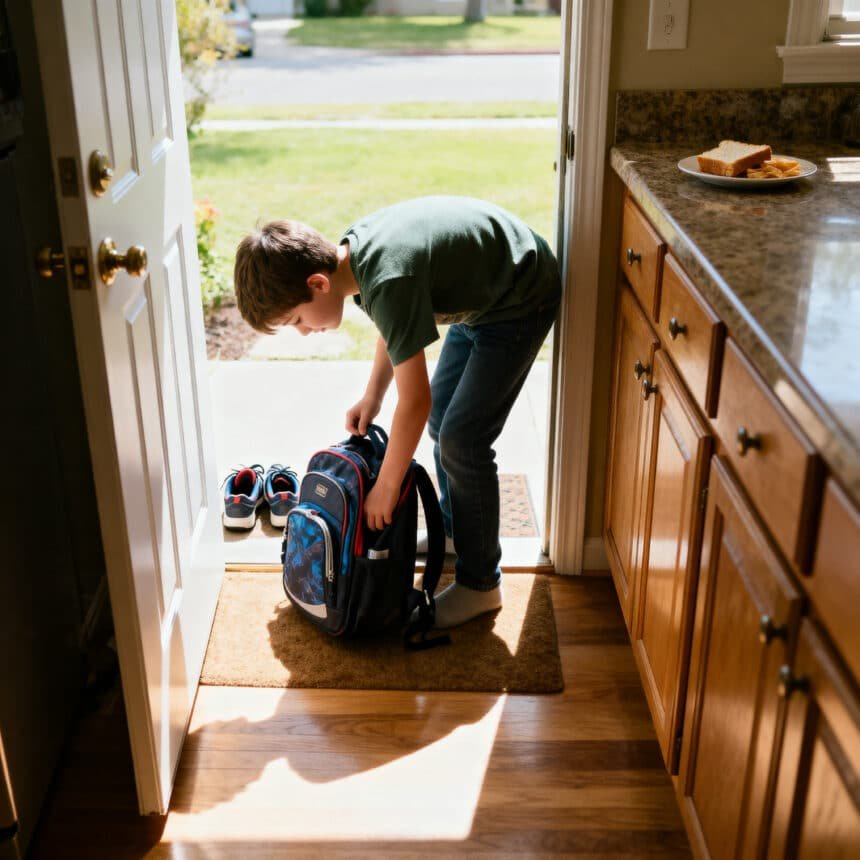
An after-school routine for kids sounds like something you establish once and it just works. And then reality shows up at 3:15pm and the backpack lands in the middle of the hallway, someone is crying about a worksheet, the snack cupboard gets raided, and by 4pm the whole house has a specific energy that makes dinner feel like a distant dream. If that sounds familiar, the problem isn’t your kids and it isn’t you. It’s the absence of a transition structure between school mode and home mode, and that gap is where the chaos lives.
Kids need a landing zone. Not a list of instructions taped to the wall that they’ll ignore after Day 2, but a physical and predictable sequence that becomes automatic over a few weeks. The first five minutes after they walk in the door matter more than most parents realize. That’s the window where things either decompress or escalate. And what happens in that window is almost entirely determined by what you’ve set up in advance rather than what you say in the moment.
The first step in any functional after-school routine is the transition snack. Not a negotiation, not a “what do you want,” just a snack that’s already out or obviously available when they walk in. Something with protein and a little carb, peanut butter on crackers, cheese and apple slices, a handful of nuts with some crackers. Blood sugar after school is genuinely low for most kids, and low blood sugar at 3pm looks exactly like a meltdown about nothing. It is not a meltdown about nothing. It is a child whose body needs fuel and whose brain is currently running on fumes after six hours of sitting still and focusing. Feed them first. Save the conversations and the homework check for after.
The backpack and shoes situation needs a designated spot that is not the middle of the hallway or the couch. This sounds like a small thing and it is, except that a bag dropped in a random location every single day turns into a hunt every morning and a visual mess that makes the entryway feel chaotic even when everything else is clean. A hook at kid height by the door, a basket on a low shelf, even a taped square on the floor with their name on it works for younger kids who respond to visual cues. The simple command center that keeps a family organized shows how to set this up practically without spending much, and it connects directly into the morning launch too. The two routines support each other, so fixing the afternoon often fixes the morning at the same time.
Give them 20 to 30 minutes of genuine downtime before anything gets asked of them. Not screen time necessarily, just decompression. Some kids need to talk through their whole day the second they walk in. Others need to sit quietly for 20 minutes and be left alone. Neither of those is wrong. The mistake is starting homework, chores, or any kind of demand during that first window because a kid who hasn’t decompressed yet is not a kid who can focus on fractions. Pushing homework immediately after school with an unrested brain is why the homework battles happen. It’s not defiance. It’s neuroscience.
Homework works best when it happens at the same time every day in the same spot. Doesn’t have to be a dedicated desk in a quiet room. The kitchen table works fine, and some kids actually do better with low background noise than in complete silence. What matters is the consistency. When homework happens at 4pm at the kitchen table every Monday through Thursday, it stops being a negotiation and starts being just what happens at 4pm. The routine removes the argument. The argument was never really about homework anyway. It was about transition and control. If your kid won’t do homework and nothing seems to work, the issue is almost always timing and environment, not motivation.
For kids with ADHD or those who struggle with transitions, the standard after-school routine needs more scaffolding but the same principles apply. Visual checklists posted at eye level, a timer for each segment of the routine, and a clear physical cue for when one phase ends and another begins make a significant difference. The ADHD-friendly laundry routine that actually gets done uses the same logic applied to household tasks, which is worth reading if you have a child or household member who struggles specifically with multi-step routines. The structure isn’t about control. It’s about reducing the number of decisions that have to be made in the moment.
After homework, kids need something to contribute to the household before the evening gets rolling. Not a punishment, not a chore list that feels like a second job, just one small task that belongs to them. Setting the table. Taking out the recycling. Wiping the bathroom counter. Something that takes five to ten minutes and is genuinely theirs to own. Kids who feel like they contribute to the home have an easier time following the rest of the routine without resentment because they have agency in it. It also makes getting kids to listen without yelling significantly easier, because kids who feel capable and contributing don’t dig in the same way.
The screen time piece deserves an honest take. It’s overused as a decompression tool and underused as a deliberate reward. When screens come on the moment a kid walks in the door, they function as sedation rather than rest, and prying them away an hour later for homework is a battle that nobody wins. Holding screens until after homework is done, or limiting the afternoon window to a defined time block, means screens become something that happens in the routine rather than something that derails it. Screen time rules that actually work covers this with more nuance than “just take the tablet away,” because anyone who’s tried the hard stop approach knows it doesn’t go well without a replacement structure in place.
Dinner prep and the after-school routine should overlap rather than compete. If you’re starting dinner at 5:30 and the kids are still doing homework or winding down from their day, that’s two things happening in parallel and both suffer. Batch cooking on weekends is one way to reduce this overlap. Sheet pan meals that feed a family under $25 and one-pot dinners for nights when you’re too tired to think are both built for exactly this scenario. Dinner that requires minimal active attention while everything else is happening gives the after-school window back to the kids instead of splitting your attention between homework help and not burning the rice.
The evening reset that follows all of this, the 20 minutes before bed when things get set up for morning, is the piece that makes or breaks the next day. Permission slips signed, bags packed, shoes by the door, tomorrow’s clothes laid out. The 5-minute evening reset routine that keeps the home functional is a quick read if you haven’t built this into your household yet. It sounds like extra work at the end of a long day but it cuts the morning chaos by more than half, and that tradeoff is absolutely worth it. The school morning routine that finally ended the chaos connects directly into this, because a good afternoon sets up a good morning and a good morning sets up a good afternoon. They’re the same loop, just running in different directions.
The after-school routine that holds up isn’t rigid. It has a skeleton, a predictable sequence of snack, decompression, homework, contribution, dinner, and reset, but it flexes for bad days and sports schedules and the occasional day when everything goes sideways by 3:20pm and you just order pizza and move on. Flexibility within structure is the goal, not perfection inside a schedule. The routine exists to reduce friction, not create a new kind of it.
When it works, it genuinely works. The house is calmer. The evenings feel longer. And somehow, you’re getting to 8pm without feeling like you fought a battle you didn’t sign up for.
For parenting books and resources on this topic, Amazon has a solid selection worth browsing.









What’s your go-to after-school activity? Check out this routine for a smoother evening! #ParentingTips #KidsActivities #CozyCornerDaily