







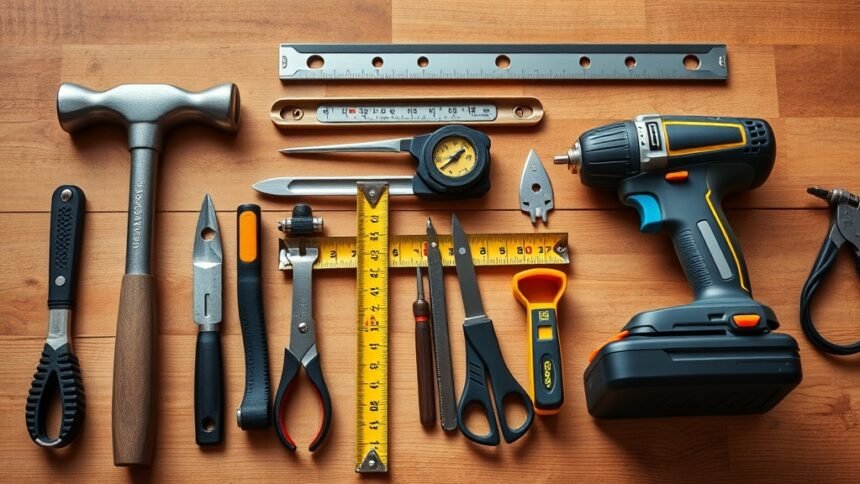
Buying a 200-piece tool kit where you use eight tools and the rest collect dust in the garage is one of the most common first-home purchases people regret. Those massive kits look impressive in the packaging, but half the contents are redundant sizes of the same tool and the other half are specialty items you will never touch unless you become a licensed electrician or decide to rebuild your deck from scratch.
The truth about a home tool kit for beginners is that six tools cover 95 percent of everything a homeowner needs to handle. Furniture assembly, hanging shelves, tightening loose hardware, minor repairs, picture hanging, and basic home maintenance. Everything beyond those six is a specialty purchase you buy when a specific project requires it, not before.
Tool One: A Cordless Drill (The Only Power Tool You Need)
A cordless drill with a driver bit set handles 80 percent of all home projects by itself. Assembling furniture from IKEA or Wayfair, driving screws into studs for shelf mounting, drilling pilot holes for wall anchors, and removing stripped screws that a manual screwdriver cannot budge. This is the one tool worth spending real money on because you will use it constantly.
Look for a 12V or 20V lithium-ion drill with variable speed and a built-in LED light. The 12V models are lighter and easier to handle in tight spaces. The 20V models have more power for harder materials. Either works for home use. Avoid the cheapest no-name options because battery life and chuck quality vary dramatically at the low end.
HOTO makes compact, well-designed tool sets that include a quality drill along with essential accessories in a case that actually fits in a closet. Their kits are built for people who need reliable tools without the bulk of a contractor’s toolbox. The design is clean enough that you will not mind keeping it in a visible spot.
Tool Two: A Hammer
A 16-ounce claw hammer covers everything from picture hanging to light demolition. The claw end pulls nails. The flat end drives them. You do not need a collection of hammers. You need one good one with a comfortable grip that does not vibrate your hand after ten swings.
Fiberglass handles absorb vibration better than wooden handles and will not crack over time. A rubber grip on the handle prevents slipping. The weight matters because anything under 12 ounces requires too many swings and anything over 20 ounces tires your arm for small projects. Sixteen ounces is the universal sweet spot.
Tool Three: A Measuring Tape
A 25-foot measuring tape with a locking mechanism covers every household measurement from curtain lengths to furniture placement to the space between studs. Get one with a belt clip because you will carry it around the house more often than you expect.
The hook at the end of the tape should move slightly. That is not a defect. It is designed to compensate for its own thickness whether you are pushing it against a surface or hooking it on an edge. If the hook is rigid, the tape is cheap and your measurements will be consistently off by 1/16 of an inch.
Tool Four: A Level
Nothing looks worse in a home than a crooked shelf, a tilted picture frame, or a cabinet that was installed by eyeballing it. A 24-inch torpedo level takes the guessing out of every mounting project. The bubble sits between the lines and the surface is level. That is it. Simple, effective, and it prevents the kind of mistakes that haunt you every time you walk past them.
Digital levels exist and they are fine, but the traditional bubble level requires no batteries, never needs calibrating, and works in any condition. For $10, a quality bubble level will outlast you. There is genuinely no reason to overcomplicate this one.
Tool Five: Screwdrivers
Two flathead screwdrivers (one small, one medium) and two Phillips screwdrivers (one small, one medium) cover nearly every screw you will encounter in a home. Light switch covers use small flathead. Cabinet hardware uses Phillips. Furniture assembly alternates between both depending on the manufacturer.
Magnetic tips are worth the extra dollar because they hold the screw in place while you position it, which is invaluable when you are working overhead or in tight spaces. A screw that drops behind a washing machine because your screwdriver did not hold it is a frustration that a magnetic tip eliminates entirely.
If you have been putting off shelving or wall-mounted storage because you did not have the right tools, these bedroom shelving ideas are specifically designed for the exact tool set described here.
Tool Six: Pliers
A standard pair of slip-joint pliers and a needle-nose pair handle gripping, bending, pulling, and holding anything that requires more force than fingers alone. Pulling nails that the hammer claw cannot reach, bending wire, tightening nuts that are too small for a wrench, and gripping bolts while you tighten the other side.
Needle-nose pliers are especially useful in tight spaces where standard pliers cannot fit. Inside electrical boxes, behind appliances, and inside small mechanical assemblies. Get a pair with a built-in wire cutter on the joint and you eliminate the need for a separate wire cutting tool in most situations.
The Next-Level Additions (When You Are Ready)
Once you have the foundation, three additional tools round out a complete home toolkit. A stud finder is essential before doing any wall-mounted project. Without it, you are guessing where the structural wood is behind the drywall, and guessing wrong means shelves that pull out of the wall under weight. A basic stud finder costs $15 to $25 and prevents hundreds of dollars in wall repair.
A utility knife with replaceable blades handles box opening, carpet trimming, wallpaper cutting, and dozens of other tasks that a kitchen knife should not be doing. A set of wall anchors in multiple sizes means you can hang anything on drywall without hunting for a stud, as long as the weight is within the anchor’s rating.
When your tools are assembled, this garage declutter method includes a section on tool storage that keeps everything accessible instead of buried in a box you forget about. If you are furnishing a home and need furniture that these basic tools can actually assemble, Tribesigns furniture is specifically designed for straightforward assembly with standard tools.
Store Everything in One Place
The most common reason people do not use their tools is because they cannot find them. A hammer in the kitchen junk drawer, a screwdriver in the bedroom nightstand, pliers somewhere in the garage. Tools scattered across multiple locations never get used because finding them takes longer than the actual project.
Designate one storage spot for your complete tool kit. A tool bag in a closet, a drawer in the garage, or a mounted pegboard on a wall. Everything goes back to the same place after every use. This sounds basic because it is basic, but it is the difference between a five-minute fix and a 20-minute search followed by a five-minute fix.
The Broke Mom 30-Day Home Reset includes a practical approach to organizing every room including tool and supply storage. It is $17 and it gives you a day-by-day structure so organizing does not become another project that stalls halfway through.
The kitchen organization guide uses the same one-location principle for cooking tools and supplies, and the family budget reset guide makes sure tool purchases fit within your actual spending plan instead of becoming impulse buys.
For the tools and materials needed for this project, Amazon has everything you need delivered to your door.














What essential tools do you think every beginner should start with? Check out the link for some great recommendations!