





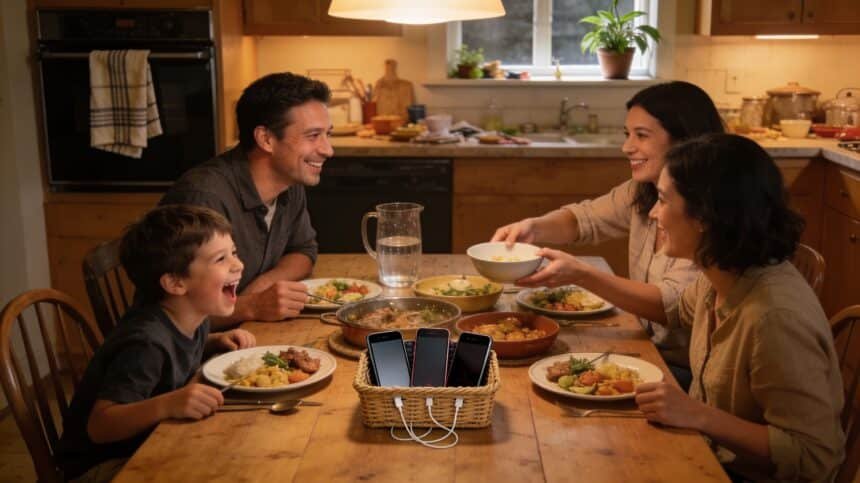
Dinner is technically happening. Everyone is at the table. The food is warm and there is plenty of it. But two people are watching something with one earbud in, one is mid-text, and nobody has made actual eye contact in six minutes. The meal ends and nobody remembers what anyone said. The devices did not break the family. The absence of a clear boundary around them did, and boundaries are the one thing families can build this weekend without spending a dollar.
Why the Usual Approach Fails
Most households that try to address screen time at home go straight to restriction: time limits, blocked apps, parental controls. Those tools have a place but they address the symptom rather than the underlying dynamic. A child who hits a screen time block without understanding why screens matter less than the dinner conversation learns to resent the limit, not respect it. A parent who enforces phone-free dinner while checking their own messages under the table teaches exactly the opposite lesson they intended.
The 2026 American Academy of Pediatrics guidance moved away from strict hour counts entirely and toward context and quality: is screen time replacing sleep, physical activity, or face-to-face connection? That reframe is useful for families because it shifts the question from how much to when and why, which is a conversation families can actually have together rather than a limit parents manage against resistance.
Research shows that families who eat together without screens have children with stronger communication skills, lower rates of behavioral problems, and better overall emotional regulation. The dinner table is not just a meal. It is a daily practice of noticing each other, and screens interrupt that practice in a way that quietly compounds over weeks and months.
The Central Charging Station
The most effective single change most families can make is a central charging station that lives outside the bedrooms. One location, usually the kitchen counter or a hallway shelf, where every device in the household charges overnight.
The rule is simple: after a set time each evening, all phones, tablets, and devices go to the station. Not just the kids’ devices. Everyone’s. The AAP specifically identifies device-free bedrooms as one of the most impactful changes for sleep quality in both children and adults. A phone charging on the nightstand is a phone that gets checked at 2 a.m. A phone in the kitchen is not.
For families with teenagers, co-creating this rule together rather than announcing it changes how it lands. A conversation about why the rule exists, what it protects, and what exceptions are reasonable produces far more compliance than a unilateral announcement. Teenagers who feel consulted are dramatically more likely to follow through than teenagers who feel managed.
Pair the charging station with the family media plan for 2026 to set written expectations around when, where, and how devices are used so the conversation happens once rather than nightly.
Defining Your Tech-Free Zones
Three zones work for most households without requiring a complete overhaul of daily life:
The dinner table: No devices during any shared meal. This applies to every family member including adults. A small basket at the center of the table, or a counter hook nearby, gives phones a physical home that is close enough to feel safe but far enough to be out of reach. Families who do this consistently report that conversations restart within a week, often awkwardly at first, and then naturally.
Bedrooms after a set hour: Devices leave the bedroom at a consistent time each night. For younger children, that might be when the bedtime routine starts. For teenagers, a reasonable starting point is thirty to sixty minutes before lights out. The evening routine that stops sensory meltdowns and low-energy evening rhythm for restful sleep both become easier to sustain once devices are not in the room competing for attention.
The morning window: A thirty-minute phone-free zone after waking up before anyone checks notifications protects the quality of the morning for the whole household. The back-to-school morning launch system runs more smoothly when the first thirty minutes are not spent reacting to overnight notifications before the household has found its footing.
The After-School Screen Agreement
The after-school window is where most family screen conflicts concentrate. Kids want to decompress with devices after a long school day, which is a legitimate need. Parents want homework done, the house in reasonable shape, and some form of connection before the evening disappears.
A clear agreement that maps the after-school sequence removes the daily negotiation:
- Snack and fifteen minutes of unstructured downtime, screens or not
- Homework or reading block with devices away
- Physical activity, outdoor time, or a household responsibility
- Earned screen time in a shared space, not a bedroom, until dinner
The screen-free after-school routine and the after-school routine that keeps the peace both build this kind of sequence into the afternoon in a way that reduces friction because the structure is predictable rather than negotiated daily.
Modeling the Boundary You Want
The single most consistent finding across every piece of research on family screen time is this: a parent’s screen behavior is the strongest predictor of a child’s screen behavior. Children who see parents consistently check phones during conversations, at meals, or during family activities absorb that as the household norm regardless of what the household rules say.
This is uncomfortable data for most adults because our own phone habits developed before we had children watching them. Acknowledging it honestly with your kids, including saying directly “I am working on this too,” is more effective than pretending the rule applies only to one direction in the household.
The screen time rules that actually work consistently share one feature: they apply to everyone. Not rules for kids that adults are exempt from. Shared standards that the whole household holds together.
Filling the Space Screens Occupied
The pushback most families encounter when reducing screen time is not defiance. It is boredom, and boredom is actually healthy. Children who learn to sit with unstructured time without immediately reaching for a device develop significantly stronger self-regulation and creativity over time. But the transition period requires some intentional filling of the space.
A few replacements that take hold quickly:
- Family board game night with games teens actually like gives everyone a compelling reason to be in the same room without a screen
- A household project undertaken together, cooking, a small DIY, a garden corner, creates shared focus and conversation naturally
- Physical activity after dinner, a walk, a backyard game, resets the evening energy in a way that screens never do
If child anxiety is part of the picture, reducing stimulating screen content before bed and replacing it with a calm, connected evening routine is one of the most evidence-supported interventions available, and it costs nothing beyond consistency.
When the System Gets Tested
Every family hits the weeks when the boundaries slip: a hard stretch at work, school stress, an illness that requires more screen accommodation than usual. The goal is not perfection. It is a default to return to.
The overstimulated mom evening reset is useful on the nights when the boundary held in theory but the evening still fell apart in practice. The 5-minute evening reset re-anchors the household before bed so tomorrow starts with more margin than today ended with.
For families that want a complete system for handling screen meltdowns and device boundaries with younger children, The Screen Time System That Actually Stops Meltdowns lays out the full framework without the battles.
A family that eats dinner together without phones, sleeps without devices in the bedroom, and has a shared understanding of when and why screens belong in the home is not a restrictive household. It is a household that decided what it values and built a structure around it. That structure is the boundary. And boundaries, held consistently, are how connection survives a hyperconnected world.