




Most families do not need stricter screen rules.
They need clearer ones.
That is the difference.
A lot of screen-time battles are not really about the screen itself. They are about randomness. One day the answer is yes. The next day it is no. Sometimes a tablet is fine during dinner prep, sometimes it starts a fight, sometimes nobody is sure what the rule even is anymore. That is when the whole thing starts feeling bigger than it should.
The American Academy of Pediatrics has been moving families away from the old idea that one magic number solves everything. Its current guidance focuses more on quality, context, conversation, and routines. HealthyChildren’s Family Media Plan tool encourages families to create rules that fit their own home, including screen-free zones, screen-free times, a “one screen at a time” rule, and turning off autoplay and notifications that make it harder to stop.
That approach makes a lot more sense in real life.
A family media plan for 2026 should start with the moments you want to protect.
Dinner is one. Homework is another. Bedtime is a big one. HealthyChildren specifically recommends screen-free times like the dinner table, homework, and before bed because those boundaries support face-to-face connection, learning, and sleep. So instead of starting with “how many hours,” start with “when do screens make our house worse?”
That question gets you somewhere useful fast.
For a lot of homes, the answer is that screens make the after-school window harder, not easier. They make transitions rougher. They make homework later. They turn quick breaks into long disappearances. That is why this topic sits so naturally beside screen-free after-school routine and afterschool routine that actually works. If the afternoon already feels fragile, adding unlimited screen drift rarely improves it.
The next thing I would put in a family media plan is where devices live.
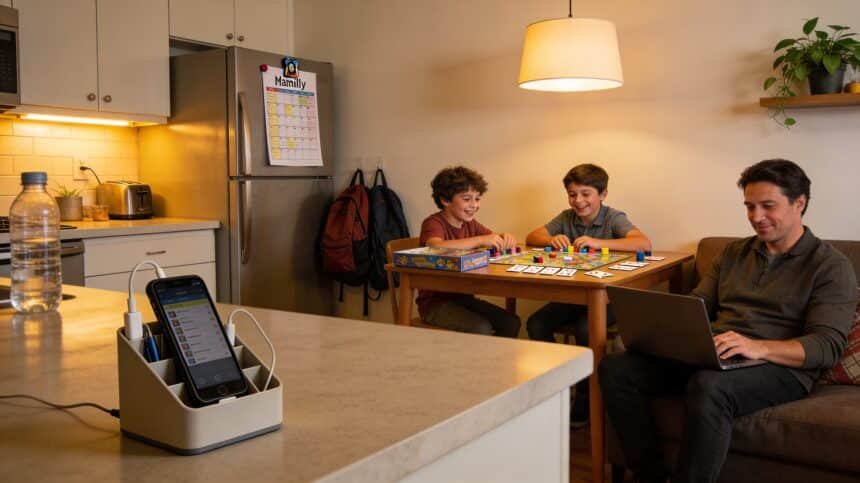
Not because you are trying to run a high-security facility, but because location changes behavior. If every device sleeps in bedrooms, screen use usually spreads later into the night. If devices charge in a shared space, bedtime gets cleaner. If the TV is always on in the background, attention gets chopped up all evening. A house can feel overstimulated without anybody realizing the screens are part of the reason.
HealthyChildren also recommends reducing distraction by keeping only one screen on at a time and turning off autoplay and nonessential notifications. I really like that advice because it is practical. It is not asking parents to become anti-technology philosophers. It is just saying, maybe do not let three devices shout at your family at once.
Another smart part of a 2026 media plan is making the rules apply to grown-ups too.
That matters more than people want it to. Kids notice fast when the official family rule is “put your device away” while one adult is still half-scrolling through dinner. HealthyChildren keeps stressing that this is a family plan, not just a kid plan, and its newer guidance says the goal is balance, not banning screens altogether.
That makes the tone of the plan important.
A good media plan should sound like a house trying to function, not a house declaring war.
You do not need twelve complicated rules. You probably need five clear ones. For example: no phones at meals, no screens during homework, devices charge in the kitchen at night, one screen at a time, and weekend screen use happens after responsibilities are done. That is enough to change a lot without making the whole house feel tense.
If your kids are younger, the plan may need more visible cues. A printed schedule. A charging basket. A simple phrase everybody knows. If your kids are older, the plan may need more conversation. What apps pull you in? What makes it hard to stop? What time do devices need to be parked so sleep does not get wrecked? HealthyChildren’s newer “5 C’s” guidance is built around age-based media conversations and emphasizes what supports relationships, development, and mental health, not just raw screen totals.
I also think media plans work better when there is something else ready to happen.
Not an elaborate craft closet. Just alternatives. Board games, outside time, music, coloring, basketball, reading, Lego, helping with dinner, even plain old boredom. A lot of families want less screen friction but never build the bridge to what comes next. That is where the plan falls apart.
If your house is already trying to calm overstimulation or reduce evening chaos, this also connects nicely with screen time rules that actually work, reduce kids screen time without meltdowns, and the screen time system that actually stops meltdowns. The main thing is not making the rules sound impressive. It is making them repeatable enough to survive a normal Tuesday.
That is what a good family media plan really is.
A small set of decisions made before the argument starts.
And honestly, that is why it works.