








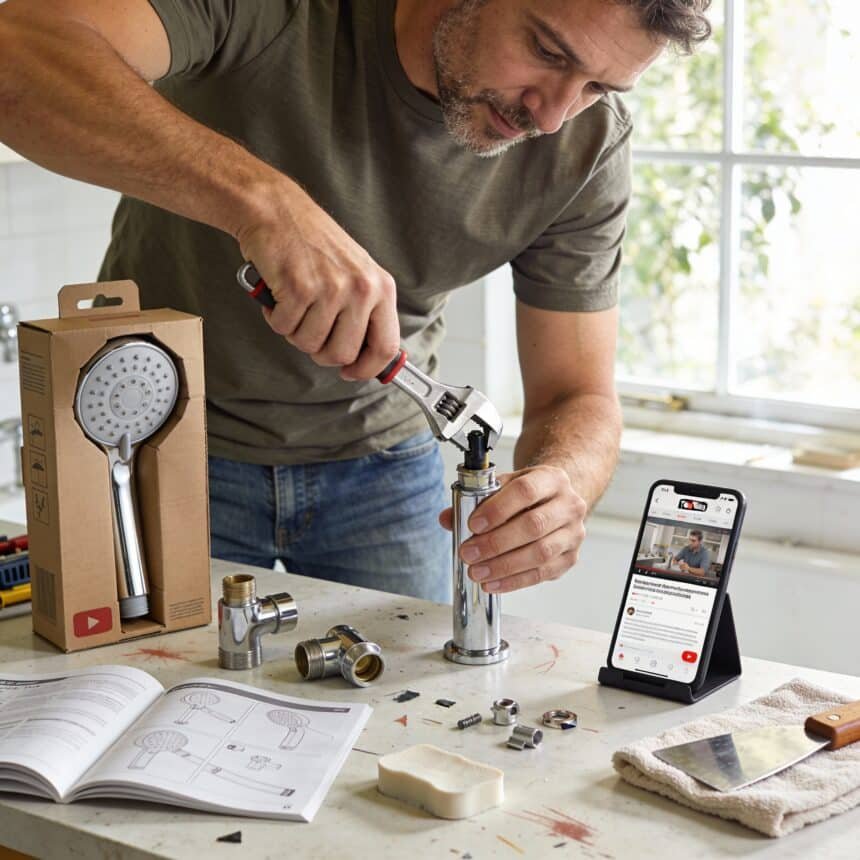
I used to think you needed some kind of special training or natural talent to fix things around the house. Like you were either handy or you weren’t, and I definitely wasn’t. So every time something broke or needed replacing, I’d call someone to come fix it and pay whatever they charged because I had no other option.
Then one day my kitchen faucet started dripping. Not a major emergency, but annoying enough that I knew I needed to deal with it. I called a plumber to get a quote, and he said it would be $150 just for the service call, plus parts and labor. For a leaky faucet.
I hung up and thought “there has to be a cheaper way to do this.” So I did what any millennial does when they don’t know how to do something. I went to YouTube and typed in “how to fix a leaky kitchen faucet.”
Turns out, it’s not that hard. There were like 50 videos showing exactly how to do it, step by step. I watched three of them, went to the hardware store, bought a $12 replacement cartridge, and fixed it myself in about 20 minutes.
That was the moment I realized I’d been wasting money for years paying people to do things I could absolutely do myself. I’m not talking about major renovations or anything that requires a licensed electrician. But there are so many basic home repairs that are genuinely simple if someone just shows you how to do them.
Here are the five things I’ve learned to fix myself, how much I saved, and why they’re way easier than you think.
1. Replacing a Toilet Flapper ($120 Saved)
My toilet was running constantly. Like I could hear water trickling into the bowl 24/7, which meant my water bill was higher than it should be. I assumed this was going to be an expensive plumbing issue.
I called a plumber and described the problem. He said “it’s probably just the flapper. I can come fix it for $120.” I asked what a flapper was. He said it’s a rubber piece inside the tank that seals the flush valve, and they wear out over time.
So instead of paying him $120, I went to YouTube. Searched “how to replace toilet flapper.” Watched one seven-minute video. Went to Home Depot and bought a universal flapper kit for $8. Came home, turned off the water supply to the toilet, took off the tank lid, removed the old flapper, snapped the new one in place, turned the water back on. Total time: 15 minutes.
It was so easy I genuinely couldn’t believe I’d been prepared to pay someone $120 to do it. The hardest part was figuring out which flapper to buy, but the guy at the hardware store helped me with that.
If you’re new to DIY repairs and feeling overwhelmed, I wrote about five home repairs I finally learned to do myself. It’s got more detailed instructions and confidence-building tips for people who’ve never done this stuff before.
2. Installing a New Showerhead ($80 Saved)
Our old showerhead had terrible water pressure and was kind of gross-looking. I wanted to replace it but assumed I’d need a plumber because anything involving water pipes sounded complicated.
Turns out, installing a showerhead is one of the easiest home improvements you can do. You literally just unscrew the old one and screw the new one on. That’s it. You don’t need any tools. Just your hands.
I watched a three-minute YouTube video to make sure I wasn’t missing anything. Then I went to Target, bought a $25 handheld showerhead I’d been eyeing for months, came home, unscrewed the old showerhead by twisting it counterclockwise, wrapped some plumber’s tape around the threads on the pipe (this came with the new showerhead), and screwed the new one on clockwise until it was tight.
The whole thing took maybe five minutes. A plumber would have charged me at least $80 for a service call plus installation. I did it for free and now I have a showerhead I actually like.
Actually, if you want the full step-by-step for this specific project, I wrote a guide on how to install a handheld showerhead yourself without calling a plumber. It walks you through every single step with pictures.
3. Patching Drywall Holes ($150 Saved)
We had a couple of holes in our walls from where we’d removed old picture hooks and shelves. They weren’t huge, but they were noticeable, and I assumed fixing them would require hiring someone who knew what they were doing.
I got a quote from a handyman. $150 to patch three small holes and paint over them. That seemed insane for something so minor, so I decided to try it myself.
YouTube taught me everything I needed to know. For small holes (anything smaller than a quarter), you just need spackle, a putty knife, and sandpaper. You fill the hole with spackle, let it dry, sand it smooth, and paint over it. For slightly bigger holes, you use a mesh patch before applying the spackle.
I bought a small container of spackle and a putty knife for about $10 total. Fixed all three holes in under an hour, including drying time. Once I painted over them, you couldn’t even tell they’d been there.
This is one of those repairs that sounds intimidating but is actually incredibly straightforward. The key is just being patient and letting each layer dry before you sand and paint.
4. Replacing Cabinet Hardware ($100 Saved)
Our kitchen cabinet handles were old and dated. I wanted to update them, but I thought I’d need someone to do it properly so the holes would line up and everything would look even.
A handyman quoted me $100 to replace all the hardware. Which seemed ridiculous for something that just involves unscrewing old handles and screwing in new ones. So I watched a YouTube video to see if there was some secret technique I was missing.
There wasn’t. You literally just unscrew the old hardware from the inside of the cabinet, line up the new hardware with the existing holes, and screw it in. The only trick is making sure the new hardware has the same hole spacing as the old stuff, or you’ll have to drill new holes.
I measured the distance between the screw holes on our old handles, went to Home Depot, found new handles with the same spacing, and replaced all of them in about 30 minutes. Cost me $40 for the new hardware instead of $140 to have someone else do it.
This is probably the easiest DIY project on this list. If you can use a screwdriver, you can replace cabinet hardware.
5. Fixing a Running Toilet (Again) ($250 Saved)
A few months after I fixed the flapper issue, a different toilet in our house started running. But this time it wasn’t the flapper. It was the fill valve, which is the tall thing inside the tank that controls the water level.
I knew enough by this point to at least try troubleshooting it myself before calling anyone. Watched a few YouTube videos about running toilets, figured out it was the fill valve, bought a replacement kit for $15 at Lowe’s, and installed it following the video instructions.
This one was slightly more involved than the flapper because you have to disconnect the water supply line and remove the old valve. But it still only took about 30 minutes, and the instructions that came with the new valve were pretty clear.
A plumber would have charged me at least $250 for this because it’s a slightly more technical repair. But honestly, if you can follow step-by-step instructions, you can do it.
If you’re dealing with a bathroom that needs some TLC, I also wrote about a grout-cleaning hack that saved me $500 on a bathroom renovation. Sometimes you don’t even need to replace things, you just need to clean them properly.
What I Learned About DIY Home Repairs
The biggest thing I learned is that most “handyman” tasks aren’t actually that complicated. They just seem complicated because nobody ever taught us how to do them. Once you watch someone walk through it step by step, you realize it’s usually just a matter of following instructions and having the right tools.
The second thing I learned is that YouTube is an incredible resource. There are detailed tutorials for literally everything. I’m talking close-up shots, slow motion, multiple angles. It’s way better than trying to figure it out from written instructions alone.
The third thing is that hardware store employees are usually really helpful. I was intimidated at first to even ask questions because I thought they’d judge me for not knowing basic stuff. But every time I’ve asked for help finding the right part or understanding which product to use, they’ve been patient and knowledgeable.
The fourth thing, and this is important, is that not everything should be a DIY project. I’m not messing with anything involving gas lines, electrical panels, or major plumbing. Those things require professionals for safety and legal reasons. But replacing a faucet cartridge or fixing a running toilet? Those are absolutely doable for a beginner.
How to Start if You’ve Never Done DIY Before
If you’ve never attempted any home repairs and you’re nervous about trying, start with something small and low-stakes. Replacing a showerhead is perfect because it’s genuinely hard to mess up. You’re just screwing and unscrewing. If something goes wrong, you can always screw the old one back on and call a professional.
Watch multiple YouTube videos before you start so you understand the whole process. I usually watch at least three different people do the same repair so I can see different approaches and troubleshooting tips.
Buy the right tools ahead of time. A basic toolkit with a hammer, screwdrivers, pliers, and a wrench will cover most beginner repairs. You can get a decent set for like $30.
Don’t be afraid to ask for help at the hardware store. Bring a picture of what you’re trying to fix if you’re not sure what part you need.
And honestly, give yourself permission to fail. The worst case scenario is you can’t figure it out and you have to call a professional anyway. You’re not worse off than you would have been if you’d just called them in the first place. But most of the time, you’ll figure it out and save yourself a bunch of money.
If you’re looking for more beginner-friendly DIY projects that make a big impact, I wrote about learning new skills at 35 and what actually worked. It’s more about the mindset shift than the specific skills.
How Much I’ve Saved So Far
Since I started doing these repairs myself instead of calling professionals, I’ve saved at least $800. Probably more, because there have been other small fixes I’ve done that I didn’t even think to calculate.
But honestly, the money isn’t even the biggest benefit. The biggest benefit is feeling capable. Knowing that when something breaks, I don’t have to immediately panic and call someone. I can at least try to fix it myself first. That sense of competence and self-reliance is worth way more than $800.
I’m also teaching my kids that fixing things is a normal life skill, not some specialized talent only certain people have. They’ve watched me replace faucets and patch drywall, and they’re learning that you can figure out how to do most things if you’re willing to try.
So if you’ve been putting off small repairs because you think you’re not handy enough or because you’re intimidated by the process, I’m telling you: you can do this. Start small. Watch some videos. Buy the parts. Give it a shot. The worst thing that happens is you learn something new. The best thing that happens is you save hundreds of dollars and feel like a total badass.
Your house doesn’t have to fall apart just because you weren’t born knowing how to fix things. Neither was I. But YouTube taught me, and it can teach you too.











What home repair tricks have you picked up from YouTube? You’d be surprised how much you can save! Check out the link for some ideas. #DIY #HomeRepairs #SaveMoney #YouTubeHacks #CozyCornerDaily