


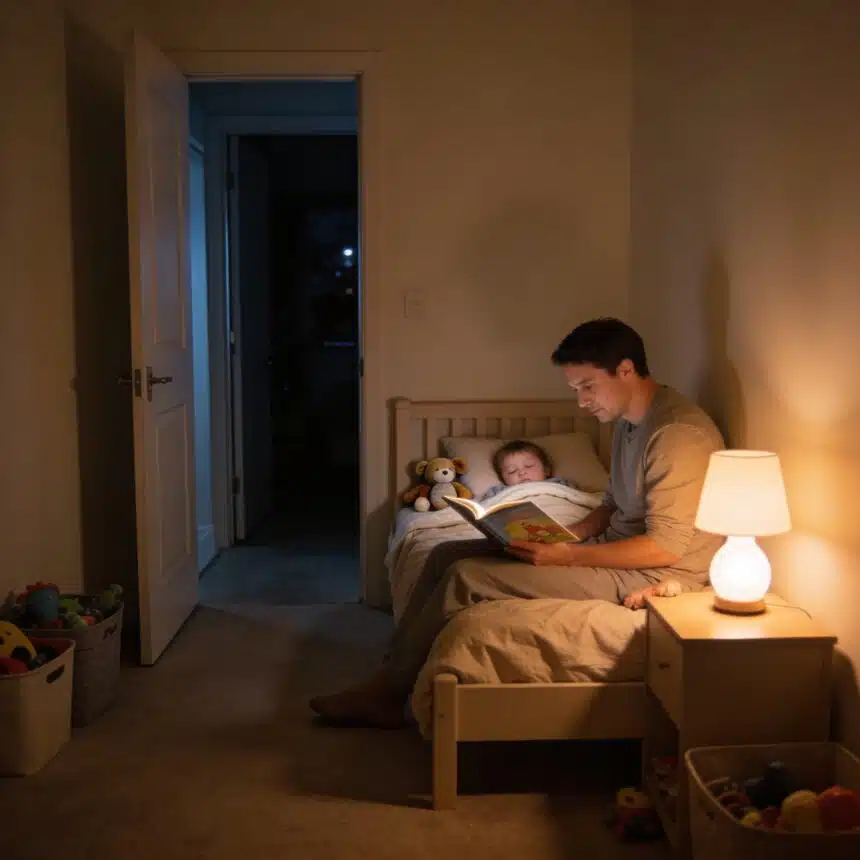
How to Get Your Toddler to Sleep in Their Own Bed (Without Crying All Night)
There’s nothing like waking up at 3 a.m. with a tiny foot in your ribcage and a Paw Patrol plush jammed into your neck and thinking, “How did we get here again?”
- How to Get Your Toddler to Sleep in Their Own Bed (Without Crying All Night)
- Step 1: Decide your “good enough” sleep goal
- Step 2: Make their bed somewhere they actually want to be
- Step 3: Build a simple, repeatable bedtime routine
- Step 4: Start with “fall asleep in your bed,” not “stay there all night”
- Step 5: Use “stay close” strategies instead of disappearing
- Step 6: Handle middle‑of‑the‑night visits with one simple rule
- Step 7: Deal with fear and bedtime stalling head‑on
- Step 8: Expect pushback and don’t panic when it happens
- Step 9: Protect your own sleep and sanity too
- It won’t be perfect, but it will get better
You swear you put your toddler in their own bed. You did the whole bedtime routine. But at some point in the night, you hear those little footsteps or just wake up and there they are, starfished across your pillow like they pay the mortgage.
If you’re tired of sharing your bed but you also don’t want to traumatize your kid with some harsh sleep training method, this is for you.
I’m going to walk through a gentle, realistic way to move your toddler into their own bed that doesn’t require you to be a robot, doesn’t ignore their feelings, and doesn’t end with everyone in tears every night.
Step 1: Decide your “good enough” sleep goal
Before you start, get clear on what you actually want.
Do you want:
- Your toddler falling asleep in their own bed but you’re okay with them coming in at 5 a.m.?
- Them sleeping the whole night in their bed most nights?
- Or just moving out of your bed but still in your room for now?
There’s no one “right” answer. For us, the first goal was simply “fall asleep in your bed, not on my pillow.” Once that was solid, we worked on fewer middle‑of‑the‑night visits.
Be honest about your season. If you’re deep in survival mode, like barely keeping up with dishes and relying on a 15‑minute cleaning routine to keep your house from falling apart, maybe your first win is just starting bedtime in their room. That’s still progress.
Step 2: Make their bed somewhere they actually want to be
If your toddler’s bed feels like punishment (“you sleep here because you’re being difficult”), of course they’re going to sprint back to your bed at the first chance.
You don’t have to go full Pinterest, but you do want cozy and inviting.
Think about:
- Soft bedding they helped pick (dinosaurs, stars, whatever they’re into)
- One or two favorite stuffed animals, not a whole zoo
- A small pillow if your pediatrician says they’re old enough
- A simple night light so the room doesn’t feel scary


Let them help set it up during the day, not five minutes before bedtime when everyone is tired. Toddlers buy into what they helped create. It’s the same principle that makes simple command centers work so well for families – if they helped make it, they’re more likely to use it.
Step 3: Build a simple, repeatable bedtime routine
Toddler sleep gets way easier when bedtime is boring and predictable.
Your routine doesn’t have to be complicated, but it does need to be the same most nights.
Example:
- Bath or quick wipe‑down
- Pajamas and teeth
- One snack or sip of water (then kitchen “closed”)
- Two books
- Lights down, night light on, snuggle and song
- Into bed with the same phrase every night (“It’s time for sleep. I’ll see you in the morning.”)
The magic is in the repetition. After a couple weeks, their body starts recognizing the pattern and winding down faster, kind of like how my whole house started calming down once I added a 10‑minute closing shift at night.
If mornings are chaos too, pairing this with your school morning routine that finally ended the chaos gives the whole day a stronger rhythm. Toddlers love knowing what comes next, even if they pretend they don’t.
Step 4: Start with “fall asleep in your bed,” not “stay there all night”
This is a big mindset shift that takes the pressure down for everyone.
Your first goal: they fall asleep in their bed, in their room. That’s it.
If they show up at 1 a.m. the first few nights, you don’t have to declare the whole experiment a failure. You can walk them back a few times if you’ve got the energy, or you can decide “for now, we’re practicing falling asleep in your bed and we’ll deal with middle‑of‑the‑night later.”
The more they practice falling asleep in that space, the easier it is to stretch the rest.
If bedtime is full of tears, remember the same idea from handling toddler tantrums without losing your mind: you can be firm about the boundary and still gentle about the feelings.
Step 5: Use “stay close” strategies instead of disappearing
A lot of toddlers lose it when you try to leave the room immediately. The fix isn’t to lay there all night with them forever. It’s to use small step‑downs.
Some options:
The sit‑by‑the‑bed method
Night 1–3: sit on the bed next to them while they fall asleep.
Night 4–6: sit on a chair next to the bed.
Night 7–9: move the chair a little closer to the door.
Eventually: you’re sitting just outside the door or doing quick check‑ins.
The check‑in method
You tell them, “I’m going to switch the laundry, I’ll come back and check on you in two minutes.” Then you actually come back. Slowly lengthen the time. This is especially good if you’re also trying to keep up with simple evening chores so mornings aren’t a disaster.
The goal is to show them they’re safe, you’re nearby, and you always come back, without turning yourself into a human mattress.



Step 6: Handle middle‑of‑the‑night visits with one simple rule
Toddlers are persistent. Once they realize they can get to your bed, they will test that walkway a hundred times.
Pick a simple, repeatable rule and stick with it.
Examples:
- “If you wake up, I’ll come to your room, but you sleep in your bed.”
- “You can sleep on a little floor bed next to my bed if you’re scared, but not in my bed.”
- “If you come to my room, I’ll walk you back to yours every time.”
And then the hardest part: follow through consistently.
You already know from getting kids to listen without yelling that follow‑through is where the magic is. Same with sleep. If you say “you sleep in your bed” and then at 2 a.m. you cave half the time, they learn “oh, I just have to keep trying.”
You can absolutely pick a gentler version in the short term (like the floor bed compromise) while you’re exhausted, then tighten the boundary later. The key is that whatever rule you choose, you stick with it for at least a couple weeks so they’re not confused.
Step 7: Deal with fear and bedtime stalling head‑on
A lot of “I don’t want to sleep in my bed” is actually “I’m scared” or “I don’t want to be done with you yet.”
Instead of arguing (“there’s nothing to be scared of”), try:
- Naming it: “You’re feeling nervous about sleeping here by yourself.”
- Offering a specific comfort: a special stuffed animal that “watches the door,” a night light, a “monster spray” that’s really water.
- Giving one extra connection ritual: a silly handshake, a verse you say every night, a hug routine.
You can also use books here. Short stories about bedtime, bravery, or characters sleeping in their own bed help kids externalize the change.


And if screen time is making bedtime harder (which, honestly, it usually is), point readers to your screen time system that stops meltdowns so they’re not trying to put a blue‑light wired toddler straight into bed.
Step 8: Expect pushback and don’t panic when it happens
The first week you change any sleep habit, things usually get worse before they get better. Toddlers are like “oh, this is new? Let me vigorously protest.”
You might see:
- Extra bedtime stalling
- More wake‑ups the first few nights
- Big feelings at bedtime
This doesn’t mean the plan is failing. It means their brain is adjusting.
When my kid pushed hard on new routines, I tried to remember what I learned in kid won’t do homework: what actually works – my job is to keep the boundary simple and calm, not argue them into liking it.
Give each step at least a week before you decide it’s not working. Tweak gently, not wildly changing the approach every two nights.
Step 9: Protect your own sleep and sanity too
You trying to do a perfectly gentle toddler sleep transition while living on four hours of broken sleep is a recipe for resentment.
So build in tiny supports for yourself:
- Lower the housework bar right now. Lean on routines like the daily cleaning schedule that actually works instead of trying to deep clean.
- Batch what you can: lay out pajamas, diapers, and tomorrow’s clothes earlier in the day when you have more brain cells.
- If you have a partner, trade off “on‑call” nights or set shifts so one of you gets at least one decent block of sleep.
The goal isn’t to win some invisible “perfect bedtime” trophy. It’s to slowly move your toddler toward independent sleep while keeping everyone relatively sane.
It won’t be perfect, but it will get better
You’re not going to nail this in three nights. Most families take a couple of weeks, sometimes a month, to really feel the shift.
There will be nights where they fall asleep in their own bed and stay there till morning and you’ll feel like a wizard. And there will be nights where you wake up at 2 a.m. with a tiny heel in your kidney again.
That doesn’t mean you’re back at zero. It just means you’re raising an actual human, not running a software update.
Keep the routine simple. Make their room cozy. Use “stay close” strategies instead of disappearing. Hold the boundary with kindness. Let tools like an ok‑to‑wake clock and white noise machine work for you instead of trying to white‑knuckle it.
Most of all, remember this: teaching your toddler to sleep in their own bed isn’t just about getting your pillow back. It’s about helping them feel safe and capable in their own space.
And you’re absolutely capable of leading them there, even if you’re currently writing this from the edge of a toddler bed with a numb leg.
For parenting books and resources on this topic, Amazon has a solid selection worth browsing.






What’s your best tip for getting toddlers to sleep alone? Check out this link for more ideas! #ToddlerTips #Parenting #CozyCornerDaily