



Water damage in a bathroom doesn’t announce itself. It doesn’t send you a text or leave a note on the counter. It works quietly for weeks, sometimes months, softening the subfloor beneath your feet, feeding mold behind your tile, and rotting the wood framing around your toilet or vanity before you ever see anything obvious. By the time a water stain appears on the ceiling below, or a floor tile shifts slightly under your foot, or you notice the baseboard is bubbling near the tub, the damage has been building for a long time. And the repair estimate that follows tends to be significantly more painful than whatever caused the leak in the first place.
The good news is that most hidden bathroom leaks give off signals before they become disasters. They’re just quiet signals, easy to miss if you’re not looking. Learning to do a basic bathroom leak inspection once or twice a year, with no tools and no plumbing knowledge required, can genuinely save you thousands of dollars and the particular kind of stress that comes from an unexpected home repair that wasn’t in any budget.
Start with your nose. This is not a joke. A damp, earthy, slightly musty smell in a bathroom that you clean regularly is one of the earliest signs that moisture is collecting somewhere it shouldn’t be. Mold and mildew have a distinct smell, and it’s different from the normal post-shower humidity smell that clears when the fan runs. If you walk into your bathroom in the morning before anyone has showered and there’s a low, persistent mustiness that you can’t trace to a visible surface, something is retaining moisture behind or beneath something else. Pay attention to that. It’s worth investigating before you rationalize it away.
Get down near the floor. Specifically, press both palms flat on the tile floor in front of the toilet and in front of the vanity. You’re feeling for softness, sponginess, or any give that shouldn’t be there. A solid bathroom floor feels firm and unyielding. A subfloor that has absorbed water feels different, slightly cushioned, almost like pressing on dense foam rather than wood and tile. If any section of the floor feels softer than the surrounding area, that’s moisture damage already in progress and it warrants a closer look. Even a small soft spot near the toilet base is worth treating seriously because the wax seal at the base of a toilet is one of the most common sources of slow, continuous bathroom floor leaks.
Check the toilet base carefully. Run your fingertips around the entire perimeter where the toilet meets the floor. Any dampness, residue, or slight staining in the grout or caulk right at that junction is a sign the wax seal is no longer sealing properly. The toilet doesn’t need to be visibly leaking every flush for this to be a problem. Even a tiny compromise in the seal allows small amounts of water to escape with each use and work into the subfloor over time. The complete guide to hidden water leaks raising your water bill covers the toilet leak detection process in more depth and is worth reading alongside this if you suspect the toilet is involved.
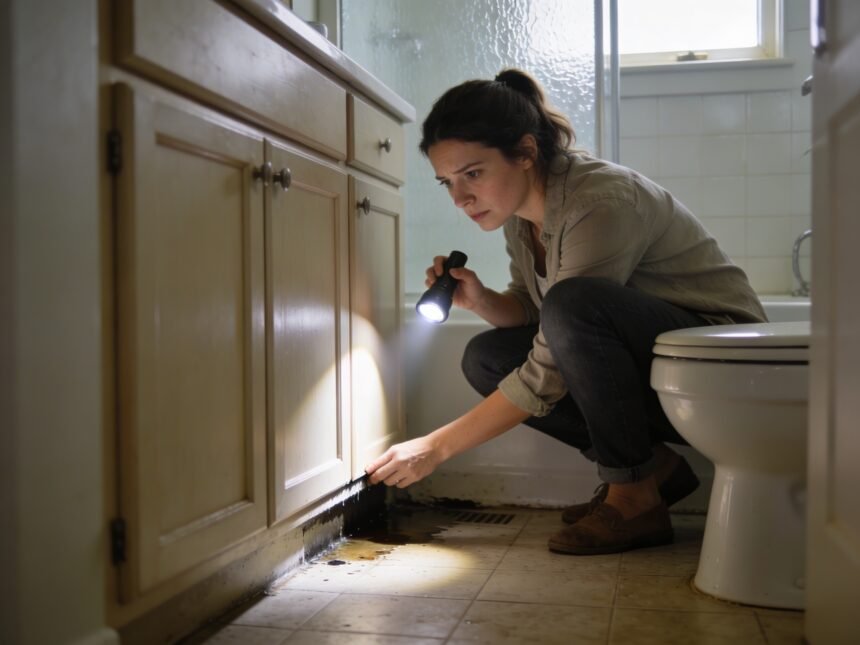
Open the cabinet under the sink and take a real look inside, not a passing glance. Remove everything stored under there so you can see the entire back wall and floor of the cabinet clearly. Look for water stains, which show as brown or grey rings or streaks. Look for swelling in the cabinet floor or back wall, which shows as buckling, warping, or a soft section when pressed. Look for any white mineral deposits on the pipes or fittings, which indicate past or ongoing dripping. Check the supply lines, those braided or chrome-colored tubes connecting the shutoff valves to the faucet, and run your fingers along their entire length. Any moisture on a supply line that isn’t from condensation means it’s seeping somewhere it shouldn’t be. Supply line failures are one of the most common causes of sudden bathroom flooding and they often give a warning period of slow weeping before they fail completely.
Check your grout lines in the shower and around the tub. Grout is porous and over time it cracks, erodes, and allows water to pass through the tile surface into the wall behind it. Run your fingers along the grout lines in the lower sections of your shower walls. They should feel firm. Any grout that crumbles slightly under finger pressure, or sections where the grout is visibly absent, are entry points for water. The caulk line where the tub or shower base meets the wall tile is even more vulnerable. This joint flexes slightly with every use and the caulk there tends to crack and separate before grout does. A gap in that caulk line, even a small one, allows water to run behind the surround with every shower. This is a common source of the musty smell that develops in bathrooms that seem clean on the surface. Re-caulking that joint costs about $6 and 20 minutes. Replacing water-damaged drywall or a rotted tub surround costs anywhere from $400 to several thousand. The math is obvious. If you’ve been noticing early signs of moisture issues, the bathroom reset that stops buildup is a good companion to the structural inspection because keeping tile surfaces clean also makes it easier to spot new grout erosion early.
The toilet tank is worth checking separately from the toilet base. Take the lid off the tank and look at the water line inside. If the water level is above the overflow tube, that’s a continuously running fill valve, and water is draining down the overflow tube into the bowl constantly. You won’t always hear this. To check, add a few drops of food coloring to the tank, don’t flush, and wait ten minutes. If the colored water appears in the bowl without flushing, the flapper is leaking. This isn’t a floor leak, but it’s water waste that shows up on your water bill quietly every single month. A replacement flapper costs $5 to $8 and takes about ten minutes to install with no tools. If you’ve seen a water bill creep up without explanation, this check alone is worth doing today. The water bill reset guide for busy families identifies this as one of the most common and easily fixed sources of unexplained water cost increases.
Check the bathroom exhaust fan. Exhaust fans that aren’t functioning properly allow humidity from showers to linger in the room rather than being pulled out. That persistent moisture then settles on every cold surface, including the walls behind the toilet, the underside of the sink cabinet, and in the corners near the floor. Over time this creates the kind of ambient dampness that supports mold growth even without a single dripping pipe. If your bathroom fan sounds labored, or if it’s running and you can still feel humidity lingering 20 minutes after a shower, it needs attention. The bathroom fan fix when it’s not removing moisture properly covers exactly what to check and how to address it without calling anyone.
If you find a soft spot in the floor or visible damage under the vanity cabinet, the extent of the damage determines your next step. Small areas of surface damage, a single warped cabinet floor section or minor grout erosion, are DIY-manageable with targeted repairs. Replacement cabinet flooring, recaulking, and a wax seal replacement are all reasonable weekend projects for someone with basic tools and willingness to learn. If the subfloor itself is damaged, meaning the structural layer beneath the tile, that’s a larger repair that likely involves pulling tile and potentially cutting out and replacing subfloor sections. At that point, getting one professional assessment before deciding whether to DIY or hire out is worth the service call cost. The 5 home repairs worth learning yourself includes subfloor work in the category of repairs that most homeowners can handle with a little guidance, particularly for smaller damaged areas.
One preventive habit worth building into your monthly routine is a five-minute bathroom check. Hands on the floor, a look inside the cabinet, a quick press on the grout around the tub base, a check under the tank lid. It takes less time than cleaning the mirror. For the home repair tasks that are too easy to ignore until they’re expensive, the bathroom leak inspection belongs near the top of the list. Not because bathrooms are especially fragile, but because the water in them is always on, always under pressure, always looking for the smallest path of least resistance. Catching it early is almost always a matter of looking before the signs get loud enough to be impossible to miss.